
Most people get tripped up by the same thing: they log into the income tax portal before they have their documents ready, hit a mismatch, panic, and either file wrong or delay. The fix is simple - gather first, file second. This guide tells you exactly what to gather, for every type of taxpayer.
Step 1: Documents Every Taxpayer Needs First
These five documents are non-negotiable - whether you're salaried, retired, or a freelancer. Keep these ready before you open the portal.
Step 2: Choose Your Tax Regime First - It Changes Everything
For FY 2025-26, the New Tax Regime is the default. The big change from Budget 2025: income up to ₹12 lakh is effectively tax-free for most individuals under Section 87A. Standard deduction of ₹75,000 applies under the New Regime. But it comes with a trade-off - most deductions are gone.
Step 3: If You're Salaried - Form 16 is Your Bible
Your employer must issue Form 16 by June 15, 2026. Do not file before you have it. Form 16 has two critical parts:
Salaried Employee Document Checklist
- Form 16 Part A - TDS certificate. Shows tax deducted quarter-by-quarter and deposited with the government.
- Form 16 Part B - Salary breakup: basic, HRA, LTA, special allowance. Shows which exemptions your employer has already applied.
- Salary slips - April 2025 to March 2026. Backup if there's any Form 16 discrepancy.
- HRA documents - Rent receipts + landlord's PAN if annual rent exceeded ₹1 lakh. (Old Regime only)
- LTA bills - Domestic travel bills if claiming Leave Travel Allowance. (Old Regime only)
- Multiple Form 16s - If you switched jobs, collect Form 16 from every employer and consolidate. Missing this is one of the most common sources of income underreporting.
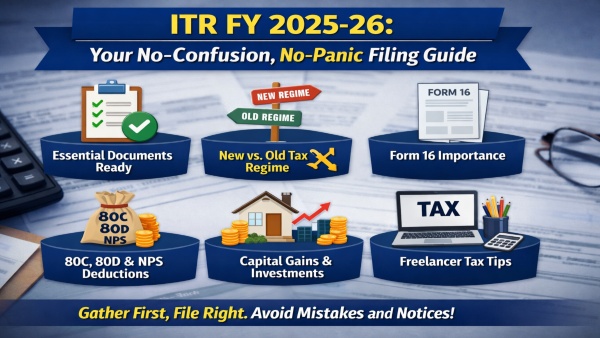

Step 4: Old Regime Deduction Documents (80C, 80D, NPS)
Only relevant if you're filing under the Old Regime. These documents determine how much tax you save.
Step 5: Capital Gains & Investment Income
Capital gains must be reported regardless of which regime you file under. This applies to stocks, mutual funds, and property sales.
Capital Gains & Investment Document Checklist
- Equity/Stock capital gains - Download capital gains statement from your broker. LTCG on equity: 12.5% (no indexation) for FY 2025-26. STCG: 20%.
- Mutual fund statement - From CAMS or KFintech portal. Both equity and debt fund gains must be reported.
- Property sale - Original purchase deed (cost of acquisition), sale agreement, registration documents, and proof of improvements. Sec 54/54EC reinvestment proof if claiming exemption.
- FD/RD interest certificates - From your bank. Savings account interest deductible up to ₹10,000 (Sec 80TTA) or ₹50,000 for senior citizens (80TTB).
- Rental income - Rent agreement, rental receipts, property tax receipts. 30% standard deduction on net annual value allowed. Full home loan interest deductible on let-out property.
Step 6: For Freelancers & Self-Employed Professionals
The margin for error is smaller here - every client's TDS must reconcile against your Form 26AS.
"The difference between a clean return and an income tax notice is almost always documentation. Gather first. File second."
Freelancer / Self-Employed Checklist
- Form 16A - TDS certificate from every client who deducted tax before paying you. Must match Form 26AS. Any gap must be resolved with the client before filing.
- P&L Statement & Balance Sheet - Required if income exceeds ₹50 lakh. Prepared by CA or accounting software.
- Section 44ADA (Presumptive Scheme) - If gross receipts are below ₹75 lakh, declare 50% as net income. No detailed accounts needed, but bank statements showing all receipts are required.
- Advance tax challans - Paid in four instalments (June, Sep, Dec, March). These appear in Form 26AS, but retain physical challans as backup.
- GST registration number - If registered. Include all GST-related turnover in income computation.
- Business expense records - Documented expense ledger for deductions against professional income.


 Click it and Unblock the Notifications

 Sign in with Google