

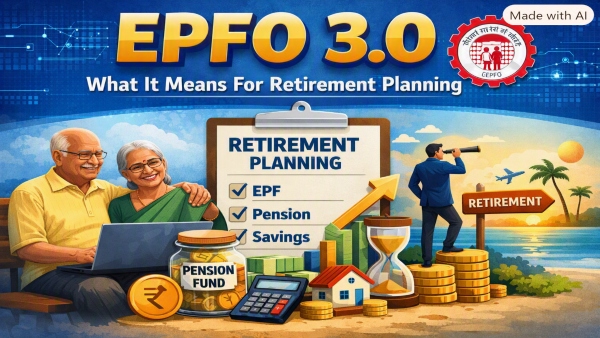
The Employees' Provident Fund Organisation (EPFO) is undergoing a significant transformation, evolving from a traditional retirement repository into a modern, digitally-driven financial ecosystem.
As of 2026, the launch of "EPFO 3.0" marks a paradigm shift in how social security is managed for over 7 crore members across India. This regulatory shift aims to maximise transparency, accountability, and the efficient delivery of provident fund, pension, and insurance benefits.
By integrating cutting-edge technology and simplifying decades-old procedures, the EPFO is making retirement savings more accessible than ever before, ensuring that the formal social security net expands to cover more workers while maintaining the robust 8.25% interest rate on deposits.
The merits
One of the most impactful changes in the new landscape is the radical simplification of withdrawal rules. Previously, members had to navigate 13 different withdrawal provisions, which often led to confusion, high rejection rates, and significant delays.
These have now been merged into a single framework consisting of just three broad categories: essential needs, housing requirements, and special circumstances. This consolidation aims to reduce ambiguity and significantly speed up claim processing for crores of subscribers.
Furthermore, the eligibility criteria have been unified and made more inclusive. Under the new guidelines, a member becomes eligible for all types of withdrawals after just 12 months of membership. This replaces the previous system where eligibility depended on specific reasons and could require up to seven years of service.
Accompanying this accessibility is the provision for higher withdrawal amounts. Members can now access funds from their own contributions, the employer's contributions, and the interest earned, providing a much higher withdrawable balance for urgent financial needs.
Meanwhile, members can now look forward to instant access to their funds through UPI integration and ATM-based withdrawals, reducing dependency on traditional, lengthy claim processing timelines.
The introduction of Aadhaar-based face authentication has also simplified identity verification, allowing members to complete KYC and submit claims securely without relying on OTPs, which effectively reduces fraud risks and improves ease of use.
Additionally, the auto-settlement limit has been increased from ₹1 lakh to ₹5 lakh, and in many cases, employer approval is no longer a prerequisite for withdrawal.
Demerits and trade-offs
While increased flexibility is a boon, it brings new risks that require heightened self-discipline from members. The primary concern is the risk of premature withdrawal, where easy access might tempt workers to spend their retirement corpus on non-essentials, leaving them vulnerable in the future. The Ministry of Labour and Employment has clarified that while the rules expand benefits, the focus remains on long-term financial well-being.
A notable trade-off is in the revised timelines for the Employees' Pension Scheme (EPS). To prevent members from prematurely exiting the pension system and losing out on lifelong benefits, withdrawal from the pension portion is now only allowed after 36 months (three years) of service. This is a significant increase from the earlier requirement of just two months. This "tweak" is apparently designed to protect pension rights and ensure that members remain eligible for family pension benefits in the event of unforeseen circumstances.
Moreover, the ease of digital access creates a potential "liquidity trap". If subscribers treat their PF balance as a regular savings account due to the simplified digital interface, they may inadvertently deplete the compounding power of their long-term savings.
The safeguards
To mitigate the risk of account depletion, the EPFO has introduced a mandatory 25% lock-in rule. Under the revised norms, workers who leave their employment can withdraw up to 75% of their PF balance immediately to handle the financial strain of job loss. However, the remaining 25% must stay invested until retirement, disability, or other specific final settlement conditions are met.
This safeguard is rooted in data showing that frequent full withdrawals often left members with inadequate resources for old age. By ensuring that a quarter of the balance remains untouched, the EPFO protects a "retirement cushion," allowing members to continue benefiting from compounding interest over time even during periods of unemployment.
Authored by Handa Uncle, Your AI Personal CFO.


 Click it and Unblock the Notifications

 Sign in with Google
