

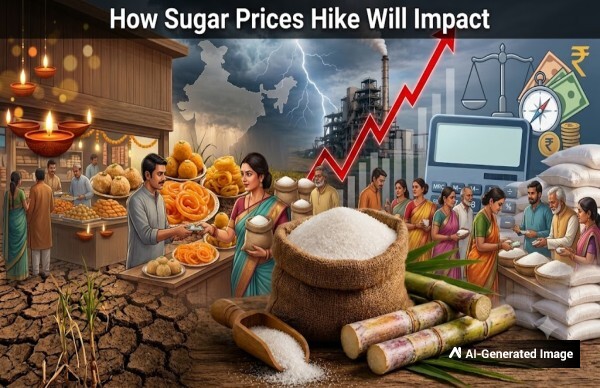
Raksha Bandhan is on August 28, Ganesh Chaturthi begins on September 14, Navratri starts on October 11, and Diwali is to be celebrated in early November, and the most essential ingredient to make these festivals sweeter has gone bitter well ahead of them. We're talking about sugar, a key essential item in every household. Sugar prices have been rising rapidly for the past few weeks, leaving a dent in consumers' pockets. The reason? Supply constraint!
While the reasons behind the spike in sugar prices are several, its impact will have a chain of reaction to the pockets of common citizens.
Sugar Prices Rising
Both retail and wholesale prices of sugar skyrocketed by 40%, while the surge is around 50% in many states.
In cities like Chennai, Hyderabad, Ranchi and Kolkata, the medium-sized sugar prices, including GST, have reached Rs 70 per 1Kg on August 22, 2026, a hike of 30-35% from the start of this month, as per Chinimandi daily tracker. On a month-on-month basis, the surge is around 40% in Hyderabad alone.
Meanwhile, in some cities like Guwahati, the price has reached Rs 71. In Delhi, Mumbai, Kanpur, and Raipur, 1Kg sugar is priced in the range of Rs 68 to Rs 69.
Also, the all-India modal retail price, which is seen as the benchmark to price sugar to end consumers, reached Rs 65 per Kg, a hike of over 44% in over a month from Rs 45 on July 21, 2026, according to the Department of Consumer Affairs.
Even buying sugar on a quintal basis is sky-high. Sugar prices climbed to between Rs 6,800 to Rs 7,000 per quintal in August, from Rs 3,800 per quintal in June, registering an 80% hike in less than two months. The latest intervention from the government has eased prices at a certain level, but they remain elevated. The Chinimandi report revealed that sugar prices per quintal in Maharashtra dropped to Rs 5,800 to Rs 6,000 last week from Rs 6,800-7,000 per quintal.
/img/2026/08/shot-131315-add0627cd693-desktop.jpg)
Sugar Season Explained In India
Typically, the sugar season in India begins from October 1st and continues till September 31st. Indian farmers take around 10-18 months to plant sugarcane and then pluck it once the harvest reaches maturity. Farmers deliver the harvested sugarcanes to mills for extracting and crushing them into crystallized sugar particles for end consumers.
The crushing of sugarcane starts in October or November, peaks in January, and lasts till April every year. However, this varies from state to state. For instance, in Maharashtra and Karnataka, crushing of sugarcanes usually starts after the monsoon, but in states like Uttar Pradesh, it has a longer season.
/img/2026/08/screenshot2026-08-24125047-46161787556055.jpg)
Supply Crunch In Sugar Stocks
During the 2026 season, sugar production, which was initially estimated to be around 343 LMT by sugarcane-growing states, is lowered by 10.7% to 306 LMT. Red rot and top borer disease, along with excess rainfall that led to waterlogging, are cited as the main reasons for the decline in sugar stocks.
However, the ministry claims that despite the lower-than-estimated production, adequate sugar stocks are available in the country to meet domestic demand until the new crushing season begins in October.
Are Sugar Prices Rising Globally?
According to Consumer Affairs data, the global sugar deficit for 2026-27 is estimated at around 33 LMT. As a result, international sugar prices have risen sharply from $474 per tonne on 30 June 2026 to $552 per tonne on 20 August 2026 - an increase of over 16% in less than two months.
Measures Taken To Curb Latest Supply Crunch?
The government has declared a host of measures, such as a stock limit of 400 tonnes on sugar dealers from August 1 to November 30, 2026. Allowing bulk customers to hold sugar stocks exceeding 15 days of consumption, with effect from September 1, 2026.
And further, as a precaution, for the first time in a decade, the government has decided to allow duty-free import of 10 LMT of raw sugar to further augment domestic availability.
States and sugar mills have been advised to begin crushing from 15 October 2026. This is expected to raise October sugar production from the usual 3-4 LMT to more than 10 LMT, further improving availability during the festive season.
But what no one is talking about is the spike in sugar prices is going to make already-pressured inflation from the West Asia war to further intensify.
How Rising Sugar Prices Will Impact Inflation?
"Reopening duty-free imports after nearly a decade is a candid admission that the domestic balance has tightened sharply, and it fits the broader food-inflation picture the MPC is watching. The measure should cool ex-mill and retail prices near-term and is well-timed against festival demand, but it is a reactive lever rather than a structural fix," said a report of Choice Institutional Equities.
Analysts here explained that record mill prices and a 13% retail jump reflect genuine supply stress that a one-off quota cannot resolve if the deficient monsoon crimps the coming cane crop.
"Stockholding limits on bulk buyers add a rationing element that signals just how thin availability has become. For a country that habitually exports sugar, turning importer even briefly underscores how quickly the monsoon shortfall is rippling through the food basket. It further reinforces the case that food-led price pressure, not demand, remains the dominant inflation risk this quarter," they added.
The Chain Of Reaction!
India's CPI inflation has reached its highest level since December 2024, at a staggering 4.45% in July 2026. This is the second consecutive month where inflation is above the RBI's main target of 4%. Inflationary pressure ignited after the Middle East conflict flared in late February due to USA and Iran. But India's inflation has been rising throughout 2026 and for ten consecutive months. The last time inflation fell was in October 2025 to 0.25%.
In August 2026, RBI said, looking ahead, the turbulent global economic environment is likely to have some bearing on domestic economic activity. Energy prices and supply chain pressures remain elevated and uncertain. The adverse impact is being contained with various supply-side measures. Even though the situation is still evolving, a deficient and uneven south-west monsoon amid El NiÑo conditions poses risks to the agriculture sector's outlook and rural demand.
The indirect impacts: Rising inflation brings back the question of rate hikes. A rate hike impacts rate-sensitive sectors like banks, real estate, NBFCs, and automobiles. For instance, a rate hike will make your borrowings expensive, with home loan, personal loan, and car loan EMIs rising.
The direct impacts: Sugar is essential for making a host of items like beverages, chocolates, biscuits and bakery products, dairy and desserts, sweets, processed foods, coffees and teas, pharmaceutical products, and fruit processed items. If companies pay higher prices, they pass on the impact to consumers who buy these products. These products have huge demand during the festive season, and they can become expensive if the supply crunch is not met.


 Click it and Unblock the Notifications

 Sign in with Google
