

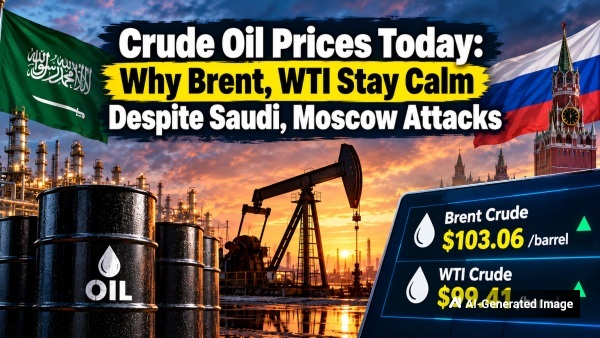
Crude oil prices remained under pressure on Monday even as fresh attacks in Saudi Arabia and Russia added to concerns over global energy supplies.
Brent crude futures were around $103 a barrel, while US West Texas Intermediate, or WTI, traded below $100. At around 0031 GMT, Brent was down 81 cents, or 0.78%, at $103.06 a barrel. WTI was lower by 89 cents, or 0.89%, at $99.41. Both benchmarks had also declined in the previous session.
The relatively muted reaction to the latest attacks reflects a market that is currently weighing several factors at the same time. While geopolitical risks remain elevated, traders are also looking at the recovery in Saudi oil shipments, the possibility of diplomatic engagement between the US and Iran, and the availability of crude through alternative export routes.
Saudi Arabia's Oil Supply Recovery
Saudi Arabia remains at the centre of the oil market's attention after attacks disrupted parts of its energy infrastructure.
Yemen's Iran-backed Houthi group said it had targeted sites in Riyadh and an Aramco facility in Yanbu. The attacks have raised concerns because Yanbu is an important oil export hub and the kingdom's East-West pipeline has already faced disruption.
However, Saudi Arabia has been adjusting its export routes. Saudi Aramco has increased shipments through the Strait of Hormuz, helping offset some of the disruption affecting exports through the Red Sea.
Saudi oil shipments have also started recovering. Reuters reported that Saudi exports had risen above 4 million barrels per day in September, compared with around 2.4 million barrels per day in August.
That recovery has reduced some of the immediate supply concerns that had pushed crude prices higher earlier in the month.
Why the Saudi Attacks Have Not Triggered a Bigger Oil Price Reaction
Oil markets usually react sharply when there is a direct threat to production or major export infrastructure. This time, traders are also seeing evidence that physical supplies continue to move.
Middle East oil exports have remained relatively resilient despite the disruptions. Reuters reported that regional exports averaged around 17.1 million barrels per day over the 10 days leading into the latest market session.
Saudi Arabia is also using alternative shipping arrangements to maintain supplies to customers.
This has helped prevent the latest attacks from translating immediately into a major crude supply shock.
Moscow Refinery Attack Adds Another Risk
The energy market is also monitoring developments in Russia.
A large Ukrainian drone attack hit the Moscow region over the weekend, with several drones striking the Moscow oil refinery. The facility processed about 11.6 million metric tonnes of crude in 2024, making the incident relevant for regional fuel supply.
The attack adds another layer of pressure to an already sensitive global fuel market. However, traders have so far focused more closely on actual changes in crude flows rather than reacting solely to the geopolitical headlines.
US-Iran Diplomacy Is Another Market Factor
Diplomatic developments are also influencing sentiment.
US President Donald Trump has indicated openness to meeting Iranian President Masoud Pezeshkian during the United Nations General Assembly in New York. Reports of communication between Washington and Tehran have added a diplomatic element to the oil market at a time when supply disruptions remain a major concern.
For traders, the key issue remains the balance between physical supply disruptions and the availability of crude through alternative routes.
What Is Driving Crude Oil Prices Now?
The oil market is currently responding to several competing factors:
- Saudi Arabia's efforts to restore disrupted export capacity
- Higher Saudi shipments through the Strait of Hormuz
- Continued attacks on energy infrastructure
- The impact of the Moscow refinery attack
- US-Iran diplomatic developments
- Ongoing concerns around Middle East oil flows
- The availability of alternative crude supplies
For now, these factors are keeping Brent crude around the $103-a-barrel mark and WTI below $100, despite fresh geopolitical tensions.


 Click it and Unblock the Notifications

 Sign in with Google
