

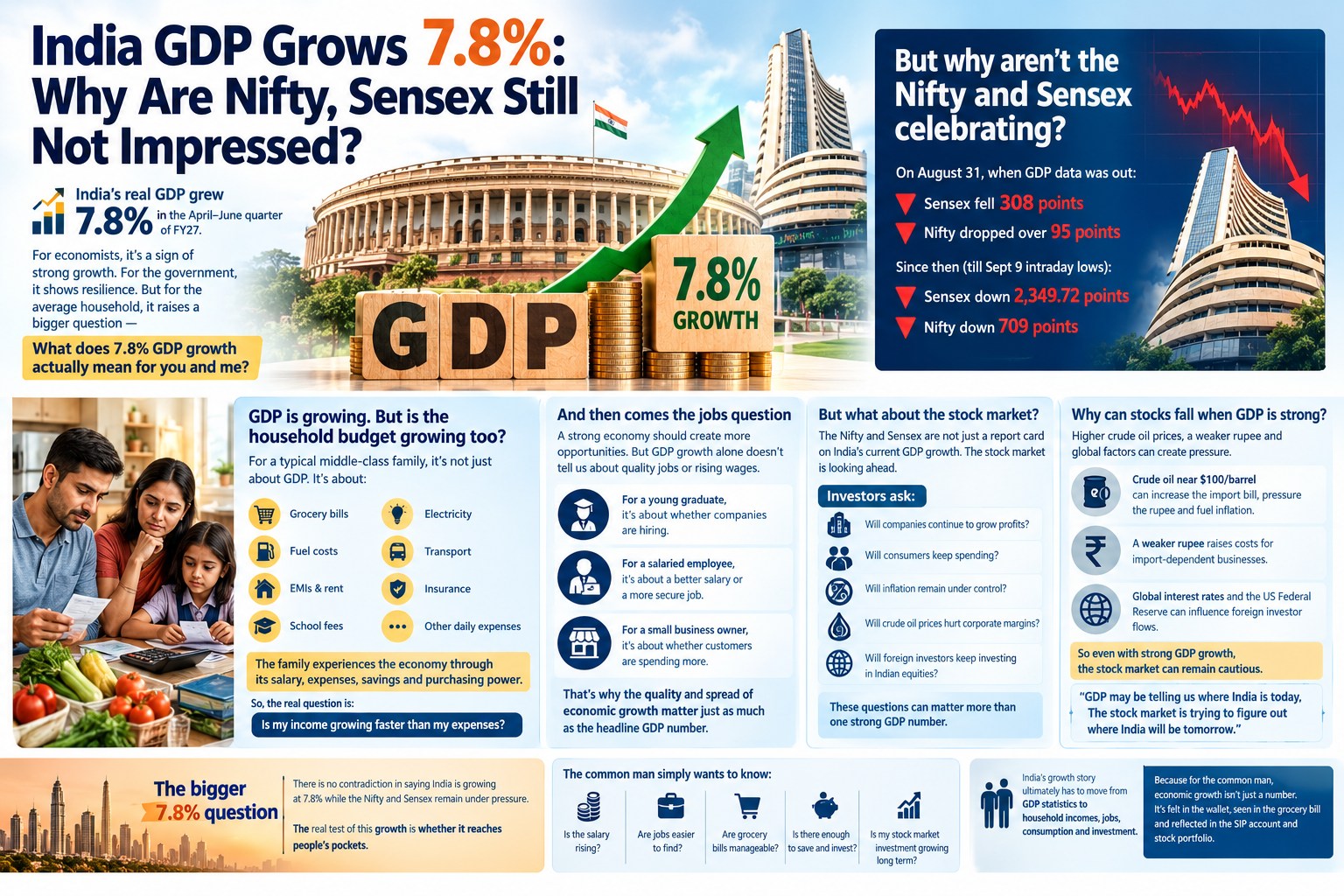
India has just delivered a number that looks impressive on paper - 7.8% real GDP growth in the April-June quarter of FY27.
For economists, it is a sign that India's economy continues to grow strongly. For the government, it is a number that highlights the country's economic resilience, but for the average Indian household, there may be a more basic question:
What does 7.8% GDP growth actually mean for you and me?
Because while the economy is growing, the family budget is still dealing with rising grocery bills, fuel costs, EMIs, school fees, and other everyday expenses.
And there is another interesting disconnect.
If India's economy is growing at 7.8%, why aren't the Nifty and Sensex celebrating?
When GDP data was out, Sensex was down 308 points and Nifty fell over 95 points on August 31st. Prior to GDP data, Sensex and Nifty stood at 77,264.51 and 24,175.65. Since then, Sensex has nosedived by 2,349.72 points, and Nifty crashed by 709 points if we take into consideration the September 9th intraday lows.
/img/2026/09/shot-161520-48dbcbde6036-desktop.jpg)
GDP is growing. But is the household budget growing too?
Imagine a typical middle-class family.
The salary comes in. Rent or home-loan EMI goes out. Then there are school fees, electricity, groceries, transport, insurance and other monthly expenses.
If onion prices rise, the family notices.
If sugar becomes more expensive, it shows up in the grocery bill.
If crude oil prices rise sharply, it can eventually affect fuel, transportation and the cost of goods.
The family doesn't experience GDP growth as a percentage.
It experiences the economy through its salary, expenses, savings and purchasing power.
So the question for the common man isn't simply whether India grew 7.8%.
It is:
Is my income growing faster than my expenses?
And then comes the jobs question
A strong economy should ideally create more opportunities for people to earn.
But GDP growth alone does not tell us how many quality jobs are being created or whether wages are rising fast enough.
For a young graduate looking for work, the GDP number matters much less than whether companies are hiring.
For a salaried employee, the real measure of economic progress could be a better salary or a more secure job.
For a small business owner, it could be whether customers are actually spending more.
That is why the quality and spread of economic growth matter just as much as the headline GDP number.
But what about the stock market?
This is where the story gets interesting.
The Nifty and Sensex are not simply a report card on India's current GDP growth.
The stock market is looking ahead.
When an investor buys shares, they are effectively betting on the future profits of companies.
So even if India grows at 7.8%, investors will ask:
Will companies continue to grow their profits?
Will consumers keep spending?
Will inflation remain under control?
Will crude oil prices hurt corporate margins?
Will foreign investors continue putting money into Indian equities?
These questions can matter more to the stock market than one strong GDP number.
Why can stocks fall when GDP is strong?
Take crude oil.
If oil prices move towards $100 a barrel, India could face a higher import bill. That can put pressure on the rupee and complicate the inflation outlook.
For companies, expensive fuel can mean higher transportation and production costs.
For households, it can eventually mean higher costs of getting around and buying goods.
And for investors, it raises another question:
Will higher costs hurt corporate earnings?
The rupee is another factor.
If the rupee weakens, businesses that depend heavily on imports can face higher costs. At the same time, global interest rates and the US Federal Reserve can influence where foreign investors choose to put their money.
So even with strong GDP growth, the Indian stock market can remain cautious.
GDP may be telling us where India is today. The stock market is trying to figure out where India will be tomorrow.
The bigger 7.8% question
There is no contradiction in saying India is growing at 7.8% while the Nifty and Sensex remain under pressure.
The GDP number tells us how fast the economy grew.
The stock market is asking what that growth means for future corporate earnings.
And the common man is asking something even simpler:
Am I better off?
Is the salary rising?
Are jobs becoming easier to find?
Are grocery bills manageable?
Is there enough money left to save and invest?
And is the money already invested in the stock market growing over the long term?
These questions matter because India's growth story ultimately has to move from GDP statistics to household incomes, jobs, consumption and investment.
India may be growing at 7.8%.
But the real test of that growth is whether it reaches people's pockets.
Because for the common man, economic growth isn't just something read in a GDP report.
It is felt in the wallet, seen in the grocery bill and, increasingly, reflected in the SIP account and stock portfolio.


 Click it and Unblock the Notifications

 Sign in with Google