

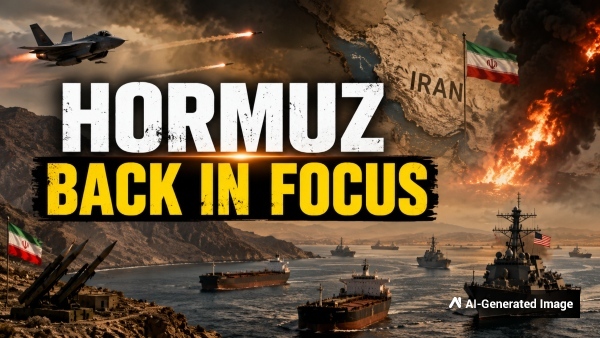
Oil prices jumped more than 2% on Monday after the United States carried out strikes on Iranian military launchers on Larak Island in the Strait of Hormuz, raising fresh concerns that a six-month-old war could once again disrupt one of the world's most important energy routes.
Brent crude futures rose $2.21, or 2.51%, to $90.31 a barrel, while U.S. West Texas Intermediate crude gained $1.83, or 2.19%, to $85.23. The move came after U.S. forces struck two Iranian launchers on Sunday that American officials said were being prepared for use against shipping in the Strait of Hormuz.
The strikes triggered a response from Tehran. Iranian media reported that the Islamic Revolutionary Guard Corps attacked two U.S. air bases in Jordan with ballistic missiles, although most of the missiles were intercepted.
The latest exchange is a reminder that the Iran war, which many initially expected to be relatively short, has turned into a prolonged confrontation with consequences far beyond the battlefield.
How Did the Iran War Begin?
The current war began on February 28, 2026, when the United States and Israel launched coordinated airstrikes against Iran. Washington said the military campaign was aimed at degrading Iran's nuclear and missile capabilities and reducing its ability to threaten the region. Iran responded with attacks against Israel and U.S. bases and other targets across the Middle East.
What followed was months of military strikes, ceasefire attempts and growing pressure around the Strait of Hormuz.
The waterway quickly became one of the biggest economic flashpoints of the conflict. Before the war, roughly one-fifth of the world's oil and gas supplies moved through the Strait of Hormuz, making it critical for major Asian energy importers, including India, China, Japan and South Korea.
Why Does Larak Island Matter?
Larak Island sits in the Strait of Hormuz, close to one of the world's most heavily watched shipping lanes. The U.S. said the launchers targeted in Sunday's operation were being prepared by Iran's Revolutionary Guards to deploy rockets and sea mines into the waterway.
That matters because even the threat of mines, missiles or attacks on tankers can force shipping companies to stay away from the route.
And that is already happening.
Shipping data showed that only around five visible commodity vessels a day passed through the strait over the weekend. A tanker was also reportedly hit by a projectile while travelling inbound through the waterway on Saturday.
The result is a dangerous combination: oil is still available in global markets, but getting it from producers to consumers has become far more complicated.
Oil Could Stay Volatile
DBS energy research chief Suvro Sarkar said the market was more likely to see a contained confrontation than a sustained escalation, but warned that every flare-up could delay the reopening of the Strait of Hormuz.
He expects oil to remain broadly rangebound around $85-$95 a barrel unless there is greater clarity over the situation.
For consumers, particularly in oil-importing countries such as India, the stakes are high. A prolonged rise in crude prices can increase the cost of petrol, diesel, transportation and imported goods while also adding pressure to inflation.
No Clear End Yet
The bigger problem is that diplomacy remains stuck.
Attempts to negotiate an end to the conflict and restore normal shipping through Hormuz have repeatedly struggled. The latest escalation could make those negotiations even harder.
At the same time, Washington is increasing economic pressure. U.S. Treasury Secretary Scott Bessent said the United States is likely to impose new secondary sanctions on Iran every week.
President Donald Trump has also said oil from Venezuela, following a recently struck deal, will be used to replenish the U.S. Strategic Petroleum Reserve, which is close to its lowest level in 44 years.
Six months after the first U.S.-Israeli strikes, the Iran war has therefore become much more than a military confrontation. It is now an energy, shipping and economic crisis as well - and the Strait of Hormuz remains at its centre.


 Click it and Unblock the Notifications

 Sign in with Google