

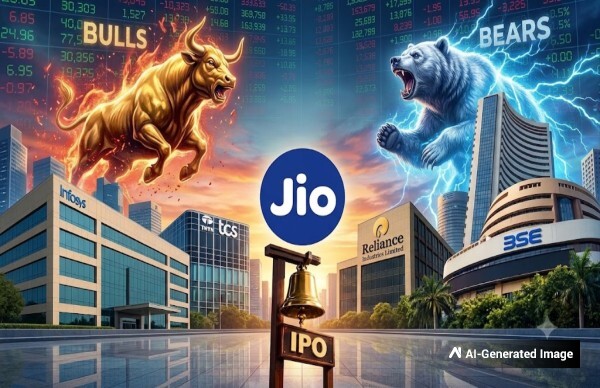
The listing of Jio Platforms has shifted the top 10 elite clubs of the Indian stock market. Listing at over 21% premium, Jio rallied to surpass Rs 13 lakh crore market valuation. This makes Jio the second most valued company of India. And riding on its bullish trend, Reliance Industries becomes the largest conglomerate.
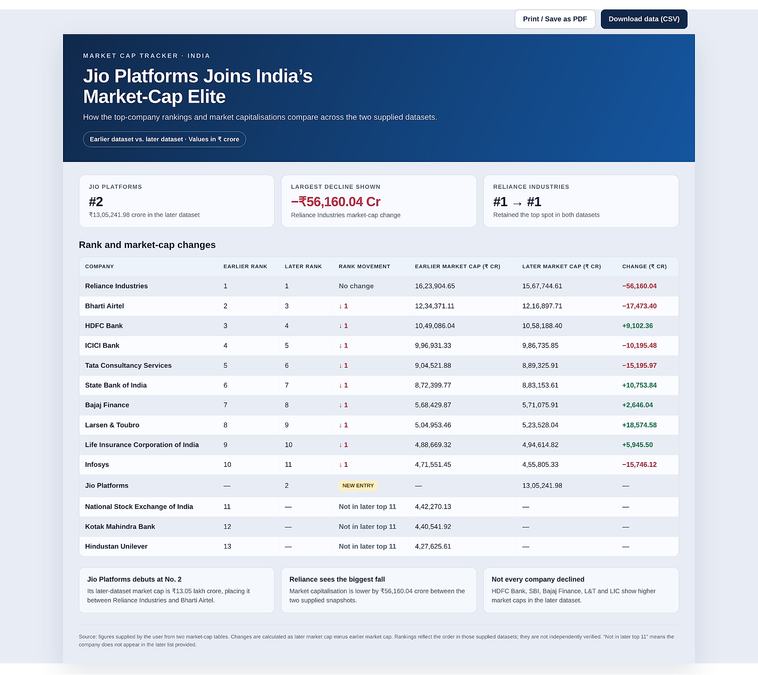
However, a host of heavyweight giants paid a heavy price on Jio's debut day. The most losses occurred from the telco's parent, Reliance Industries, who neared a 52-week low and erased Rs 56,160.04 crore of market cap in a single day.
Stock Market Top 10 Rankings Changed:
Due to Jio's listing, 9 behemoths from the top 10 club slide down by 1 rank each. Airtel slid to third rank with a market cap of over Rs 12.16 lakh crore, while HDFC Bank slipped to 4th position with a m-cap of over Rs 10.58 lakh crore.
Before Jio's listing, Airtel and HDFC held the 2nd rank and 3rd rank.
Additionally, ICICI Bank dropped to 4th rank with a market cap of over Rs 9.86 lakh crore and Tata Consultancy Services (TCS) tumbled to 5th rank with a market cap of more than Rs 8.89 lakh crore.
SBI, Bajaj Finance and Larsen & Toubro (L&T) slipped by 1 rank each to become 6th, 7th and 8th most valued companies with market cap of Rs 8.83 lakh crore, Rs 5.71 lakh crore, and Rs 5.23 lakh crore.
Now, LIC of India and Infosys are the 9th and 10th largest companies in terms of market share to Rs 4.94 lakh crore and Rs 4.55 lakh crore respectively.
On Jio's listing day, five out of the top 10 companies lost up to Rs 97,297.61 crore. Among them, Reliance lost the most, with Rs 56,160.04 crore decline in m-cap to over Rs 15.67 lakh crore from the earlier Rs 1,623,904.65 crore.
Bulls turned away from Reliance despite Jio Platforms' strong listing. Jio closed at Rs 1419 apiece on BSE, which is up by 4.5% from its listing price of Rs 1,358.00 apiece and higher by 27% from its IPO issue price of Rs 1,119 apiece. Jio's market cap breached the Rs 13 lakh crore threshold to hit Rs 13.05 lakh crore.
Airtel was the second worst-performing stock among the top 10, losing a staggering Rs 17,473 crore, followed by Infosys, which erased Rs 15,746.12 crore of m-cap. TCS and ICICI Bank also wiped out Rs 15,195.97 crore and Rs 10,195.48 crore on October 28.
Together, these five companies eroded up to Rs 97,297.61 crore of market cap, dragging the Indian stock market overall. Sensex ended at 73,246.03, down by 352.64 points or 0.48%. Meanwhile, Nifty 50 tanks by 50.90 points or 0.22%.
What Does Jio's Listing Mean For Investors, Telecom Sector, Market?
Amidst the market roller coaster of bears and bulls, Reliance Industries has reshaped India's corporate rankings. Reliance is now the most valuable listed conglomerate in India, with a cumulative market valuation of Rs 29.92 lakh crore including Jio Platforms and Jio Financial Services valuation.
The Mukesh Ambani-backed oil-to-telecom empire has overtaken Tata Group by Rs 4.81 lakh crore. The late Ratan Tata's group now has a market cap of Rs 25.12 lakh crore.
As of now, Tata is still Reliance's closest rival, while the latter's gap with Adani Group is Rs 13.45 lakh crore. The Gautam Adani-backed Group has a market cap of Rs 16.48 lakh crore and continues to be the third largest conglomerate in India.
Incorporated on 15 November 2019, Jio Platforms is a technology platform built on proprietary digital technology and pan-India digital connectivity, driving digital transformation across India. It offers a broad portfolio of consumer and enterprise services, including mobile and fixed broadband, digital entertainment, cloud and productivity solutions, IoT, cybersecurity, managed services and AI applications. Its distribution ecosystem combines digital channels, such as the MyJio App, with physical access points, supported by Reliance Retail Limited for prepaid connectivity distribution, marketing and customer acquisition.
"India's digital economy is likely to reach Rs 125.8 trillion by FY2031, driven by increased digital adoption and growing connectivity. The mobile connectivity market is expected to grow from Rs 2.9 trillion in FY2026 to Rs 5.2 trillion by FY2031 and the fixed broadband market is expected to grow from Rs 340-350 billion to Rs 920-930 billion. Digital entertainment is expected to grow from Rs 562 billion to Rs 920 billion at a CAGR of 10%. Personal digital productivity solutions are expected to grow from Rs 160 billion to Rs 482 billion at a CAGR of 25%," said Dr. Ravi Singh chief research officer at Master capital services.
For investors, Singh believes the key factors to track will be whether the company can sustain revenue growth, improve profitability and execute its expansion plans while maintaining healthy cash flows. The listing-day jump matters less. Over the long run, investors should track quarterly revenue, EBITDA margins, average revenue per user (ARPU) and cash flow, along with how its digital services, telecom business and applications perform.
Jio IPO opened for subscription from October 21 to October 23, at a price band of Rs 1,065 to Rs 1,119 per share. The IPO size was largest ever at Rs 30,213 crore in India. Jio IPO was broadly record-breaking. Jio received nearly 1.4 crore applications, making it the first IPO globally to cross this mark. Also, Jio became the fastest-subscribing IPO, reaching full subscription within just 100 minutes of opening on October 21.
Three brokerages already believe Jio is a long-term bet. They assign BUY rating due to Jio's exponential growth in telecom connectivity by raising tariffs, expanding broadband and monetizing digital services. Elara Capital Jio to record a 3% subscriber addition CAGR during FY26-29E, driven by affordable plans, extensive network, and low churn. It also expects a 12-15% tariff hike from H2FY27E. Together with other levers (2G-to-4G & 5G migration, prepaid-to-postpaid upgrade, premiumisation, rising data consumption, and bundled digital services), this should drive ARPU from Rs 214 in FY26 to Rs 257 in FY29E.
Disclaimer: The views and recommendations expressed are solely those of the individual analysts or entities and do not reflect the views of Goodreturns.in or Greynium Information Technologies Private Limited (together referred as "we"). We do not guarantee, endorse or take responsibility for the accuracy, completeness or reliability of any content, nor do we provide any investment advice or solicit the purchase or sale of securities. All information is provided for informational and educational purposes only and should be independently verified from licensed financial advisors before making any investment decisions.


 Click it and Unblock the Notifications


 Sign in with Google