
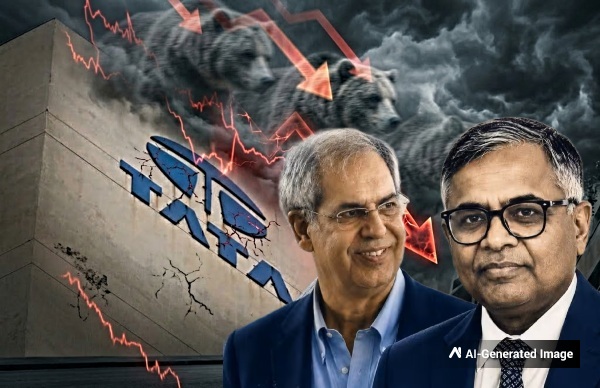
The majority of Tata Group stocks crashed sharply on September 18, 2026, after a clear split between Tata Sons and Tata Trust over the reappointment of N Chandrasekaran and board decisions. Tata Trust, which owns 66% of Tata Sons, calls for the latter's approval of giving Chandrasekaran another 5-year term in the group as 'illegal'. The visible feud and divergence between Tata Trust and Tata Sons have kept investors jittery over the conglomerate's future, one that has bolstered during the time of late Ratan Tata. On September 18, 2026, Tata Chemicals, TMPV, Tata Investments, TCS, Tata Technologies and other Tata siblings crashed up to 8% on stock exchanges.
TATA Group Stocks Crashing Today
At the time of writing, Tata Consultancy Services (TCS) dropped nearly 3% to trade around Rs 2,128.40 apiece on NSE, while TMPV shares plunged nearly 2.6% to trade at Rs 306.45 apiece. Also, Tata Power dropped by 1.33% to trade around Rs 364.1 apiece. Other stocks like Tata Steel, TMCV, Titan, and Tata Consumer Products slipped marginally to 1%. The only two stocks in green are Voltas and Indian Hotels, with a marginal to 1% upside.
Meanwhile, Tata Sons' holding company, Tata Investment, dropped by over 3.4% to trade at Rs 694.60 apiece on NSE. The worst stock to take the beating is Tata Chemicals, which crashes 8% to trade around Rs 720 apiece.
Tata Stocks Have Been Bleeding For A Long Time
On year-on-year performance, with the exception of TATA Steel and Titan Company, all other Tata stocks are in deep red. TMPV is the top loser with nearly a 57% decline in 1-year performance, followed by TCS, which tanked 33%.
/img/2026/09/shot-111525-b8b0b52b5f5e-desktop.jpg)
Voltas declined over 20%; Trent slipped nearly 19%; and Tata Consumer plunged nearly 11%.
Tata Chemicals' stock price slipped by over 27%.
The Tata Group Nifty Index has crashed 9% in a year.
Not just that, Tata Chemicals, TCS and Tata Technologies are also underperforming other Tata stocks in 5-year performance. Tata Chemicals plummeted nearly a 15% decline in 5-year performance. While TCS and Tata Technologies are the worst hit, with a 39% to 45% decline.
Earlier, while talking to GoodReturns, Adib Noorani, an independent market expert, said Tata Group, one of India's biggest business empires, is going through a rough patch, with most of its major stocks falling sharply. The reasons are a mix of global slowdown, weak consumer spending, and foreign investors pulling money out of Indian markets.
Adding to the pain, he said, is the internal boardroom uncertainty, where a key leadership decision around Chairman Chandrasekaran's continuation was put on hold, unsettling investor confidence. The group's newer businesses, from Air India to semiconductors, are still bleeding money, and markets are losing patience. Since the end of Ratan Tata's era, the emotional glue that once held investor faith together is missing, and no single announcement has filled that void.
He lastly said, The outlook isn't all gloomy; long-term bets on AI, clean energy, and manufacturing are promising, but right now, investors want results, not roadmaps.
The dynamics within the Tata Group have changed significantly since Ratan Tata's departure. Tata Trusts, which holds a majority stake in Tata Sons, has reportedly felt sidelined in key board decisions. Against this backdrop, Chairman Noel Tata has opposed a vote to reinstate Chandrasekaran, who resigned in August.
N Chandrasekaran Reappointment: The Page Has Turned!
Tata Sons wants to reappoint N Chandrasekaran with another five-year tenure. In a board meeting on September 17, Tata Sons received majority votes. However, Noel Tata called the reappointment "illegal" and voted against the decision.
On the chairmanship decision, Noel Tata argues Chandrasekaran's own decision on August 12 to resign from Tata Sons and not seek another term once his tenure ends in February 2027. He said, "The Group's employees, its lenders, its counterparties and the market have all proceeded upon it. So, has the majority shareholder. The page has turned."
/img/2026/09/shot-111557-f28b1c482f1d-desktop.jpg)
The board comprises six members, including Chairman Chandrasekaran, with at least two members nominated by Tata Trusts, which owns two-thirds of the company.
Tata Sons Stake Buyout
Investors also need greater clarity on the proposed stake buyout in Tata Sons. Tata Trusts Chairman Noel Tata has placed a proposal before the Tata Sons board under which the SP Group could receive at least Rs 25,000 crore by monetising a portion of its stake in Tata Sons, the holding company of the Tata Group.
The proposal comes after discussions between Noel Tata, Tata Sons Chairman N Chandrasekaran and SP Group Chairman Shapoor Mistry. The development is significant because the SP Group has been looking for a way to unlock value from its sizeable but largely illiquid holding in Tata Sons while managing its debt obligations.
Under the proposal, Tata Sons would acquire a portion of the Tata Sons shares held by Sterling Investments Corporation Private Limited and Cyrus Investments Private Limited, the two entities through which the Mistry family holds its stake.
The transaction is proposed to take place in two tranches over 18 months. It would be structured through a selective reduction of Tata Sons' share capital, a process that requires approval from the National Company Law Tribunal (NCLT).
Importantly, the proposal does not indicate that the SP Group intends to exit Tata Sons completely.
The SP Group currently owns around 18.4% of Tata Sons, making it the largest minority shareholder in the holding company. The proposed transaction would involve only a portion of this holding, with the number of shares determined based on a valuation under Rule 11UA of the Income Tax Rules.
The exact number of shares that could be bought back and the implied valuation of Tata Sons under the proposed transaction have not been disclosed.
Tata Sons listing debate adds another layer
The proposed stake buyout comes at a time when the future of Tata Sons listing remains a major issue.
The SP Group has historically supported greater liquidity and value discovery for its Tata Sons investment, while TataTrusts has opposed a public listing, citing concerns around the structure and charitable ownership of the Tata Group.
The latest proposal could therefore offer an alternative route to address the SP Group's liquidity requirements without necessarily requiring an immediate sale of its entire stake in the market.
However, the ₹25,000 crore proposal should not be treated as a completed transaction. It is currently a proposal placed before the Tata Sons board, and the structure will require further discussions, valuation and regulatory approvals.
What happens next?
The immediate focus will be on discussions between Tata Sons, Tata Trusts, the SP Group and their advisers and bankers.
The proposed selective capital reduction will also require the NCLT process to move forward.
For the SP Group, the transaction could provide much-needed liquidity from its Tata Sons investment. For Tata Sons, it could help address a long-standing shareholder issue while retaining the privately held structure of the holding company.
For investors tracking Tata Sons, Tata Group companies, Tata Sons IPO, Tata Group shares and the Mistry family, the development is important because any eventual restructuring of the SP Group's stake could have wider implications for the ownership and financial structure of India's largest business conglomerate.
For now, however, the Rs 25,000 crore Tata Sons stake buyout remains a proposal-not a concluded deal.


 Click it and Unblock the Notifications

 Sign in with Google
