

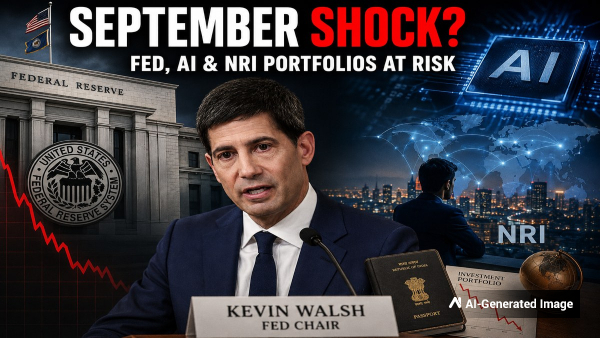
With the US Federal Reserve's rate decision and a frothy AI industry creating serious concerns, the global investing landscape is preparing for a pivotal September as Wall Street enters one of its traditionally weakest times.
This is a time that calls for strategic recalibration rather than passive observation for high-net-worth investors and the Indian diaspora.
Global financial markets are getting ready for a "risk-intensive September," according to GoodReturns' analysis of six concurrent issues, such as Fed policy, geopolitical tensions, and AI valuations, as the summer quiet ends.
The cosy story of a smooth landing is giving way to the complicated reality of sticky inflation and a market in dire need of fresh direction.
The Fed's Hawkish Pivot: A September Showdown
The direction of US monetary policy has been drastically altered by Kevin Warsh's speech at the Jackson Hole symposium.
There has been widespread belief that Warsh's statement - "policymakers need to be assured inflation is heading toward the 2% objective 'clearly and at appropriate pace' or else 'we have work to do '" - signals upcoming policy tightening.
The market moved swiftly in response; according to CME FedWatch, the expected probability of a rate hike in September has increased to 60.4%. A significant change in value has occurred, as this shows.
Both September and December are now expected to see a 25-basis-point increase, according to Barclays' revised prediction.
The persistent core inflation that has been limiting the Federal Reserve's ability to impose easing measures is a factor in this forceful shift.
This brings about possibilities and obstacles for non-resident Indian investors.
With a 30-year bond yielding about 5.3% right now, dollar-denominated assets are becoming more attractive as US Treasury yields continue to rise.
Even if the dollar were to strengthen, the opportunity cost of obtaining these rates would still be too high for non-resident Indians (NRIs) with liabilities denominated in Indian rupees.
Technicals and AI Fatigue: A Market at a Crossroads
The internal cautious signals shown by US equities are more significant than the broader indications.
Investors should "consider reducing their equity exposure before September," according to JPMorgan's technical strategist Jason Hunter.
Despite reaching a new all-time high of 7,816, the S&P 500 is still trading below a critical resistance region that extends from 7,909 to 7,935.
With a median return of -0.02% and a noticeable 7.35% adjustment during down years, the period from August to October has consistently shown weakness from 1928 onward.
This historical backdrop is highly illuminating.
This technological issue boils down to a potentially fatal inconsistency.
The current tendencies in the artificial intelligence business, according to JPMorgan, are eerily similar to the dot-com boom of the year 2000.
Major cloud providers are investing in artificial intelligence infrastructure, but there is a clear schism developing between AI hardware businesses like Nvidia and them.
The trends seen before the peaks of previous cycles of capital expenditure are mirrored by this trend.
This discrepancy suggests that the market is taking into account an excessive amount of excitement about AI, which might not be relevant to everyone.
Geopolitical Risks and India's Balancing Act
The Trump administration's aggressive "Operation Economic Outcast," which is raising sanctions on Iran and targeting Indian firms in particular, adds another layer of complexity to the investing landscape.
For their part in facilitating the import of petrochemicals from Iran, four Indian organisations and three people were recently sanctioned.
This further strains an already fragile economic relationship between the United States and India.
Since the Chabahar port is strategically important and India is worried about the "tremendous economic consequences" that Washington has threatened, tensions continue despite India's attempts to reduce its visibility.
Important decisions will be made during the May G20 Trade Ministerial meeting in the US, which Commerce Minister Piyush Goyal is expected to attend.
India hopes to acquire tariff advantages through the BTA so it can compete with its regional rivals.
This geopolitical unpredictability isn't merely a theoretical concern; it really influences the way non-resident Indians carry out their plans to invest abroad.
For the Indian diaspora, the present landscape necessitates steering clear of the pitfall of committing entirely to one market.
As the market shifts rapidly, with the frontrunners of 2025's technology sector losing momentum and areas such as energy and industrials gaining traction, careful selection is crucial.
Allocation is Key: A portfolio that harmonises the stability of the US dollar with the potential for long-term growth in India is recommended.
Nifty valuations are presently aligned with a two-year average, while earnings growth has reached an eight-quarter peak, indicating a more favourable entry point.
Fixed Income Strategy: Indian FCNR deposits exhibit distinct characteristics compared to US Treasuries.
The benefit of FCNR(B) deposits compared to Treasuries lies in their attractive returns of 6-7% in USD, along with the added advantage of being tax-exempt in India for non-residents.
This tool addresses particular liquidity requirements; however, it is influenced by tax implications for US residents and an overall limited availability of liquidity.
Instead of trying to time the market, it is preferable to adopt a gradual technique for developing stock positions, given the projected persistence of volatility.
The continued structural expansion in areas like renewable energy and electric vehicle infrastructure, as well as a supportive budget, have contributed to the stable foundation of the Indian industry.
It would be irresponsible to ignore the global concerns, though. A watershed moment is about to occur in September 2026.
Now is the time for prudent financial strategists to take cautious risks, diversify their holdings, and put a premium on execution, making sure their financial decisions are in line with the intricacies of a changing world in the wake of the epidemic.


 Click it and Unblock the Notifications

 Sign in with Google