

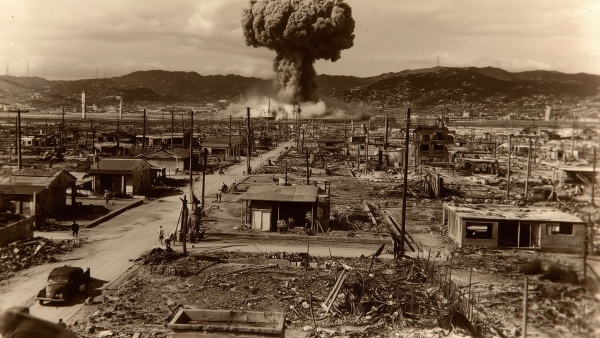
On August 6, 1945, at 8:15 a.m., history changed forever when the American B-29 bomber Enola Gay dropped the first atomic bomb used in warfare, code-named "Little Boy," on the Japanese city of Hiroshima. The devastating explosion killed around 80,000 people instantly, while the death toll rose to nearly 140,000 by the end of 1945 due to injuries and radiation exposure. The attack marked the beginning of the nuclear age and remains one of the most tragic reminders of the human cost of war.
Fast forward to 2026, and the world continues to witness the devastating impact of conflicts. The Russia-Ukraine war, which escalated into a full-scale invasion on February 24, 2022, remains one of the biggest geopolitical crises of the decade, reshaping global energy markets, trade routes and security alliances.
India too has faced its own security challenges last year. In response to the deadly Pahalgam terror attack that claimed the lives of tourists, India launched Operation Sindoor as a strategic military response against terror infrastructure. The operation highlighted the country's evolving approach towards national security and counter-terrorism.
Meanwhile, tensions in the Middle East have once again raised global concerns, with the ongoing US-Iran conflict adding to fears of a wider regional crisis. From Eastern Europe to the Middle East and South Asia, wars today are not just battles between nations-they impact global markets, fuel prices, supply chains and everyday lives across the world.
Decades after Hiroshima and Nagasaki showed humanity the catastrophic consequences of nuclear warfare, the question remains: Has the world become less afraid of war, or simply more accustomed to living with conflict?
/img/2026/08/hiroshima2-80071785996348.jpg "Hiroshima")
Just A Boy? Or Is The World Losing Its Moral Compass?
I am not sure of that. The world's most powerful leaders are declaring wars in the blink of an eye. There are hundreds of thousands of casualties, and economies are destroyed in days. The only thing that's rising is stock markets around the world.
Investors are pouring in billions of dollars in the stock market; the rich are getting richer and the poor poorer.
On the other hand, as of today, nine countries have access to nuclear weapons. Together, they hold an estimated 12,100 to 12,200 nuclear warheads, with Russia and the United States holding nearly 90% of the total inventory.
/img/2026/08/ww60-28101785996122.jpg "Hiroshima")
The other countries include India, China, France, the United Kingdom, Pakistan, Israel, and North Korea.
The United States, China, and Russia have spent billions of dollars on defense, and interestingly, nuclear weapons are not considered the last resort anymore. World peace seems like the least of concerns. Power and money are what are driving humanity, at least.
Love-and-Hate Relationships Between Countries
A peace deal is coming - well, that is the hope. But every day there is a new headline, old threats, and devastation of infrastructure because someone is not happy with talks between the leaders.
So, where are we heading? AI is taking over jobs, defence companies are making double-digit profits, stock markets are skyrocketing, unemployment is rising, and the global economy is slowing down. There is a climate change threat, but that ship has sailed long back.
The world today stands at a complicated crossroads. We are witnessing historic technological breakthroughs, booming markets and rapid innovation, yet millions are grappling with uncertainty, job disruption and economic pressure. Wars continue to reshape borders, alliances and global priorities, while climate change remains a challenge that can no longer be ignored. The promise of peace often competes with the reality of conflict. As artificial intelligence transforms industries and nations strengthen their defence capabilities, the biggest question remains: are we building a safer, more prosperous future, or simply adapting to a world of constant disruption?"


 Click it and Unblock the Notifications

 Sign in with Google
