

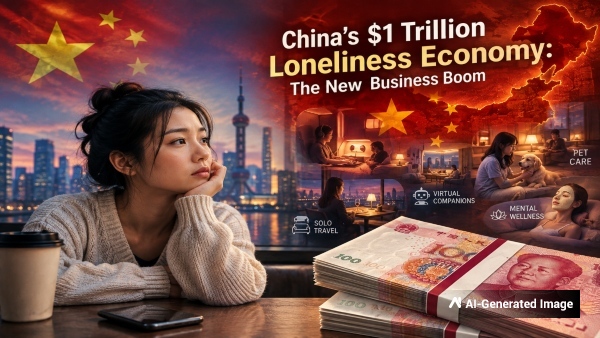
China is discovering that loneliness can be a business opportunity.
From artificial-intelligence boyfriends and virtual pets to solo karaoke rooms, single-person hotpots and paid companionship, a new consumer market is emerging around people who want company-or simply want to enjoy life without having to depend on someone else.
What began as a response to changing lifestyles is becoming a significant economic trend. China's so-called loneliness economy is bringing together technology, entertainment, food, retail and personal services, as businesses look to serve a growing population of people living alone.
According to estimates cited in reports on China's changing consumer economy, spending by single consumers reached approximately $1 trillion in 2025. The figure reflects a broad range of spending and should not be confused with the revenue of a single industry.
Why loneliness is becoming a business opportunity
China's economic transformation has changed the way millions of people live.
Young professionals have moved to cities for education and jobs, while long working hours, expensive housing and financial uncertainty have made traditional milestones such as marriage, homeownership and raising children more difficult for many.
At the same time, some people are choosing to remain single because they value independence and personal freedom.
This has created a new consumer question: How do you build a business around people who want to eat, travel, relax and socialise on their own terms?
Companies are beginning to find answers.
Restaurants now offer individual hotpot tables. Karaoke businesses have introduced private rooms designed for solo customers. Travel companies organise experiences for people who do not want to wait for friends or family before taking a trip.
The result is a market built around convenience, personalisation and emotional comfort.
AI boyfriends and virtual companions
Technology has taken the loneliness economy into a more unusual space.
AI-powered companions can chat with users, remember details about their conversations and simulate personalities ranging from supportive friends to romantic partners.
For some users, these systems offer a convenient way to talk after a stressful day. Others use them for entertainment, role-playing or emotional support.
China's technology sector has been particularly active in developing AI products, supported by a large digital consumer base and a strong hardware manufacturing ecosystem.
AI pets are another emerging category. Unlike real animals, digital companions do not require feeding, walking or veterinary care. Some products are designed to respond to users, develop distinctive personalities and create the feeling of an ongoing relationship.
However, the sector also faces serious questions about privacy, emotional dependence and whether technology can genuinely address social isolation.
China has moved to regulate anthropomorphic AI services, reflecting concerns about potentially harmful emotional manipulation and the psychological impact of these products.
Solo entertainment is becoming mainstream
The loneliness economy is not limited to artificial intelligence.
In China's cities, businesses are increasingly designing experiences around individual customers.
Solo karaoke is one example. Instead of paying for a large room and inviting a group, customers can book smaller spaces, choose their own music and enjoy singing without an audience.
The same idea extends to restaurants, cinemas, travel and fitness.
For businesses, this model offers an important advantage: customers no longer need to organise a group before spending money.
A single person can become a paying customer independently.
This is especially relevant as younger consumers become more comfortable with spending on experiences that prioritise personal satisfaction rather than social approval.
The companionship economy: Paying for company
A related trend is the rise of paid companionship.
In some parts of China, people can hire companions for activities such as hiking, sightseeing, dining or exploring a new city.
The service is not necessarily romantic. Often, customers are paying for someone to share an experience, provide conversation or make an unfamiliar activity feel less intimidating.
For students and gig workers, companionship services can also provide flexible income.
This creates a new kind of service economy in which the product is not a physical object but time, attention and shared experience.
The growth of this market highlights how consumers are willing to pay for convenience and emotional value-even when the underlying activity is something they could technically do alone.
Why this matters for China's economy
China has been trying to shift its growth model towards domestic consumption. But weak consumer confidence, employment concerns and uncertainty about household finances remain significant challenges.
The loneliness economy offers a glimpse into how businesses are adapting to these changes.
Instead of relying only on traditional family-oriented consumption, companies are targeting single-person households and smaller spending occasions.
A person living alone may buy smaller food portions, pay for individual entertainment, subscribe to digital services or spend on experiences that fit their schedule.
Individually, these purchases may seem insignificant. Collectively, they represent a substantial shift in consumer behaviour.
The trend also has implications beyond China. As urbanisation, delayed marriage and solo living increase in other countries, businesses elsewhere may begin developing similar products and services.
The limits of the loneliness economy
There is, however, a danger in viewing loneliness only as a commercial opportunity.
An AI companion may provide temporary comfort, but it cannot necessarily replace human relationships. Similarly, paid companionship may make an evening more enjoyable without addressing deeper feelings of isolation.
Regulation, affordability and customer retention will also determine how sustainable these businesses become.
For investors and businesses, the key question is whether consumers will continue paying for these services after the initial novelty fades.
China's loneliness economy is therefore more than a collection of unusual products. It reflects a broader transformation in how people live, spend and seek connection.
In a country where millions are redefining independence, businesses are discovering that even solitude can have a price tag.


 Click it and Unblock the Notifications

 Sign in with Google
