

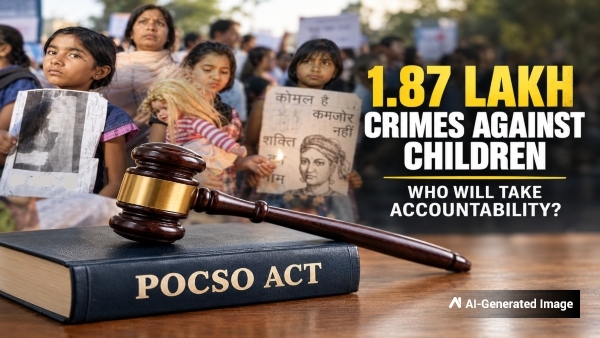
There are numbers that tell a story. And then there are numbers that leave you wondering how many times the same story needs to be told before something changes.
India recorded 1,87,702 cases of crime against children in 2024, according to the National Crime Records Bureau's Crime in India 2024 report. That was a 5.9% increase from 1,77,335 cases in 2023. The crime rate also rose from 39.9 to 42.3 cases per lakh children during the year.
Behind that number are children who should have been worrying about school, exams, friends, games and their next holiday. Instead, thousands became victims of kidnapping, sexual offences, violence and exploitation.
The biggest concern comes from two crime categories that together account for more than three-fourths of all crimes against children.
Kidnapping and abduction accounted for 75,108 cases, or 40% of all crimes against children in 2024. POCSO offences followed with 69,191 cases, accounting for another 36.9%.
These are not just statistics sitting inside an annual government report. Each case represents a child whose safety failed somewhere along the way.
The kidnapping data is particularly difficult to look at because NCRB separately includes missing children deemed to have been kidnapped within the broader kidnapping and abduction category. The police disposal tables show 43,743 cases under this category.
The problem also extends into the digital world.
NCRB recorded 881 cases involving the publishing or transmission of material depicting children in sexually explicit acts under the cyber crime and Information Technology Act category. The report separately recorded 60 other cyber crimes against children.
The numbers under other child protection laws also tell their own story. The Child Labour (Prohibition & Regulation) Act recorded 1,235 cases, while the Prohibition of Child Marriage Act recorded 1,499 cases in 2024.
And then there is the most uncomfortable question: what happens after a crime is reported?
The NCRB report separately tracks police investigation, chargesheeting and court disposal, making it clear that registration of a case is only the beginning of the justice process. The scale of cases moving through investigation and courts shows why reporting the annual number alone cannot capture the full child safety problem.
There is also an important limitation to remember. NCRB data represents crimes reported and registered by the police. It cannot, by itself, tell us how many incidents never reached the police or how many children remained outside the formal justice system.
That makes the 1.87 lakh figure both important and incomplete.
India has laws specifically designed to protect children. There are specialised provisions for sexual offences, child marriage, child labour and juvenile justice. Yet the numbers continue to show the vulnerability of children across physical and digital spaces.
So the question is no longer simply how many cases were registered in a year.
The harder question is this:
How many more children have to become statistics before prevention, protection and justice begin working well enough to bring these numbers down?
And perhaps the most important question of all is one that an annual crime report cannot answer:
When will this stop?


 Click it and Unblock the Notifications

 Sign in with Google
