

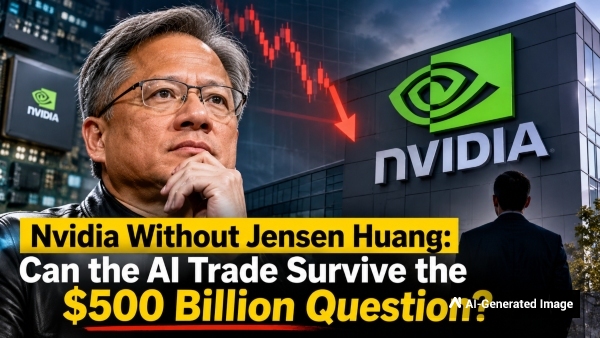
Jensen Huang's exit from Nvidia has raised fresh questions about the leadership, financial strategy and business relationships that helped turn the chipmaker into the biggest force in the artificial intelligence industry. While the company continues to benefit from strong demand for AI chips, investors are now looking closely at the financial commitments and investment arrangements built under its former chief executive.
The immediate market reaction reflected the uncertainty. Nvidia shares fell sharply on Thursday, November 12, losing as much as 14% during the session before recovering some ground to close 4.3% lower. The sell-off also drew attention to competitors Advanced Micro Devices (AMD) and Broadcom, as investors reassessed the competitive landscape of the AI chip industry.
However, the bigger concern extends beyond the change in leadership. At the centre of the debate is Nvidia's role in financing the wider AI ecosystem, including investments in technology companies, cloud providers and data centre projects.
Colette Kress Takes Charge Amid Financial Uncertainty
Nvidia CFO Colette Kress has taken over as interim CEO following Huang's resignation. Having served as the company's finance chief since 2013, Kress brings considerable experience in managing Nvidia's finances and supporting its expansion.
She inherits a business with strong demand for its Blackwell AI chip platform and substantial data centre revenue. However, her immediate challenge involves managing the company's financial commitments while maintaining investor confidence.
Huang's leadership style placed Nvidia at the centre of the AI investment cycle. The company was not just selling chips to AI developers and cloud computing companies. It was also investing in several businesses that relied on Nvidia's technology and infrastructure.
This approach helped strengthen Nvidia's position in the AI market. However, it also raised concerns among investors about the extent of financial exposure between the company and its customers.
Nvidia's Circular Financing Model Faces Scrutiny
One of the biggest questions surrounding Nvidia's leadership transition is the future of its investment and financing strategy.
Nvidia's equity investments stood at around $99 billion by late July, including a reported $30 billion investment in OpenAI. The company also has financial commitments and guarantees linked to chip purchases, cloud computing capacity and data centre infrastructure.
The business model involved a closely connected flow of capital. Nvidia invested in AI companies and cloud infrastructure providers. These businesses, in turn, used their financial resources to purchase Nvidia's processors and computing systems.
This arrangement supported demand for Nvidia's products while helping AI companies secure the infrastructure needed to expand their operations.
However, critics have questioned whether this creates an overdependence on continuous investment within the same ecosystem.
The departure of Huang has brought this arrangement under greater scrutiny. UBS estimates that a halt to such financial recycling would remove at least $50 billion from the AI ecosystem.
The concern is particularly relevant at a time when borrowing costs remain an important consideration for technology companies undertaking large infrastructure investments.
Existing contracts remain in place, but investors are examining the terms of future financing arrangements and the level of support Nvidia provides to its business partners.
AMD and Broadcom Attract Investor Attention
Nvidia's leadership uncertainty has also renewed interest in competing semiconductor companies, particularly AMD and Broadcom.
Large cloud service providers and technology companies have been exploring alternatives to Nvidia processors as they look to diversify their chip supply chains.
According to market estimates cited in the original analysis, Nvidia held 63% of the AI chip supply market in the second quarter of 2026. Google accounted for 25%, while AMD had a 4% share.
AMD and Broadcom have established positions in the semiconductor industry, but Nvidia retains a significant advantage through its CUDA software ecosystem, developer network and established relationships with major technology companies.
The competitive challenge is therefore not limited to manufacturing powerful AI chips. Companies also need to offer the software, infrastructure and commercial support that customers require.
Leadership Change Raises Questions Over US-China AI Policy
Huang's influence extended beyond Nvidia's commercial operations. His engagement with policymakers in Washington and Beijing made him an important voice in discussions surrounding artificial intelligence, semiconductor exports and technology regulations.
His departure comes at a sensitive time for the US semiconductor industry, particularly as Washington continues to review restrictions on advanced chip exports to China.
The absence of Huang from these discussions adds another layer of uncertainty for Nvidia. The company faces regulatory scrutiny, including an antitrust inquiry by the US Justice Department.
China also remains an important market for semiconductor companies. Nvidia's position there has faced increasing competition from domestic chipmakers, including Huawei.
Stricter export restrictions and rising competition have added to the challenges facing the company as it enters a new leadership phase.
Nvidia's Succession Challenge
Nvidia's board has begun the search for a permanent chief executive, with both internal and external candidates under consideration.
Kress currently provides leadership continuity, but investors are also looking at the company's ability to retain the entrepreneurial and technology-driven approach that defined Huang's tenure.
Potential successors include senior Nvidia executive Ian Buck, while external industry leaders have also attracted attention.
The leadership transition is taking place at a crucial point for the semiconductor industry. AI infrastructure spending remains a major driver of demand, and Nvidia continues to occupy a central position in the global technology supply chain.
The immediate challenge for the company is to maintain its operational momentum while addressing concerns about corporate governance, financial exposure and regulatory compliance.
Nvidia's AI business remains supported by strong demand for advanced computing infrastructure. However, the departure of its most influential leader has brought greater attention to the financial structure and relationships behind the AI boom.
For investors, the $500 billion question is no longer simply about how many AI chips Nvidia can sell. It is also about how much of the wider AI investment ecosystem the company is prepared to finance under its new leadership.


 Click it and Unblock the Notifications


 Sign in with Google