

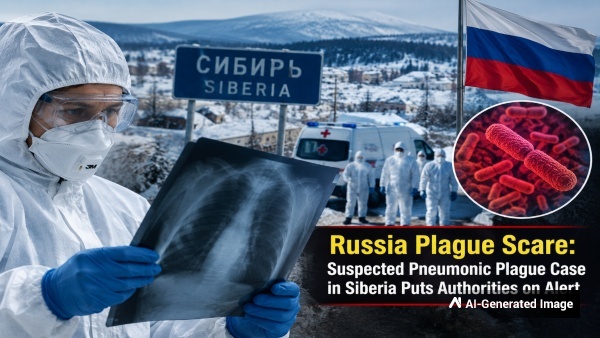
A suspected case of pneumonic plague in Russia's Siberian region of Irkutsk has triggered heightened monitoring by US authorities, including the Trump administration, after the death of a 28-year-old laboratory worker linked to an anti-plague research facility.
The case has drawn international attention not because a widespread outbreak has been confirmed, but because of the nature of the suspected infection and the worker's reported exposure to plague bacteria.
According to reports from Russian and international media, Daria Shipilova, a laboratory technician at the Irkutsk Anti-Plague Institute, became seriously ill after reportedly breaking a test tube containing pneumonic plague bacteria on September 25. She died on October 2.
However, there is an important distinction between the reports surrounding the incident and what Russian health authorities have officially confirmed.
Rospotrebnadzor, Russia's consumer and public health watchdog, has said the woman was diagnosed with pneumonia of unknown cause. Authorities have not publicly confirmed that she had plague. They have also said that testing did not detect microorganisms associated with her work at the institute.
Despite that uncertainty, precautionary measures have been introduced in the region. Nearly 200 people who may have come into contact with the woman have reportedly been placed under medical observation or isolation. Hospitals have also introduced additional restrictions.
The development has been closely watched in Washington. A Trump administration official said the US government is aware of the reports, is monitoring the situation and is assessing its options. The US State Department has also said it is monitoring the suspected case with the Centers for Disease Control and Prevention.
Why Is Pneumonic Plague So Dangerous?
Plague is caused by the bacterium Yersinia pestis. It is usually found among small mammals and their fleas and can spread to humans through flea bites, contact with infected material or, in the case of pneumonic plague, through respiratory particles.
There are three major forms of plague: bubonic, pneumonic and septicemic.
Pneumonic plague is particularly serious because it affects the lungs and can spread from person to person. The disease can progress rapidly, but modern medicine has changed the picture dramatically. Antibiotics can be highly effective when treatment begins early. The World Health Organization says untreated pneumonic plague can become fatal very quickly, while timely treatment can save lives.
That is why health authorities are taking the Siberia case seriously even though there is currently no publicly confirmed evidence of wider community transmission.
Has Plague Hit Humanity Before?
Plague is not a new threat. It has shaped human history for centuries.
The World Health Organization identifies three major plague pandemics in recorded history: the Plague of Justinian in the sixth century, the Black Death in the 14th century and the third pandemic, which began in the late 19th century.
The Black Death remains one of the most devastating disease events in history, killing tens of millions of people. The third plague pandemic began in China in the late 1800s and spread internationally.
But there has not been a comparable global plague pandemic in the past 100 years.
That does not mean plague disappeared.
There have been significant regional outbreaks and recurring cases. Madagascar, for example, continues to report plague cases almost every year. In 2017, the country experienced a major outbreak involving more than 2,300 confirmed, probable and suspected cases and more than 200 deaths by November. The outbreak included a large number of pneumonic plague cases.
India also witnessed a major plague scare in 1994 involving Surat and Beed. However, subsequent investigations questioned whether all of those cases were actually caused by Yersinia pestis, with the bacterium not isolated during the outbreak.
So, while humanity has experienced three major plague pandemics historically, the last 100 years have seen repeated local and regional outbreaks rather than a fourth global plague pandemic.
For now, the Russia situation remains a suspected case, not a confirmed new plague pandemic. The focus is on laboratory testing, contact monitoring and determining whether the infection was linked to the reported laboratory incident.
The episode is a reminder that some of history's most feared diseases have never completely disappeared. What has changed is humanity's ability to detect, isolate and treat them before a local health emergency becomes something much larger.


 Click it and Unblock the Notifications

 Sign in with Google
