

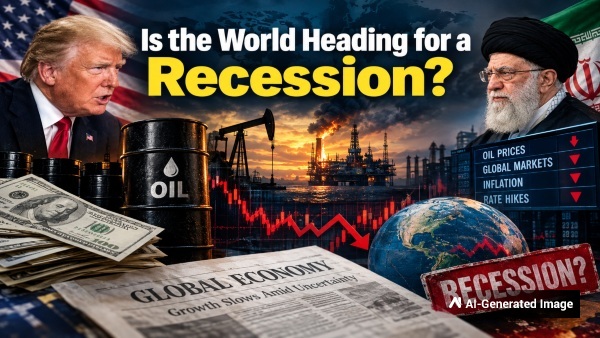
Not necessarily. Economists worldwide do not foresee a complete economic downturn just yet. Some are still hopeful that 2027 will bring stability in the worldwide war dynamics, but more than growth, inflation-led by higher oil prices remains a concern.
The economic impact of the US-Iran conflict is spreading well beyond West Asia. The disruption to oil supplies and shipping through the Strait of Hormuz has pushed energy costs higher, increased transportation expenses and added pressure on inflation across major economies.
The Strait of Hormuz is at the centre of the disruption. Before the conflict, around 20.9 million barrels of oil and petroleum liquids moved through the waterway every day, equivalent to roughly one-fifth of global petroleum consumption. About 89% of the crude and condensate passing through the strait was headed towards Asian markets, making countries such as China, India, Japan and South Korea particularly exposed to any disruption.
The impact is already visible in oil prices, trade flows and import bills.
/img/2026/09/imf-50001790143223.jpg "IMF")
India faces a sharp rise in oil costs
India is among the major economies most exposed to higher crude prices because it imports more than 85% of its crude oil requirements.
The country's crude oil import bill rose 48.4% year-on-year to $74.8 billion during April-August 2026. Import volumes, however, declined only marginally by 0.4% to 100.7 million metric tons.
The difference is largely explained by prices.
Interestingly, S&P, Fitch, and Moody's have raised their FY27 GDP growth forecasts for India in their latest report, and the world's largest democracy is expected to remain the fastest-growing economy in the world next year.
What could be a problem is that the Reserve Bank of India might have to hike its repo rate if inflation keeps rising. Higher borrowing costs put pressure on a consumer-driven economy. But we cross the bridge when we get there.
For now, the festive season is expected to boost businesses despite scarcity of rainfall due to the El NiÑo effect.
Oil shock reaches consumers
The impact of higher crude prices does not stop at the oil market.
Crude is an input for transportation, manufacturing, aviation, chemicals and several consumer industries. Higher fuel costs can therefore move through supply chains and affect the prices of goods and services.
Diesel is particularly important because it powers much of the road freight and logistics network. A sustained increase in diesel prices can raise the cost of transporting food, industrial goods and consumer products.
For India, this creates a difficult balance between protecting consumers from sudden fuel-price increases and limiting the pressure on government finances and oil marketing companies.
/img/2026/09/shot-113359-9ae3ce04242a-desktop.jpg)
China has major exposure to Hormuz
China is another major Asian economy with significant exposure to the Strait of Hormuz.
More than one-third of China's crude supply normally passes through the waterway. China has strategic petroleum reserves and a wide network of oil suppliers, providing some buffer against disruptions.
However, the country's large manufacturing base means that higher energy and transportation costs can still affect industrial production, exports and consumer prices.
China's position is also important for the wider Asian economy because it is one of the world's largest crude oil importers.
Japan and South Korea face energy pressure
Japan remains heavily dependent on imported energy and therefore has limited protection from a sharp rise in international oil and gas prices.
Higher fuel costs affect Japanese households as well as manufacturers, airlines and transport companies. South Korea faces a similar challenge because of its dependence on imported energy.
The concentration of Hormuz oil flows towards Asia means that the region bears a significant portion of the immediate supply shock.
Europe faces higher energy and transport costs
European economies are also dealing with the impact of higher energy prices.
Germany, Europe's largest economy, has a large industrial sector that consumes substantial amounts of energy. Higher oil and gas prices increase costs for manufacturers and transport operators.
The UK is facing similar pressures through fuel, transportation and household energy costs.
For European businesses, the problem extends beyond crude oil. Disruptions to shipping routes can increase freight costs and lengthen delivery times, adding another layer of pressure to already complicated global supply chains.
US has a different exposure
The United States is less dependent on Middle Eastern oil than many Asian economies because it is one of the world's largest oil and gas producers.
In the first half of 2025, only around 0.4 million barrels per day of US crude oil and condensate imports came from Persian Gulf countries through the Strait of Hormuz. That represented about 7% of US crude and condensate imports.
American consumers, however, remain connected to global oil prices.
The national average price of regular gasoline was around $4.47-$4.48 a gallon on September 21. Higher fuel prices can increase household spending on transportation and raise operating costs for businesses.
Hormuz disruption changes the global energy equation
The latest shipping data highlights the scale of the disruption. On September 21, only two commodity vessels crossed the Strait of Hormuz, compared with 10 the previous day. Before the conflict escalated in February, the waterway handled an average of about 125 large commercial ships a day.
The disruption matters because alternative routes cannot completely replace the volumes normally transported through Hormuz. Saudi Arabia and the UAE have pipelines that can bypass part of the strait, but their combined capacity is significantly smaller than the volumes normally moving through the waterway.
The crisis has therefore become more than a regional geopolitical issue. Oil prices, inflation, trade deficits, freight costs and currency markets are all connected to the availability and movement of energy.
For India, the numbers are particularly significant. A crude import bill of nearly $75 billion in just five months, crude import dependence of more than 88% and a rapidly rising Indian crude basket show how directly the global energy shock is feeding into the country's external finances.
Across the US, Europe and Asia, the channels are different, but the common pressure point remains the same: energy costs. For now, the global economy is navigating a difficult balance between growth and inflation. While a broad downturn is not yet the dominant view, higher oil prices remain a key concern. Much will depend on how long the conflict lasts and whether energy markets regain stability in the months ahead.


 Click it and Unblock the Notifications

 Sign in with Google
