

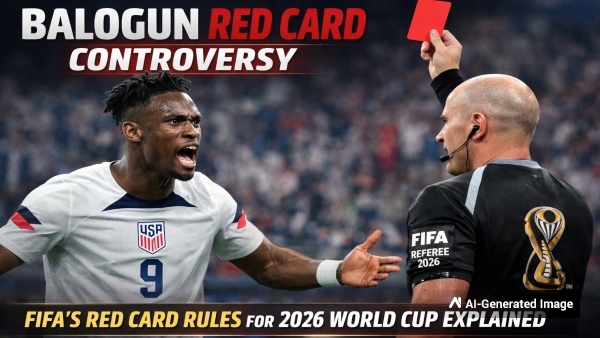
Recently, US striker Folarin Balogun was shown a straight red card during the Round of 32 match against Bosnia and Herzegovina after accidentally catching a defender high on the ankle with his studs. Under FIFA rules, a straight red card carries an automatic one-match suspension. The incident sparked controversy after US Secretary of State Marco Rubio called for the dismissal to be overturned, arguing that the United States had been "screwed."
The debate has left many football fans wondering how FIFA's red card rules actually work. Here's a closer look.
What Is A Red Card?
A red card is the most serious punishment a player can receive during a football match. Once sent off, the player must leave the field immediately and cannot be replaced, meaning his team has to play the remainder of the match with just 10 players. In addition, the player automatically serves a one-match suspension, regardless of the tournament stage.
There are two ways a player can receive a red card. The first is a straight red for serious offences such as dangerous tackles, violent conduct, spitting, biting, using offensive or abusive language, or denying an obvious goal-scoring opportunity. The second is by receiving two yellow cards in the same match, which automatically results in a red card and dismissal. After the match, FIFA's disciplinary committee reviews serious incidents and can impose additional suspensions or fines depending on the severity of the offence.
New Red Card Rules At The 2026 World Cup
Following several controversial incidents in recent years, FIFA introduced two new red card-related rules for the 2026 World Cup. The first targets players who cover their mouths while arguing with opponents or match officials. The change followed a Champions League match in February in which Benfica's Gianluca Prestianni covered his mouth with his jersey while directing abuse at Real Madrid star Vinicius Junior, making it impossible for officials to determine what was said.
The second rule addresses walk-offs in protest. Players who deliberately leave the field to challenge a referee's decision can now be sent off. The rule also applies to coaches and team officials who encourage players to abandon the match. The change was prompted by the Africa Cup of Nations final in January, when Senegal's players walked off the pitch for nearly 15 minutes to protest a penalty decision.
Can A Red Card Be Overturned?
Yes, match officials can use the Video Assistant Referee (VAR) system to determine whether the referee made a clear and obvious error when issuing a red card. If VAR identifies a possible mistake, play is stopped while the footage is reviewed. The referee may then watch the replay on the pitch-side monitor before deciding whether to uphold or overturn the red card.
A new rule introduced this season also allows VAR to intervene if a player is wrongly sent off after receiving a second yellow card. Even if the red card is upheld during the match, teams can appeal to FIFA's disciplinary committee afterward in an attempt to have the suspension removed from the player's record.


 Click it and Unblock the Notifications

 Sign in with Google
