



 Click it and Unblock the Notifications

Stock Market Rout: Why Sensex Crashed 1,484 Points, Nifty 50 Fell 2%; 5 Reasons Why Rs 5.20 Lakh Crore Wiped

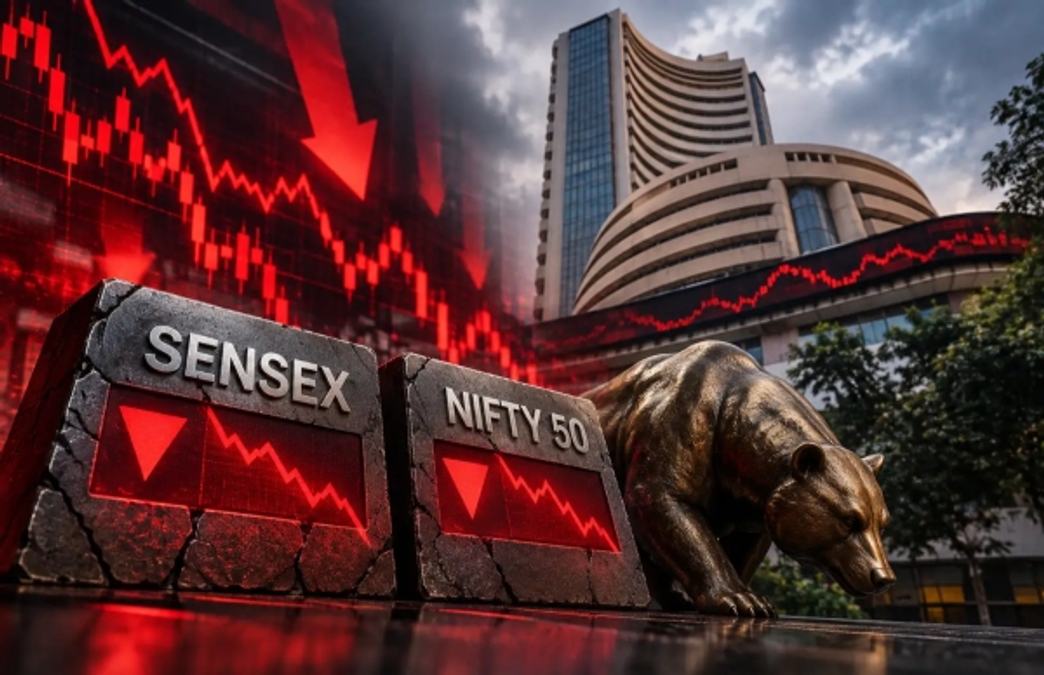
The Indian stock market logged a massive rout of nearly Rs 5.20 lakh crore on Monday, November 23, 2026, after its four consecutive weekly gains. The performance also comes ahead of a trading holiday on Tuesday. Both the Sensex and Nifty crashed sharply by 2% each due to monthly expiry positioning and heavy selloffs in banking, financials, and metal stocks. The large-cap club recorded a carnage of over Rs 1.83 lakh crore, with TCS being the only gainer. Noteworthy, the strength in rupees and decline in crude oil prices could not offer support to bulls during the session.
After the closing bell on November 23, 2026, Sensex crashed 1483.72 points or 1.8% to close at 82,435.99, while Nifty 50 dropped by 450.95 points or 1.75% to finish at 25,349.65. Midcap and small-cap indices tanked by more than 1% each.
The BSE-listed companies' market valuation collapsed by at least Rs 519,830 crore to reach Rs 508,984,444.87 crore, compared to the previous session's m-cap of Rs 514,182,746.90 crore. Of the total, 4,738 stocks traded on BSE, 2,872 of them had declined, 1,601 stocks advanced, and only 265 stocks remained unchanged.
Unlike equities, the Indian rupee eased below the 93 per dollar mark for the first time in over seven months. After market hours of Monday, the local currency closed at 92.90, extended its gain to 2.5% in November so far.
Here are five reason why Indian stock market crashed on November 23, 2026:
1. Rs 1.81 Lakh Crore Eroded In Top 11 Companies
Among the heavyweights, 10 out of 11 most valued companies declined on Monday, erasing up to Rs 183,132.85 crore worth of wealth. The Tata Consultancy Services (TCS) was the only gainer with nearly Rs 29,379 crore surge in m-cap.
On the contrary, HDFC Bank emerged as the top loser with a decline of Rs 42,057.17 crore in market value. State Bank of India and ICICI Bank recorded the second and third largest in M-CAP, at Rs 39,229.67 crore and Rs 30,583.54 crore, respectively. The m-cap of the most valued company, Reliance Industries, also shrank by Rs 30,583.54 crore, contributing to the market loss eventually.
2. Banking, Financials, Metal Stocks Worst Performance:
Bank Nifty crashed 3.2% to close at 62,585.35, while Nifty Financial Services tanked 2.5%. Nifty Metal index nosedived nearly 3.7%.
Among banks, HDFC Bank, ICICI Bank, SBI, Axis Bank, and Kotak Mahindra Bank lost 2.5% to 3.4%. Stocks like Federal Bank, Canara Bank, PNB and Union Bank slipped by 4-5%.
Apart from the banking stocks, other NBFCs like HDFC Life, SBI Life, Jio Financial Services, PFC, and LIC Housing Finance also crashed by 1.5% to 2.5%.
In case of metal stocks, APL Apollo shares recorded an eye-popping 21.3% decline after entering into a comprehensive agreement with Tata Steel to target 15.5 million tonnes of capacity. Tata Steel followed with more than 8.4% crash. Other stocks like Hindalco, JSW Steel, NALCO, Vedanta, and SAIL dropped amidst sensitivity in precious metals prices.
As per Ajit Mishra, SVP - Research, Religare Broking, sectoral performance remained largely weak, with metal, banking and financial services stocks leading the decline. Banking stocks witnessed notable selling after their strong outperformance over the preceding four weeks, while metal stocks were weighed down by softer global commodity prices and a stronger US dollar. However, IT and realty managed to buck the trend and ended in positive territory. Broader markets also remained under pressure, with both midcap and smallcap indices declining, indicating widespread profit-booking rather than a correction limited to frontline stocks.
3. Monthly Expiry
One of the reasons to why financial stocks recorded heavy losses is the monthly expiry schedule of Nifty, Bank Nifty, Nifty Financial Services, Midcap Nifty, Nifty Next 50 and 218 stocks.
Banks were the principal drag after Bank Nifty briefly touched a record high near 65,000. The sector had risen sharply over the preceding weeks, leaving it vulnerable to expiry-related unwinding once the breakout failed. Financials can regain leadership only if Bank Nifty stabilizes above support and institutional buying returns; otherwise, their heavy index weight could keep the broader market under pressure, as per Hariselvan Radhakrishnan, Founder & CEO of HST Wealth.
4. Global Markets Under Pressure:
Asian stocks slumped on Monday as concerns around artificial intelligence continue to weigh on sentiment. South Korea's KOSPI slipped 3.31%, and the Japanese Nikkei 225 plunged 5.06%, while Hang Seng and Australian shares recorded marginal downside.
In Mishra's opinion, sentiment remained subdued amid a sharp sell-off across global markets, particularly in US and Asian technology stocks, driven by concerns over AI-related valuations, the US interest-rate outlook, and rising global risk aversion.
Despite the correction, the broader domestic market backdrop continues to draw support from strong foreign investor inflows, which have exceeded $13 billion so far in November. Brent crude remained below $92 per barrel, while the rupee opened stronger against the US dollar, providing some macroeconomic relief.
5. Fall In Brent Crude, Treasury Yield, Dollar Offered Little Support
Crude oil prices have entered into their fourth weekly decline as expectations of strong global supply takes a toll, offsetting the geopolitical tensions in West Asia. US WTI and Brent crude have sank nearly 2% each to trade around $82 per barrel and $90.85 per barrel.
Also, the US dollar has retreated from its 19-month high rally above the 104 mark to slide down and trade at 103.7 on Monday. Also, the US 10-year treasury yield held around 4.95% on Monday after a sharp decline last week, as investors sought the safety of government bonds following a widespread selloff across risk assets, as per Trading Economics.
Yet these performances in commodities could not stir the buying trend in the Indian stock market. As per Radhakrishnan, Brent crude near $92 offers some macro relief, but remains well above pre-conflict levels, leaving the energy shock and its implications for inflation, corporate margins, and the import bill largely unresolved.
Also, the US 10-year Treasury yield near 4.96% also failed to provide meaningful support to equities, as the decline in yields reflected a shift towards safer assets amid heightened global risk aversion rather than improving financial conditions. Lower yields are likely to become more constructive for equities only if global risk appetite stabilizes and the broader sell-off abates.
Disclaimer: The views and recommendations expressed are solely those of the individual analysts or entities and do not reflect the views of Goodreturns.in or Greynium Information Technologies Private Limited (together referred as "we"). We do not guarantee, endorse or take responsibility for the accuracy, completeness or reliability of any content, nor do we provide any investment advice or solicit the purchase or sale of securities. All information is provided for informational and educational purposes only and should be independently verified from licensed financial advisors before making any investment decisions.

 Sign in with Google