



 Click it and Unblock the Notifications
7% FD Rate vs 6.09% Inflation: Are Your Savings Earning Real Returns? Check Top Bank FD Rates

Several large banks have raised their fixed deposit interest rates in the latest two months after the RBI hiked the policy repo rate by 25 basis points to 5.50%. These banks included HDFC Bank, Canara Bank, Indian Overseas Bank, and Bank of Baroda, among others. While FDs suddenly look attractive in a policy-tightening environment, experts believe their actual returns on your savings should be measured by the inflation rate.
For most investors, wealth creation is a measure of how much their investments have grown in a particular period. While a fixed deposit earning 7% interest per annum can appear appealing when it comes to generating income, investors often ignore inflation when calculating the real returns made on their investments, as per Rishabh Nahar, Partner and Fund Manager at Qode Advisors.
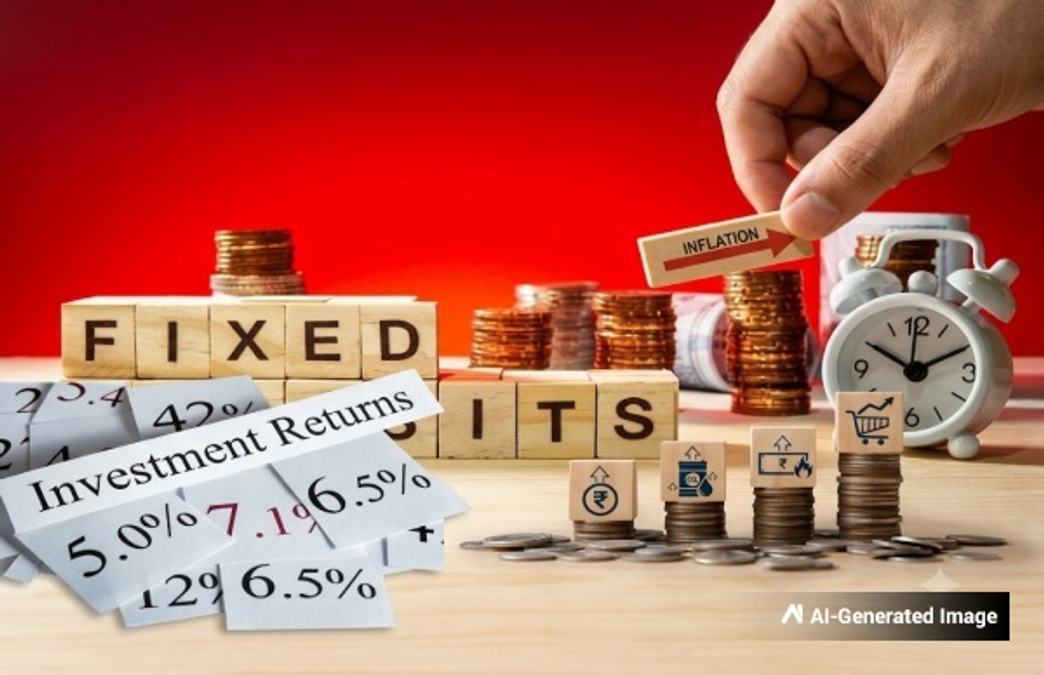
India's CPI inflation rose to nearly 2-year high at 6.09% in October 2026, which is also above RBI's upper limit of 6%. Amidst the inflationary pressure, the difference between making money and actually building wealth lies in what one's investment returns can buy in the foreseeable future.
Best FD Interest Rates:
Bank of Baroda is the latest to join the bandwagon with 10 basis points hike in its special 555-day fixed deposit (FD) scheme, taking the interest rate to 7.50% per annum. Senior citizens are the biggest beneficiaries, who can earn up to 7.40% and super senior citizens can earn up to 7.50%, while the general customers, including NRO and NRE account holders can earn highest up to 6.85%.
Earlier, the largest lender, HDFC Bank also hiked its FD rates by a whopping 50 basis points this month. On tenures like 61 days to six months, the new FD rate rose from 4.75% to 4.25%. On longer tenures like three years and one day to 10 years, general category customers can earn up to 6.60% on FDs.
Canara Bank also hiked rates of its special FD scheme of 555-days tenure to 6.75%, while Indian Overseas Bank raised interest rate to 6.75% on its special FD scheme of 444-days. Indian Bank raised its FD rates to 6.80% on 555 days scheme and to 6.75% on 777-day scheme. Bank of India increased its FD rate to 6.85% on 500-day BOI Akshay deposit scheme. Punjab National Bank is the latest PSU to hike its FD rates on special scheme like 444-days and 680 days tenure to 6.70% and 6.80% respectively.
Other private banks like ICICI Bank revised deposit rates up to 6.50% on general category, while Kotak Mahindra Bank raised rates up to 6.80% and Axis Bank was also in the list with new FD rates rising up to 6.60%.
Fixed Deposit Returns Hedged Against Inflation
Explaining in detail, Nahar said, it is important to understand that when inflation rises, the cost of everyday essentials increases. Even in an environment where inflation is seen moderating, prices do not return to earlier levels. Thus, a fall in the inflation rate merely means that one's purchasing power continues to be eroded, albeit at a slower pace than before.
For example: A household that needs Rs 50,000 a month to meet its expenses today, persistently high retail inflation around the 6% mark could mean doubling of monthly expenses in around 12 years' time.
Likewise, education, healthcare and retirement costs would also rise significantly over long periods, making investors who plan financial goals using today's prices particularly prone to underestimating the finances they will actually need in the near future.
He added that this is the reason why going by nominal returns can create a misleading sense of wealth creation. While an investment earning 7% annually in pre-tax income may appear attractive, the real returns are impacted by both inflation and the applicable tax rate.
For those falling in the 30% tax rate slab, this could mean negative real returns if retail inflation is assumed at 6%.
Take the case of Rahul, a software professional earning Rs 25 lakh in annual income. If he chooses to invest a bulk of his savings in a fixed deposit earning 7% per annum, his post-tax returns fall to 4.9% which is less than the current retail inflation rate. In other words, while the actual account balance may be growing, Rahul's actual ability to maintain the same lifestyle may be under serious threat over a longer term, explains Nahar.
In such an environment, relying purely on traditional fixed-income instruments and bank deposits for long-term wealth creation ought to be avoided.
Yet, as per the RBI's October 2026 Bulletin, of every Rs 100 households saved in financial assets in FY26, about Rs 34 went into bank deposits and only around Rs 13 into mutual funds, shares and other market investments.
Accordingly, the expert believes that while bank deposits offer predictable returns, investors need a balanced portfolio that also includes market-linked investments capable of generating inflation-beating returns. Ultimately, every long-term wealth- creation strategy rests on balancing liquidity, stability and growth.
What Should Be Your Strategy?
As per the expert, while the right mix of investments depends on an investor's financial goals and risk appetite, it is also important to consider the post-tax real return that remains after both taxation and inflation have been considered.
Investors who account for the inflation gap and the impact of income taxes on their long-term investments are more likely to build wealth that holds its value in the real world.
Ultimately, Nahar added that the difference between making money and compounding wealth is about ensuring that the net increase in real world earnings translate into greater financial freedom, with an additional component dedicated to improving one's purchasing power over time so as to enhance the household's standard of living.
Disclaimer: The views and recommendations expressed are solely those of the individual analysts or entities and do not reflect the views of Goodreturns.in or Greynium Information Technologies Private Limited (together referred as "we"). We do not guarantee, endorse or take responsibility for the accuracy, completeness or reliability of any content, nor do we provide any investment advice or solicit the purchase or sale of securities. All information is provided for informational and educational purposes only and should be independently verified from licensed financial advisors before making any investment decisions.

 Sign in with Google