



 Click it and Unblock the Notifications

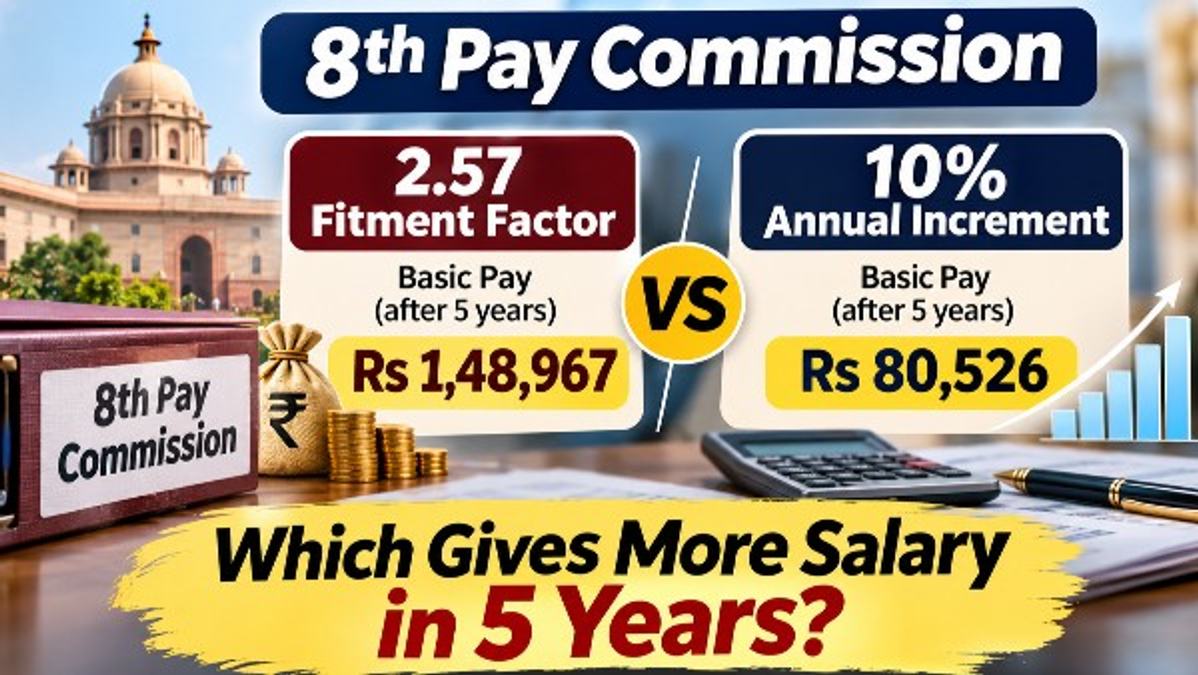
8th Pay Commission: 10% Annual Increment Vs 2.57 Fitment Factor; Which Gives More Salary In 5 Years?

While the fitment factor is expected to play a huge role in determining revised basic pay, the annual increment employees receive every year will also influence their long-term salary growth.
Now the question is whether a higher annual increment can give better salary growth than a one-time increase through the fitment factor. To understand the difference, let us compare various fitment factor scenarios with annual increments ranging from 3% to 10% over a five-year period.
8th Pay Commission: How Does The Fitment Factor Affect Salary?
The fitment factor is a multiplier used to revise the existing basic pay under a new pay commission. It is applied to the employee's current basic salary to arrive at the revised basic pay.
For example, if an employee currently receives a basic salary of Rs 50,000 and the fitment factor is 2.57, the revised basic pay would become Rs 1,28,500.
3% Vs 5% Vs 7% Vs 10% Annual Increment: Salary After 5 Years
Annual increments increase an employee's basic pay every year. The impact becomes substantial over time because each subsequent increment is calculated on the increased basic salary.
If the starting basic salary is Rs 50,000 and no fitment factor is applied, the salary would grow to approximately Rs 57,964 after five years with a 3% annual increment.
At a 5% annual increment, the basic salary would reach around Rs 63,814. A 7% annual increment would take it to approximately Rs 70,128, while a 10% annual increment would increase it to around Rs 80,526.
2.15 Vs 2.57 Vs 2.85 Vs 3.0 Fitment Factor: What Will Basic Pay Be After 5 Years?
Let us now consider the impact of different fitment factors, assuming a standard annual increment of 3%.
With a fitment factor of 2.15, the basic salary of Rs 50,000 would increase to Rs 1,07,500 initially. After five annual increments of 3%, it would reach approximately Rs 1,24,622.
At a fitment factor of 2.57, the revised starting basic pay would be Rs 1,28,500. After five years, it would rise to around Rs 1,48,967.
If the fitment factor is 2.85, the initial revised basic pay would be Rs 1,42,500. With 3% annual increments, the amount would grow to approximately Rs 1,65,197 after five years.
At a fitment factor of 3.0, the starting basic pay would be Rs 1,50,000. After five years of 3% annual increments, it would reach around Rs 1,73,891.
How Much Annual Increment Is Needed To Match A 2.57 Fitment Factor?
An interesting way to compare the two is to calculate how much annual increment an employee would need, without any fitment factor, to reach the same basic salary after five years.
Starting with Rs 50,000, an employee would need an annual increment of approximately 16.5% to match the five-year salary outcome under a 2.15 fitment factor and 3% annual increments.
To match the outcome under a 2.57 fitment factor, the required annual increment would be around 20.8%. For a 2.85 fitment factor, it would be approximately 23.3%.
Under a 3.0 fitment factor scenario, the annual increment would need to be around 24.6% every year to reach the same five-year basic pay without the initial fitment revision.
This entire comparison shows the clear difference between a one-time revision in basic pay and recurring annual increments. A higher annual increment can surely compound over time, but it won't match the huge fitment-related increase.
Moreover, the actual salary revision will depend on the recommendations of the 8th Pay Commission and the government's decision on their implementation.
Disclaimer: The views and recommendations expressed are solely those of the individual analysts or entities and do not reflect the views of Goodreturns.in or Greynium Information Technologies Private Limited (together referred as "we"). We do not guarantee, endorse or take responsibility for the accuracy, completeness or reliability of any content, nor do we provide any investment advice or solicit the purchase or sale of securities. All information is provided for informational and educational purposes only and should be independently verified from licensed financial advisors before making any investment decisions.

 Sign in with Google