
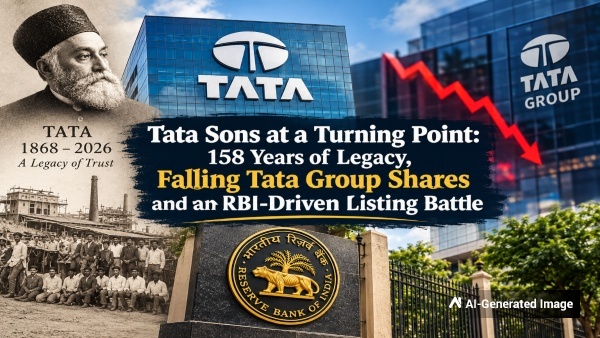
The Tata Group, one of India's most respected business conglomerates, is facing a crucial turning point. Its holding company, Tata Sons, is under renewed pressure to list on the stock market after the Reserve Bank of India (RBI) rejected its request to surrender its non-banking financial company (NBFC) registration.
The development comes amid leadership uncertainty following N Chandrasekaran's decision not to seek another term as chairman and a decline in several Tata Group stocks. Together, these developments have raised questions about the group's future, corporate structure and leadership.
Here is a timeline of the Tata Group's journey, its major businesses and the challenges confronting the conglomerate.
1868: The Tata Group Begins
The Tata Group was founded in 1868 by Jamsetji Nusserwanji Tata, who envisioned building an industrial enterprise that would contribute to India's economic development.
Over the decades, the group expanded from trading into textiles, steel, power, hotels, automobiles, information technology and aviation. Its businesses eventually spread across several continents.
1907: Tata Steel Takes Shape
Tata Steel, originally established as Tata Iron and Steel Company, began production in 1907. It became one of the foundations of the group's industrial identity.
However, the steel business has faced persistent challenges, including volatile global prices, high energy costs, competition from Chinese producers and pressure to reduce carbon emissions.
1938-1991: The JRD Tata Era
Jehangir Ratanji Dadabhoy Tata, popularly known as JRD Tata, became chairman in 1938. Under his leadership, the group expanded into aviation, chemicals, engineering and other industries.
Tata Airlines, which later became Air India, was among the group's major early ventures in aviation.
1991: Ratan Tata Takes Charge
Ratan Tata became chairman of Tata Sons in 1991, coinciding with India's economic liberalisation.
He transformed the group into a more globally ambitious conglomerate. During his tenure, Tata Consultancy Services (TCS) became a major global IT services company, while Tata Motors and Tata Steel expanded internationally.
The group acquired major international businesses, including Tetley, Corus and Jaguar Land Rover, strengthening its global presence.
However, these acquisitions also brought challenges. Jaguar Land Rover has had to navigate changing consumer demand, electric-vehicle competition, supply-chain disruptions and the costs of technological transformation.
2012-2016: A Leadership Dispute
In 2012, Cyrus Mistry succeeded Ratan Tata as chairman of Tata Sons. However, disagreements over strategy and governance eventually led to his removal in 2016.
The dispute triggered a major corporate governance controversy and culminated in a legal battle. In 2021, the Supreme Court upheld Tata Sons' decision to remove Mistry.
The episode highlighted the complex relationship between the Tata Trusts, Tata Sons' shareholders and the group's professional management.
2017: Chandrasekaran Becomes Chairman
N Chandrasekaran, a former chief executive of TCS, became chairman of Tata Sons in 2017. He was the first non-Parsi professional to lead the group.
During his tenure, Tata expanded its focus on technology, electronics, semiconductors, electric vehicles, renewable energy and aviation.
The group also consolidated its aviation operations. Air India returned to Tata ownership in 2022, and Vistara subsequently merged with Air India in 2024.
2022: RBI Classifies Tata Sons as an Upper-Layer NBFC
The RBI introduced a scale-based regulatory framework for NBFCs. Tata Sons was classified as an Upper-Layer NBFC, a category subject to stricter regulatory requirements.
Under the framework, qualifying entities are required to list their shares within a specified period.
Tata Sons sought to avoid this obligation by surrendering its NBFC registration and seeking a different regulatory classification. The RBI's decision to retain Tata Sons in the upper layer brought the listing question back into focus.
2025-2026: Listing Pressure Intensifies
Tata Sons' standalone assets stood at approximately ₹1.75 lakh crore as of March 2025.
As the principal holding company of the Tata Group, Tata Sons owns significant stakes in several major businesses. Its regulatory classification has therefore become an important issue for the group's shareholders and investors.
In September 2026, the RBI rejected Tata Sons' request to surrender its NBFC registration. This decision moves the company closer to a potential stock-market listing, although the precise structure and timing remain matters for Tata Sons and regulators to resolve.
2026: Chandrasekaran's Exit Adds to Uncertainty
Chandrasekaran's decision not to seek another term as Tata Sons chairman has added to the group's leadership uncertainty.
The development comes at a sensitive time, as Tata Sons must address regulatory requirements, shareholder interests and its future corporate structure.
For investors, the leadership transition raises questions about the group's next phase of growth, capital allocation and business strategy.
Tata Shares Under Pressure
The uncertainty surrounding Tata Sons has coincided with pressure on several publicly traded Tata Group companies.
Tata Steel, Tata Motors Passenger Vehicles and Tata Chemicals have reportedly declined between 8% and 22% over the three months covered in recent market reports.
However, the fall in Tata shares cannot be attributed to the RBI's decision alone. Global market conditions, sector-specific challenges and concerns about business performance have also influenced investor sentiment.
- TCS: Faces challenges from changing technology spending patterns, artificial intelligence and global demand uncertainty.
- Tata Motors: Is navigating the electric-vehicle transition, intense competition and changing automobile demand.
- Tata Steel: Continues to deal with cyclical steel prices, global competition and decarbonisation costs.
- Tata Power: Is investing heavily in renewable energy, electricity infrastructure and the clean-energy transition.
- Tata Chemicals: Faces challenges related to global chemical demand, commodity cycles and the performance of its international businesses.
/img/2026/09/tata-61821789362904.jpg "TATA")
What Lies Ahead for Tata Sons?
A potential Tata Sons IPO could improve transparency, establish a market valuation for the holding company and unlock value for its shareholders.
It could also provide an opportunity for the Shapoorji Pallonji Group, which owns approximately 18.37% of Tata Sons, to monetise its stake.
However, the listing could raise questions around ownership, governance and the influence of the Tata Trusts over the group.
For Tata Sons, the next chapter is no longer just about expanding the Tata legacy. It is about balancing regulatory compliance, shareholder expectations, leadership transition and the challenges of running a vast global business empire.


 Click it and Unblock the Notifications

 Sign in with Google
