
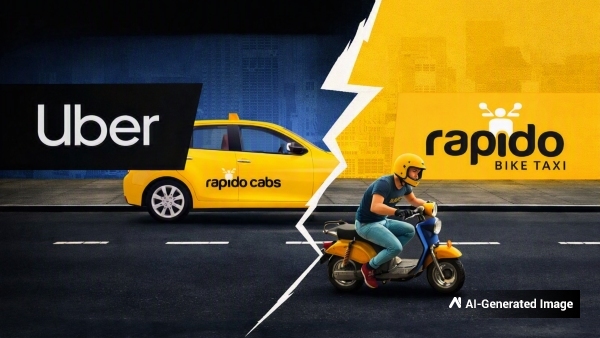
Uber and Rapido merger talks in India have fallen apart after the two ride-hailing companies failed to agree on how a potential combination of their businesses should be structured, people familiar with the matter told Economic Times.
The discussions took place in May during Uber CEO Dara Khosrowshahi's visit to India, with both companies exploring whether combining their operations could create a stronger player in India's increasingly competitive mobility market.
However, the talks did not progress beyond the exploratory stage after Uber and Rapido came to the table with very different ideas about who would control the combined business.
What Happened Between Uber and Rapido?
According to people familiar with the discussions with ET, Uber's proposal was to merge the two businesses and allow Rapido's management team to operate the combined entity.
Rapido, however, had a different approach. Its proposal involved a cash-and-stock transaction that would effectively amount to an acquisition of Uber's India business, with Uber receiving a minority stake in Rapido.
That became the biggest sticking point.
Uber was reportedly not prepared to give up control of its India operations or leave the Indian mobility market. As a result, the discussions broke down soon after.
So, despite reports of a possible Uber-Rapido merger, there is currently no merger or acquisition deal between the two companies.
Why Did Uber and Rapido Explore a Deal?
The talks come at a time when India's ride-hailing market is undergoing a major shift.
Uber and Rapido compete for many of the same riders and drivers, while both companies have been investing heavily to expand their presence across different segments of the mobility market.
A combination could have reduced some of the competitive pressure and potentially created a much larger platform with a broader driver network.
But the two companies occupy somewhat different positions in the market.
Rapido has built a strong lead in India's overall mobility market, largely because of its dominance in bike taxis. Uber, meanwhile, remains particularly strong in four-wheeler cab services.
Industry estimates cited in the discussions put Rapido's overall mobility share at around 50%, compared with roughly 35-40% for Uber, with Ola and Namma Yatri accounting for much of the remaining market.
In four-wheeler cabs, however, Uber remains the stronger player, with an estimated 40-45% share, even as Rapido has been expanding rapidly into the segment.
A combination would therefore have brought together two companies with significant but complementary strengths.
Why Did the Uber-Rapido Deal Fail?
The fundamental problem was not whether the two companies could benefit from combining. It was who would control the combined business.
Uber wanted a structure in which the businesses were merged but Rapido's team would run the new entity.
Rapido's proposal was considerably more ambitious. It would have effectively put Uber's India business under Rapido, with Uber retaining only a minority interest.
For Uber, that would have meant giving up control of an important market.
That was a difficult proposition for the US-based ride-hailing giant, particularly because Uber continues to view India as a strategically important market.
As the two sides could not bridge the gap, the talks collapsed.
Uber Has Exited One India Business Before
The failed Rapido discussions are particularly interesting because Uber has previously taken a very different approach in India.
In 2020, Uber sold its Uber Eats India business to Zomato in an all-stock transaction. The move came after Uber concluded that it was unlikely to become one of the leading players in India's highly competitive food-delivery market.
Mobility is different.
Ride-hailing remains central to Uber's global business and India represents a major long-term opportunity. That makes a complete exit from India's mobility market far less attractive.
The collapse of the Rapido talks therefore should not necessarily be interpreted as Uber looking to leave India.
If anything, the failed negotiations highlight how important control of its India mobility business remains for Uber.
For Rapido, meanwhile, the talks underline how dramatically the company has expanded from a bike-taxi specialist into a broader mobility platform.
For now, both companies remain competitors.
The proposed combination may have disappeared, but the underlying reason for the talks - intense competition, rising scale and pressure to build a more sustainable ride-hailing business - remains very much alive in India's mobility market.


 Click it and Unblock the Notifications

 Sign in with Google
