

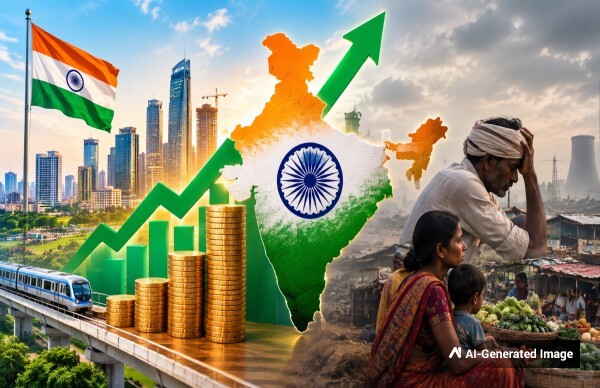
India's GDP growth rate of 7.8% looks pleasing and almost enviable when the world is unsettled by geopolitical risks, trade wars, energy crises, and economic uncertainty. On paper, 7.8% growth looks powerful—a clear message that we are the world's fastest-growing major economy.
But if we are the fastest-growing economy, why are prices rising, inflation high, per capita income modest, unemployment barely improving, and the jobs market barely growing?
The 7.8% growth rate has been debated since its release. Former Finance Secretary Subhash Chandra Garg claimed India grew by just 2.6%, calling the 7.8% figure "statistically meaningless."
While Garg's criticism was technical, former RBI Governor Raghuram Rajan questioned the growth from a more fundamental perspective. Rajan asked why growth is above 7% when corporate investment and foreign capital flows remain disappointing. In his words, "something is off."
The government and critics have gone back and forth over India's growth rate. But the real question is, how economically strong are we currently?
Per Capita Income
As per IMF estimates, India's per capita income is around $2,813, or Rs 269,520.60 per person annually. That translates to roughly Rs 738.41 per person per day.
For the world's fastest-growing major economy, this remains low compared with countries like Singapore and Indonesia, whose GDP growth rates are 5.9% and 5.29%, respectively.
Singapore's per capita income stands at $107,758, while Indonesia's is $5,362. Even closer to home, Bangladesh, growing at 4.7%, has a higher per capita income of $2,911 per person.
What Common Citizens Face on the Ground?
Let's start with basic vegetables—prices have skyrocketed in recent times.
Vegetable prices in August surged by 40% to 50% ahead of the festive season.
Potato and onions, basic essentials in every household, have nearly doubled from wholesale to retail.
1 kg of potato is priced at Rs 12 in Mandi but reaches Rs 20 at the retail market.
Onion retail prices have crossed Rs 75-80 per Kg, compared to wholesale prices of Rs 36-45.
Tomato is priced at Rs 40-60 per kg at retail, while mandi prices range from Rs 23-25.
Beans are available at Rs 50-60 per kg, brinjal at Rs 40-60, and cabbage around Rs 40 from Rs 15 in mandi, while cauliflower is available at Rs 60-80 per kg from Rs 30 wholesale.
Last month, sugar prices reached Rs 70 per kg—a 30-40% hike—while sugar prices at the quintal level recorded an over 80% surge in less than two months, driven by supply constraints.
To curb the supply crunch, India went from exporting sugar to importing it from other countries.
The reality check: food and beverage inflation climbed to 5.95% in August 2026.
Beyond food, service prices have also increased, creating further inflationary pressure. Consumer prices for restaurants and accommodation services rose 8.38%, and personal care, social protection, and miscellaneous goods and services rose 15.17%, while transportation inflation rose to 4.6%.
What About Savings?
At present, PSU and private banks offer 1-year FD interest rates in the range of 6.10% to 6.50%.
But the real return on savings is measured against inflation. If FD rates are above inflation, your purchasing power grows; if they are below it, your purchasing power shrinks.
FD rate at 6.50% minus August inflation at 4.82% = 1.68% real return. After tax deducted at source on FD interest income, the real return falls further.
Maybe equities are giving thriving returns? Not really.
Sensex has crashed 13.3% year-to-date and nearly 9% year-on-year. From its all-time high of 86,159.02 in December 2025, it has nosedived 14.23%.
Nifty is on the same board. The 50-scrip benchmark has plunged 11.50% year-to-date, down 7% year-on-year and 12.3% from its peak of 26,373.20.
India's stock market has also slipped in global rankings. From being the world's 4th-largest stock market, India has fallen to 7th, with Taiwan and South Korea moving ahead to 5th and 6th.
Foreign institutional investors (FIIs) have been net sellers in the Indian stock market since 2021.
FII outflows stayed above Rs 3 lakh crore in both 2024 and 2025 before hitting a new record of Rs 373,891 crore in less than nine months of 2026.
Have foreign investors lost faith in the Indian market?
Is the Housing Sector Flourishing?
It is!
So is the common man's capacity to depend upon loans.
Is Affordable Housing Really Affordable?
Affordable housing is not so affordable in the financial hub Mumbai and the capital region, Delhi-NCR.
In H1 2026, 6 of 8 major cities remained within the affordability threshold, according to Knight Frank's AffordabilityIndex. An EMI-to-income ratio above 50% is considered beyond the affordability threshold.
Mumbai, however, stood at 69%, while NCR stood at 67% – well above the threshold.
The pressure is even sharper for economically weaker households. Knight Frank's 2025 data shows the EWS EMI-to-income ratio rising from 43% in 2020 to 60% in 2025—a 17-percentage-point increase.
For middle-income households, the ratio rose from 28% to 40%, an 11-percentage-point increase.
The gap is stark: the lower-income household is devoting a far larger share of its income to housing.
And affordable housing supply is shrinking. Across India's top 8 cities, its share fell from 52.4% in 2018 to just 17% in 2025.
So, is housing becoming more accessible—or are households simply stretching their incomes further to own a home?
Jobs in Bundle?
India's unemployment rate marginally fell to 5% in August from 5.1% in July, driven largely by rural unemployment, which dropped from 4.5% to 4.1%, its lowest level since December.
But urban unemployment moved in the opposite direction, rising to 6.8% from 6.7%.
The jobs market is improving—but not significantly.
The employment rate has barely moved, rising just 0.6 percentage points, from 52.2% in August last year to 52.8% this year. Labor force participation has inched up only 0.2 percentage points, from 55.4% to 55.6%.
Private-sector hiring rose 5% in August 2026, breaking five consecutive months of decline—but it remains below its February peak.
Meanwhile, AI-driven innovation and spending are putting the IT sector and entry-level jobs under severe pressure.
So far in 2026, 622 tech-company layoffs have affected 190,058 people, according to the TrueUp tracker—roughly 709 people a day.
We're also paying higher taxes on our income. India's highest personal tax rate is 39%, higher than Singapore's 24%, Indonesia's 35%, and Bangladesh's 30%. It's also higher than the US federal rate of 37%.


 Click it and Unblock the Notifications

 Sign in with Google
