

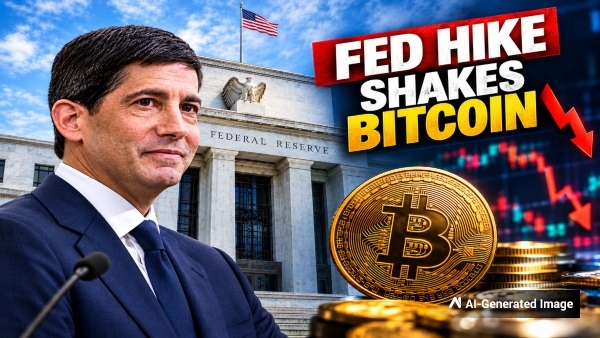
The US Federal Reserve has delivered its first interest rate hike since 2023, but for cryptocurrency markets, the bigger story is what comes next.
The Federal Open Market Committee raised the federal funds rate by 25 basis points to 3.75% to 4% in September 2026. The decision was widely expected, with markets pricing in a high probability of a quarter-point increase ahead of the meeting. What caught investors' attention was Federal Reserve Chair Kevin Warsh's hawkish tone and the possibility of further rate hikes.
For Bitcoin and other cryptocurrencies, this changes the broader market equation. Crypto has benefited for years from periods of abundant liquidity and relatively low borrowing costs. A prolonged period of higher interest rates could make that environment harder to sustain.
Bitcoin, Ethereum Face a Tougher Rate Environment
Bitcoin initially showed a relatively contained reaction after the Fed decision. BTC moved between roughly $75,000 and $76,500 before settling around the $76,000 level. Ether also swung between about $2,370 and $2,430 before ending below $2,400.
The muted reaction does not necessarily mean the market has shrugged off the Fed's policy shift.
Much of the rate hike had already been priced into crypto markets. The bigger concern is whether interest rates remain elevated for longer than investors had expected.
Sixteen of the Fed's 18 policymakers indicated that another rate increase could be appropriate this year. That has pushed investors to reassess the path of US monetary policy and its implications for risk assets.
Bitcoin ETF Outflows Add to the Pressure
Another warning sign has come from spot Bitcoin ETFs.
US spot Bitcoin ETFs recorded around $450.3 million in net outflows on the day before the Fed decision, according to the data cited in the original analysis. Ether ETFs also recorded about $141 million in outflows.
Between September 8 and September 15, Bitcoin ETFs saw combined net outflows of approximately $753.2 million. That effectively reversed much of the $770 million in inflows recorded between September 1 and September 4.
The timing is important. Crypto investors were already reducing exposure before the Fed announced the rate hike. That suggests the market had begun adjusting to tighter financial conditions ahead of the FOMC decision.
Why the 10-Year Treasury Yield Matters
For crypto investors, the federal funds rate is only one part of the story.
The US 10-year Treasury yield has become an increasingly important indicator for risk assets. The yield touched 5.04% ahead of the Fed meeting, its highest level since 2007, according to the analysis.
A higher Treasury yield raises the opportunity cost of holding assets such as Bitcoin, which does not generate traditional cash flows.
When investors can earn around 5% from relatively low-risk US government debt, speculative assets need stronger growth expectations to attract capital. This can put pressure on Bitcoin, Ethereum and other cryptocurrencies, particularly when liquidity is already tightening.
Inflation Remains a Key Risk
The Fed's decision also reflects continued concern over inflation.
US consumer prices rose 3.4% year-on-year in August, while energy and gasoline prices have added to inflationary pressure. The Fed's challenge is that higher energy costs could feed into broader inflation even as policymakers attempt to prevent prices from remaining elevated for too long.
For crypto markets, the problem is straightforward. If inflation remains sticky, the Federal Reserve may have less room to cut interest rates quickly.
That could keep borrowing costs and Treasury yields elevated for longer, creating a less supportive environment for risk assets.
What Comes Next for Bitcoin?
Bitcoin has so far held above the $75,000 area, but analysts are watching both price levels and liquidity conditions.
The $76,500 to $78,000 zone is being monitored as an important resistance area, while $75,000 remains a key support level. A sustained break below that level could bring the $71,300 to $72,000 region into focus.
However, price levels alone may not tell the full story.
The bigger question for the crypto market is whether fresh capital starts flowing back into Bitcoin, Ethereum and other digital assets. ETF flows, stablecoin supply, Treasury yields, the US dollar and expectations for future Fed rate hikes are likely to remain important market indicators.
For now, Warsh's first rate hike has reinforced a clear message for crypto investors. The era of easy liquidity may not be returning quickly, and digital assets are having to adjust to a world where interest rates and bond yields remain much higher than they were during the previous crypto cycle.


 Click it and Unblock the Notifications

 Sign in with Google
