

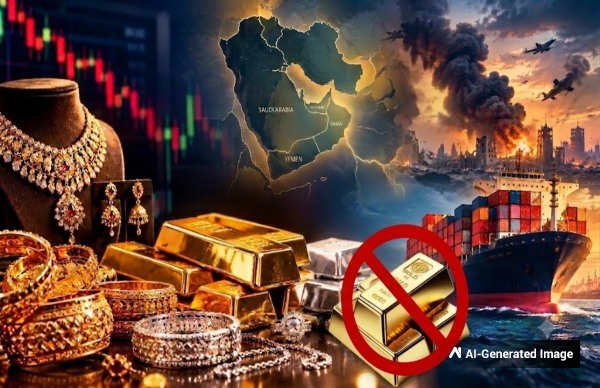
The West Asia war has entered its sixth month, with tensions between the US and Iran having only boiled over, with no signs of peace at least in the near term. While the US and Iran are kabooming each other, the global bullion market is bouncing on hotbed. For India, gold is not just an investment; it has a deeper relation to promised prosperity, which has been the case for decades. This makes India the second largest consumer of gold in the world. While geopolitical crisis has made safe haven assets like gold attractive, it also comes with its own headwinds. Every time the dollar rises, so do the import bills for gold.
Since the West Asia conflict, the government has announced two major changes to curb the gold import bill. The first one is obviously Prime Minister Narendra Modi's appeal to "Don't Buy Gold" in May and the latest in September. The other major change was to hike customs duty on both gold and silver.
But have both changes pushed India's import bills on gold lower?
Why "Don't Buy Gold" Was Appealed?
You see, India is the second largest buyer of gold in the world after China. In 2025, the country consumed 711 tones of gold, which was not very far from 792 tons of gold consumption in China. But the majority of this gold is imported. Gold alone accounted for 9.29% of total import bills of $775 billion in FY26. India imported at least $72 billion worth of gold in the last fiscal year, which is higher by 24% year-on-year.
But why not buy gold? The reason lies in the Dollar-INR exchange rate. Gold is imported in dollars, which has seen a significant surge since the conflict. This means India is spending more foreign currency on imports than earning through exports in the overseas market.
An Example: Let's say gold per troy ounce is at $4,600
At Rs 80 per dollar, India is paying Rs 368,000 for gold.
At Rs 95 per dollar, India is paying Rs 437,000 for the same gold per troy ounce.
Hence, even if gold prices are stable or falling in the international market, a combination of a weak rupee and a stronger dollar eventually makes imports extremely costly.
Why Hike Customs Duty On Gold & Silver?
Hiking import duty is another method to discourage gold buying. As per ICICI Direct's note, higher import duty increases the landed cost of gold, which may discourage purchases of bullion and jewelry.
But Have Gold Imports Fallen In India?
The don't-buy appeal and customs duty hike worked in May and June but has rebounded back in July.
Gold imports rebounded in July after two consecutive months of weakness, suggesting an improvement in demand and inventory replenishment by manufacturers and retailers ahead of the festive season. Import value rose to $4.16 billion, more than double June's $1.97 billion, while import volumes are estimated to have increased to 40-45 tonnes, up from 20 tonnes in June, according to World Gold Council data.
WGC's note added that while recycled gold—primarily from the exchange of old gold jewelry for new—continues to supplement supply, the recovery in imports points to stronger physical demand compared with recent months. Despite the increase, gold's share of total merchandise imports remained relatively modest at 5%, compared with the average 11% during January-March.
The All India Gem and Jewellery Domestic Council estimates gold imports to decline by 30% in August to 45 tonnes, compared to 64.2 tonnes in the same month a year ago. They also believe the latest appeal of "avoiding gold" could result in approximately a 15% dip in gold imports in September 2026.
However, one needs to understand that September, October, and November is heavily packed with festivals in India, which are followed by the wedding season. All these events are seen as auspicious to buy gold. Hence, it will be noted how gold demand moves in the last four months of 2026.
Also, reports have started that the government is likely to reduce customs duty on gold and silver again. If that happens, gold buying could rise.
Gold Silver Rates Predictions
All gold and silver indicators have corrected significantly since the war. Spot gold went from $5,600 per ounce in pre-war to hitting $4,170 in June. There was a brief rally in August. However, currently, spot gold trades around $4,400 per ounce. Spot silver also faced similar movement, declining to trade around $65 per ounce currently from $85-90 levels in May.
"Gold prices are likely to stay under pressure over the next two weeks. At home, healthy FCNR(B) deposit inflows have helped the rupee stay strong, and a stronger rupee usually keeps local gold prices in check even when global prices hold steady," said Rajeev Sharan, Head of Research, Brickwork Ratings.
The bigger factor is the US Federal Reserve, which will announce its rate decision on September 16. After Chair Kevin Warsh struck a hawkish tone at Jackson Hole, the market is now almost evenly divided on whether the Fed will raise rates by a quarter point or hold them at the current 3.50 to 3.75%.
Any hike, or even a hawkish hold, Sharan said, would lift US Treasury yields and pull money toward these safer, higher-paying bonds, making gold less attractive since it pays no interest. So, we expect gold to stay soft, though a softer signal from the Fed could quickly turn things around.
Disclaimer: The views and recommendations expressed are solely those of the individual analysts or entities and do not reflect the views of Goodreturns.in or Greynium Information Technologies Private Limited (together referred as "we"). We do not guarantee, endorse or take responsibility for the accuracy, completeness or reliability of any content, nor do we provide any investment advice or solicit the purchase or sale of securities. All information is provided for informational and educational purposes only and should be independently verified from licensed financial advisors before making any investment decisions.


 Click it and Unblock the Notifications

 Sign in with Google