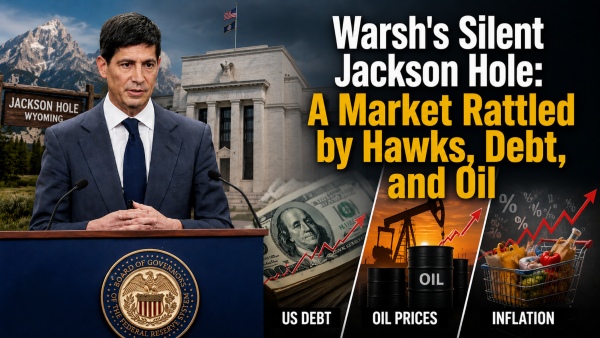
As US Federal Reserve Chairman Kevin Warsh steps into the limelight at Jackson Hole this week, it will be with the bond market in chaos, the Federal Reserve in chaos, and geopolitical tensions reigniting inflation fears rather than a tailwind.
Instead of providing a platform for direction, his inauguration as Fed Chair seems to be more of a test of how well his unique "less is more" communication style can handle dealing with a market that needs answers.
The Jackson Hole Paradox: Silence in a Time of Crisis
A self-made storm greets Warsh as he arrives in Wyoming.
At his news conference in July, he deftly avoided discussing forward guidance while asserting that the Federal Reserve has "no magic wand" to combat inflation.
A sell-off ensued as a consequence of this strategy, and the 30-year Treasury yield hit its highest level since 2007.
It was an ideological statement, not just a communication blunder.
Warsh argues that his predecessors were excessively wordy, implying that market signals are made more complicated rather than clearer by excessive advance guidance.
His Jackson Hole talk, however, will be set against an extremely difficult backdrop.
A 9-3 vote to keep rates concealed a substantial schism, as three regional presidents demanded an instant hike, according to the Federal Reserve minutes from July, revealing a committee struggling with internal strife.
It was crystal obvious from the minutes that individuals in favor of tougher measures are ready to impose more tightening if inflation does not match expectations.
This central bank shows its incoherence in the "family debate" that Warsh professes to support.
The Treasury's Shadow and the $40 Trillion Elephant
The participation of Treasury Secretary Scott Bessent adds intricacy to Warsh's duties.
To calm a market rattled by extraordinary issuance, Bessent ramped up long-term bond repurchases in the days leading up to the Jackson Hole event.
In terms of money, this is a direct reaction to a problem that the central bank of Warsh is facing.
While this move temporarily lifted yields, it has put the Federal Reserve in a dangerous position because it suggests the Treasury is now the first to react to market pressures, thereby undermining their authority.
It is genuinely astounding how big the problem is. American public debt has climbed above $40 trillion, while OECD members expect worldwide borrowing to hit $18 trillion this year.
Warsh bases his whole body of work on the "supply-side" assumption, which states that artificial intelligence (AI)-driven productivity gains can help the economy better handle this debt without inducing inflation.
Nevertheless, that reflects an outlook that is focused on the future. The war in Iran and rising oil prices are driving inflation in the short term, which is affecting market prices.
AI: The Deflationary Hype vs. the Inflationary Reality
Warsh sees artificial intelligence as a crucial factor for success, believing it has the potential to boost production and maintain low interest rates for an extended duration.
Nonetheless, the minutes from the Federal Reserve's July meeting highlighted a significant warning that the surge in AI investments is evolving into a credit issue, as both banks and non-bank lenders are increasingly exposed to the sector's expansion fueled by debt.
This argument is already facing repercussions from the market dynamics.
Last week, market participants aggressively sold off their previously soaring AI stocks due to rising oil prices and surging long-term yields.
Market signals clearly indicate that the expected productivity gains are falling short of the rising cost of capital.
Adhering to his strategy at Jackson Hole might be interpreted by the market as a refusal to acknowledge the deteriorating financial circumstances that Warsh's opaque policies have played a role in exacerbating.
What to Watch This Week
Warsh will deliver his speech after the data calendar has been put up. It is widely expected that Wednesday's PCE inflation report would confirm that core inflation is stable at 3.3%.
If there is any unexpected good news here, it will only serve to inflame the more combative Fed members and maybe even prompt Warsh to speak out.
In addition, the first payroll adjustments will give a critical picture of the basic soundness of the labour market.
Warsh's Jackson Hole debut is expected to focus less on offering clarity and more on upholding his belief in the value of silence.
He finds himself in a challenging position, navigating the pressures from a faction advocating for increased rates while also responding to the administration's call for reductions.
His supply-side, AI-driven vision for the economy is a long-term initiative that provides minimal comfort for a market fixated on monthly inflation reports and oil prices.
Currently, the market reflects a 60/40 probability of maintaining the current rate in September.
The most significant concern is not that Warsh indicates an increase, but rather that he remains completely silent.
In a market yearning for direction and grappling with a mix of fiscal and geopolitical uncertainties, the absence of communication stands out as the most assertive indication of all.


 Click it and Unblock the Notifications

 Sign in with Google