

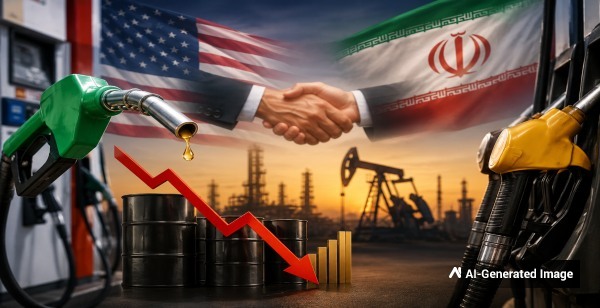
The United States (US) granted a 60-day waiver allowing Iran to continue producing, selling and exporting crude oil until August 21 as part of ongoing diplomatic efforts between Washington and Tehran. The decision has raised hopes of additional oil supplies entering the global market at a time when energy prices remain sensitive to geopolitical developments.
For India, one of the world's largest crude oil importers, the development is being closely watched as it could improve supply availability and influence the outlook for fuel prices if global crude markets remain stable.
Petrol, Diesel Prices In India: Will US-Iran Negotiations Bring Relief To Consumers?
To gauge market sentiment, GoodReturns conducted an exclusive survey among financial market experts and industry leaders, asking whether petrol and diesel prices in India are likely to decline over the next 30-60 days, what conditions would need to be met before consumers see relief at the pump, and whether US-Iran tensions are likely to ease or escalate in the coming weeks.
The survey found a broad consensus that fuel prices are likely to remain stable in the near term, with experts pointing to geopolitical risks, crude oil volatility, taxation, inflation management and currency movements as key variables.
Petrol, Diesel Prices To Fall Soon? Experts Decode Impact Of US-Iran Tensions And Crude Oil Prices
Although global crude oil prices influence domestic fuel costs, experts believe the relationship is far more complex than many consumers assume. Indian fuel prices are impacted not only by international oil benchmarks but also by refining margins, taxes, exchange rates and decisions taken by oil marketing companies.
Ross Maxwell, Global Strategy Operations Lead at VT Markets, believes fuel retailers are unlikely to rush into passing on any savings to consumers despite recent developments in global markets.
"I do not expect petrol and diesel prices in India to decline meaningfully over the next 30-60 days. Although oil prices can move sharply in response to global geopolitical events, fuel prices are influenced by crude oil costs, refining margins, taxes, currency movements and the pricing decisions of fuel retailers. Over the next two months, stability appears more likely than a significant downward move in pump prices," Maxwell told GoodReturns.
A similar view was shared by Shubham Gupta, CFA and Co-founder of Growthvine Capital, who said current crude oil levels are still not low enough to justify retail fuel price cuts.
"Crude oil prices are still trading above pre-war levels, which makes an immediate price cut unlikely. Moreover, the government and oil marketing companies had absorbed a significant part of the initial crude price shock without passing it on to consumers. Before they reduce retail prices, they will want to recover at least a portion of those losses," Gupta said.
Petrol, Diesel Price Cut: What Are The Key Triggers For Lower Fuel Rates In India?
Experts said lower crude oil prices alone may not be enough. Instead, markets would need to see a sustained decline in oil prices along with greater confidence that supply disruptions in the Middle East are unlikely.
"For India to see lower prices at the pump, global crude prices would need to remain consistently lower for a sustained period rather than falling temporarily. Geopolitical tensions that create supply issues would need to ease further, including reduced risks around the Strait of Hormuz. A stable or stronger Indian rupee would also help lower the cost of imported crude," Ross Maxwell explained.
Why Indian Consumers May Not Get Immediate Relief Even If Crude Oil Prices Fall
Anuj Gaur, Director at IBBM Pvt Ltd, said the fuel pricing equation is far more layered than many people realise.
"The moment tensions rise in the Middle East, global oil markets react emotionally as much as fundamentally. Traders start pricing in risk even before any real disruption happens. Shipping costs rise, insurance premiums move up, and there's always fear around supply routes such as the Strait of Hormuz. Since India imports most of its crude requirement, these developments matter directly to us," Gaur said.
He added that consumers should not expect retail prices to fall automatically every time crude oil declines. "Indian retail fuel prices are not purely market-driven. Taxes still form a meaningful part of the final price consumers pay. Personally, I think crude would need to remain closer to the $70 range consistently before any meaningful relief can be expected in India," he noted.
When Could Petrol And Diesel Prices in India Actually Come Down?
Most experts surveyed believe that any meaningful reduction in fuel prices is more likely later in the year rather than during the next two months.
"Meaningful reductions in fuel prices are more likely later in the year if oil markets remain calm and supply conditions improve," Maxwell said.
Growthvine Capital Co-founder Gupta believes global oil prices would need to correct significantly before authorities consider passing on the benefit. "For a meaningful reduction at the pump, crude oil would need to fall at least 10%-20% from current levels. Only at that point would there be enough headroom for the government to act. A 30-60 day window is too short for that to play out unless there is a sharp and sustained drop in global oil prices," he said.
Will US-Iran Tensions Ease Or Escalate?
On the geopolitical front, respondents were largely optimistic that tensions between Washington and Tehran could cool over the coming weeks, although risks remain.
"I believe that tensions between the US and Iran are more likely to ease than escalate over the next 60 days. Neither side appears to want to return to a broader conflict, particularly given the economic and political costs that would accompany a major regional confrontation," Maxwell said.
However, he warned that another flashpoint could emerge elsewhere in the region.
Disclaimer: The views and recommendations expressed are solely those of the individual analysts or entities and do not reflect the views of Goodreturns.in or Greynium Information Technologies Private Limited (together referred as "we"). We do not guarantee, endorse or take responsibility for the accuracy, completeness or reliability of any content, nor do we provide any investment advice or solicit the purchase or sale of securities. All information is provided for informational and educational purposes only and should be independently verified from licensed financial advisors before making any investment decisions.


 Click it and Unblock the Notifications

 Sign in with Google
