

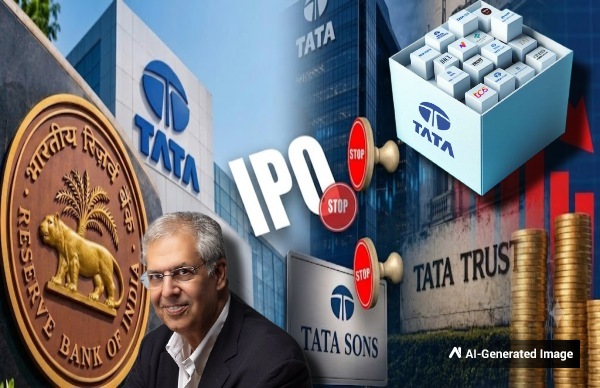
Tata Trusts is in a tug-of-war with the RBI to keep Tata Sons, the group's holding behemoth, off the market. To do so, the Noel Tata-backed trust has revisited its 2004 playbook—but in reverse. It is now proposing to merge two entities into Tata Sons, potentially changing its status as an NBFC-CIC in the Upper Layer, which carries a mandatory listing requirement within three years of being identified by the RBI.
Could Tata Sons avoid an IPO if the restructuring gets regulatory approval?
For now, markets have reacted negatively to the plan, reflecting investor expectations for a Tata Sons listing. Let's break down the proposed rejig, what it could mean, and where the fate of the Tata Sons IPO stands.
Tata Trusts Rejig Plan
11 days after Tata Sons warmed up to the idea of a listing alongside Shapoorji Pallonji Group, Tata Trusts has come up with a new plan, proposing to merge two subsidiaries, Tata Electronics Systems (TES) and Tata Consulting Engineers (TCE), with the 109-year-old holding giant.
Noel, chairman of Tata Trusts, has been opposing the listing. The reason is that Tata Trusts holds a 66% stake in Tata Sons, while Shapoorji Pallonji, who wants the listing, holds 18.4%.
The listing of Tata Sons has been debatable among all parties involved since the death of former chief Ratan Tata. Tata Trusts argues why to compel a company to list because of an asset size exceeding Rs 1 lakh crore. It has been firm on why a company should not be pushed to grow to a certain size and forced to change its basic structure, with a history of over 100 years.
More importantly, the implications of listing go beyond regulatory compliance and strike at the heart of Tata Sons' role within the group. Historically, Tata Sons has not merely been a holding company but a promoter and custodian of group values, as per Tata Trusts' May 2026 blog.
The Revisit To 2004 Playbook
While presenting the new rejig plan, FN Subedar, advisor of Tata Trusts and former Tata Sons company secretary, rekindled the plan as a return to Tata Sons' most historic restructure, which involved Tata Consultancy Services (TCS) exiting the holding company in 2004. It was after TCS debuted as a separate entity that Tata Sons became eligible for NBFC-CIC status.
So basically, instead of demerging any entities from Tata Sons like the TCS demerger, they plan to merge two different subsidiaries.
Tata Electronics is Tata Group's semiconductor giant, while Tata Consultancy Engineers delivers integrated engineering solutions. Both are prominent global players.
Tata Sons IPO Listing Twist: Investors Desire A Listing As Tata Shares Crash
On September 29th, the majority of Tata shares plunged. The Nifty Tata Group index declined 0.5% to around 13,510.10, extending its month-on-month fall to 7%. Voltas took the worst hit, nosediving 3%, followed by Titan dropping 2%. Tata Power and Indian Hotels fell over 1% each. Tata Motors Passenger Vehicles (TMPV), Tata Motors Commercial Vehicles (TMCV), and TCS slipped 0.5% to 1%.
Interestingly, 7 out of 10 Tata shares are in deep red on year-on-year performance. These include TMPV with a 58% crash, TCS with a 29% decline, Voltas with a 20% drop, Trent with a 17% fall, and Tata Consumer with a 15% decline.
In the long term, though, TCS and Voltas are the only two Tata stocks to have given negative returns. Meanwhile, Trent, Titan, Tata Power, and Indian Hotels emerged as multi-baggers, with 118% to 300% returns over 5 years.
Could The Tata Trusts New Rejig Plan Work?
Tata Sons has a standalone asset size of Rs 1.75 lakh crore, making it unavoidable under RBI's Upper Layer NBFC-CIC status. Once marked with this status, every NBFC is expected to list on BSE and NSE within 3 years. RBI identified Tata Sons in the Upper Layer list in September 2022, and the original deadline for its listing was September 2025.
When maintaining a near debt-free profile became mandatory to avoid listing, Tata Sons repaid its Rs 20,000 crore dues from internal sources and prematurely redeemed preferential shares. Further, when the CIC rule banned investments outside group companies, Tata Sons sold its stakes in a few small non-Tata Group holdings.
Tata Trusts argued that they had complied with all RBI rules, and Tata Sons did not require to be labelled as a Core Investment Company (CIC). They submitted an application to be removed from the CIC category in 2025, which RBI rejected in September 2026, asking Tata Sons to comply with the rules under the "Upper Layer NBFCs" category.
And hence, a new rejig plan has been cooked. By merging TES and TCE, Tata Trusts is aiming to avoid Tata Sons being qualified as an NBFC or CIC.
Who Is A Core Investment Company?
A CIC is an NBFC with an asset size of Rs 100 crore and above, carrying the business of acquiring shares and securities. A company is classified as a CIC when not less than 90% of its net assets are invested in equity shares, preference shares, bonds, debentures, debt, or loans in group companies.
Keep the CIC meaning in mind. Tata Trusts' reasoning behind the new rejig is that TES and TCE will bring operating revenue and assets directly into Tata Sons.
So, what could happen?
By merging TES and TCE, Tata Sons would directly own the operating businesses of the two companies instead of just being an investor in group companies. Its overall business revenue and operating assets would increase, while its asset composition would be restructured. This could also change the 90% ratio used by RBI to identify a CIC, potentially making Tata Sons a candidate for removal from the CIC framework.
**Current Tata Sons → largely investment/holding company → merge TESS + TCE → more operating assets/revenue → change the nature of the company → seek a different regulatory treatment.**
The rejig plan is yet to be approved by RBI and Tata Sons board members. It will most definitely impact Shapoorji Pallonji's plan of selling up to Rs 25,000 crore stake in Tata Sons.
What is important to note is that simply adding two businesses does not automatically lead to Tata Sons exiting the Upper Layer or the listing requirement. RBI is expected to assess the resulting structure and determine whether Tata Sons still qualifies as a CIC and, if so, whether it remains an NBFC-UL.
Why Tata Sons IPO Should List?
A Tata Sons listing would give investors a direct market valuation for the holding company for the first time, as per Kotak Neo's explainer.
This could be significant because Tata Sons has ownership interests across several major Tata businesses. However, a Tata Sons IPO would not turn all Tata companies into subsidiaries of one listed entity. TCS, Tata Motors, Tata Steel, Tata Power, and other listed companies would continue to operate as separate businesses with their own boards and financial results.
How Big Tata Sons Listing Could Be?
There have been many estimates over the past few months. As per reports, the potential market valuation for Tata Sons is estimated in the range of Rs 9 lakh crore to Rs 10 lakh crore, against its underlying portfolio value of Rs 15-16 lakh crore. The highest market valuation for Tata Sons post-listing is estimated at Rs 12.5 lakh crore.
Assuming Tata Sons lists in 2026 with a market cap of Rs 10 lakh crore, it will immediately enter the top 5 most valued companies in India at today's market levels. It will surpass companies like ICICI Bank and SBI to become the 4th largest company, as both banks have a market cap below Rs 10 lakh crore.
If Tata Sons makes a strong listing and hits an Rs 12.5 lakh crore market capitalization, it would become the second-largest company in India, surpassing HDFC Bank and Bharti Airtel, whose current market caps are around Rs 11.10 lakh crore.
Tata Sons will become a potential rival to Reliance Industries for the top rank, something that TCS once did.
Tata IPOs Historically
So far, Tata Group has listed only two companies through initial public offerings (IPOs): TCS in 2004 and Tata Technologies in 2023.
Though there are 26 publicly traded Tata companies, Tata Motors, Tata Steel, Tata Power, Titan, Tata Chemicals, Trent, Tata Elxsi and others have much older listing or corporate histories.


 Click it and Unblock the Notifications

 Sign in with Google
