

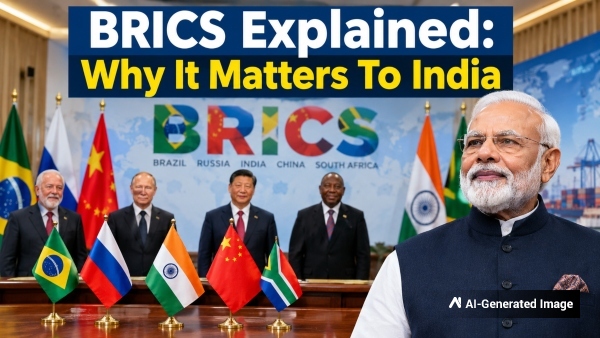
What Is BRICS?
BRICS is a grouping of major emerging economies that came together to increase cooperation on trade, investment, finance, development, technology and global economic issues.
BRICS originally consisted of Brazil, Russia, India and China, and was known as BRIC. South Africa joined the grouping in 2011, turning BRIC into BRICS.
The grouping has since expanded and now has 11 members: Brazil, Russia, India, China, South Africa, Egypt, Ethiopia, Iran, the United Arab Emirates and Indonesia.
The expansion has significantly increased the economic and geopolitical importance of BRICS.
What Does BRICS Stand For?
The word BRICS comes from the first letters of its original member countries:
Although the membership has expanded, the name BRICS has remained.
Why Was BRICS Created?
BRICS was formed to give emerging economies a stronger collective voice in global affairs.
The members wanted greater representation for developing countries in major international institutions and greater cooperation in areas such as finance, trade and development.
Over time, the agenda has expanded to include energy, climate change, food security, technology, healthcare, infrastructure, artificial intelligence, digital payments and sustainable development.
BRICS is not a military alliance. It is primarily a platform for economic, diplomatic and political cooperation.
Why Is BRICS Important?
The biggest reason BRICS matters is its growing economic and demographic weight.
The expansion of the grouping means that BRICS now represents a substantial share of the world's population and global economic activity.
This gives the bloc greater influence when members discuss issues such as:
- Global trade
- International finance
- Energy security
- Food security
- Climate change
- Technology
- Infrastructure
- Cross-border payments
- Development financing
- Reform of global financial institutions
For emerging economies, BRICS provides an important platform to push for a greater voice in the global economic system.
BRICS And The US Dollar
One of the most closely watched BRICS issues is the future of international payments.
BRICS countries have been exploring ways to increase trade using local currencies and make cross-border payments easier.
This has fuelled speculation about a possible BRICS common currency.
However, BRICS does not currently have a common currency.
The more immediate focus is on improving payment mechanisms, increasing trade in national currencies and reducing some of the difficulties involved in cross-border transactions.
For countries such as India, this could eventually have implications for international trade and payment costs.
When Is BRICS Summit 2026?
The 18th BRICS Summit will be held on September 12 and 13, 2026, in New Delhi.
The main summit is being hosted at Bharat Mandapam.
India is the BRICS Chair for 2026, having assumed the chairship on January 1.
The year is particularly significant because 2026 marks 20 years since the establishment of BRICS.
India has previously chaired BRICS in 2012, 2016 and 2021. The 2026 presidency is therefore India's fourth BRICS chairship.
Who Is Hosting BRICS Summit 2026?
India is hosting the BRICS Summit 2026.
India's 2026 BRICS presidency is being guided by the theme:
"Building for Resilience, Innovation, Cooperation and Sustainability"
The agenda focuses on making BRICS more practical and development-oriented, with discussions covering economic and financial cooperation, technology, energy, trade, sustainability and people-to-people exchanges.
Why Is BRICS 2026 Important For India?
The BRICS presidency gives India an opportunity to shape discussions among some of the world's largest emerging economies.
For New Delhi, key areas include trade, investment, financial cooperation, technology, energy security and global economic governance.
India can also use the BRICS platform to strengthen its position as an important voice for the Global South.
The summit comes at a time when global trade is being reshaped by tariffs, geopolitical tensions, supply-chain disruptions and changing relationships between major economies.
BRICS And India-China Relations
The 2026 BRICS Summit could also be important for India-China relations.
China is a founding BRICS member and one of the most economically powerful countries in the grouping. India's relationship with China has witnessed significant tensions in recent years, particularly over the border.
The BRICS platform provides an opportunity for the two countries to engage at the highest level even while differences remain on several issues.
The expected participation of Chinese President Xi Jinping would make the New Delhi summit particularly significant.
Is BRICS Against The US?
No. BRICS is not officially an anti-US or anti-Western alliance.
This is an important distinction.
BRICS includes countries that have very different relationships with the United States and Europe.
India, for example, has deep strategic and economic ties with the US while also being a founding BRICS member.
Instead, BRICS is increasingly seen as a platform through which emerging economies seek greater representation, economic cooperation and a more multipolar global system.
What Will BRICS Summit 2026 Discuss?
Several issues are likely to dominate the summit.
1. Trade
Members are expected to discuss ways to increase trade and investment within the BRICS grouping.
2. Local Currency Trade
Greater use of national currencies in trade could be discussed as countries look for ways to make cross-border transactions more efficient.
3. Global Economy
Economic growth, inflation, financial stability and changes in global trade are likely to feature prominently.
4. Energy Security
BRICS includes major energy producers as well as some of the world's biggest energy consumers. Energy security will therefore remain an important issue.
5. Technology And AI
Artificial intelligence, digital public infrastructure and fintech are emerging as important areas of cooperation.
6. Global Financial Institutions
BRICS members have long pushed for greater representation of emerging economies in global institutions such as the IMF and World Bank.
What Does BRICS Mean For Ordinary Indians?
BRICS may sound like a purely diplomatic grouping, but its decisions can eventually affect India's economy and ordinary consumers.
Greater trade cooperation can create opportunities for Indian exporters and businesses.
Financial cooperation and local-currency settlements could influence the way Indian companies conduct international transactions.
Energy discussions are also important because India is a major oil importer. Changes in global energy trade can affect India's import bill, inflation and ultimately household budgets.
Greater cooperation in technology, startups and investment could also create new opportunities for Indian businesses.
BRICS Summit 2026: Key Details
Bottom Line
BRICS has come a long way from the original four-country grouping of Brazil, Russia, India and China. With its expansion to 11 members, it has become an increasingly important platform for emerging economies.
The BRICS Summit 2026 in New Delhi will be particularly important because India is chairing the grouping at a time of major changes in global trade, geopolitics, energy markets and international finance.
For India, the summit is not just about diplomacy. It is an opportunity to push for greater trade, investment, financial cooperation and a stronger voice for emerging economies in global decision-making.
The bigger question is whether the expanded BRICS grouping can convert its growing economic influence into concrete cooperation on trade, payments, investment, technology and global economic reforms.


 Click it and Unblock the Notifications

 Sign in with Google