

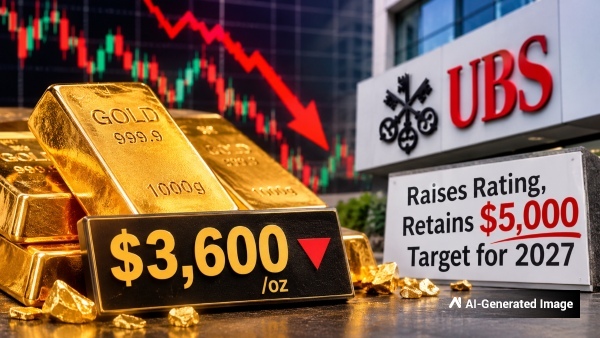
Gold prices continued to face heavy selling pressure on Friday, with bullion slipping towards $3,600 an ounce as expectations of further US Federal Reserve interest rate hikes strengthened. However, Swiss banking major UBS has taken a more constructive view of the precious metal, upgrading its rating on gold to Attractive and retaining its forecast of $5,000 an ounce by December 2027.
Gold was trading around $3,606 an ounce during Asian market hours, extending a decline that has taken prices approximately 35% below the record high touched in January. The latest weakness reflects growing concerns that the Federal Reserve may keep monetary policy tight for longer, making interest-bearing assets more attractive than gold.
US Treasury yields above 5% and a relatively strong US dollar have added to the pressure on bullion. Unlike government bonds and other fixed-income investments, gold does not generate interest income. Consequently, higher bond yields increase the opportunity cost of holding the precious metal.
Market expectations of further interest rate increases have also gained momentum. JPMorgan has joined other major financial institutions in anticipating additional Federal Reserve rate hikes in December, January and March. These expectations have weighed on investor sentiment towards gold.
UBS Upgrades Gold to Attractive Despite Recent Price Decline
While the immediate outlook remains challenging, UBS believes the longer-term investment case for gold remains intact.
In its Year Ahead 2027 outlook, titled 'Sustaining Resilience', the bank upgraded its assessment of gold to Attractive. UBS expects the precious metal to reach $5,000 an ounce by December 2027, supported by structural demand and the possibility of lower real interest rates.
The revised outlook represents a significant change in the bank's timeline rather than a withdrawal of its longer-term price target.
In August, UBS had expected gold to reach $5,000 during the first half of 2027. Its Chief Investment Office subsequently projected prices of $5,400 by September 2027 in October. However, the changing interest rate environment has pushed the $5,000 target further into the year.
The bank now expects easing inflation to create room for a moderate decline in bond yields later in 2027. Lower real yields generally improve gold's relative attractiveness by reducing the opportunity cost of holding an asset that does not pay interest.
Until that happens, however, gold remains exposed to pressure from monetary policy expectations and movements in the US dollar.
Central Bank Demand Remains Important for Gold
UBS's positive assessment also reflects the structural demand supporting the gold market.
Central bank purchases have remained an important factor in gold's longer-term investment story. Demand from official institutions, along with interest from investors seeking protection against inflation, geopolitical uncertainty and financial market volatility, continues to influence the precious metal's position in global portfolios.
UBS also views commodities as an important portfolio diversification tool, particularly in an environment marked by geopolitical risks, inflation concerns and supply constraints.
As part of its broader asset allocation strategy, the bank now favours bonds and commodities, followed by equities. It has downgraded global equities to Neutral, while cash remains its least preferred asset class.
UBS Sees Opportunities in Copper and Oil
UBS's constructive assessment extends beyond gold.
The bank expects oil prices to remain supported during the first half of 2027. It has also identified copper as its preferred industrial metal, citing demand from electrification, power infrastructure, data centres and artificial intelligence-related investments.
These sectors have increased the importance of industrial metals in discussions around long-term commodity demand.
How Other Global Banks View Gold Prices
UBS is not alone in maintaining a positive longer-term outlook for gold.
Morgan Stanley has a price forecast of $5,250 an ounce for the fourth quarter of 2027, while Goldman Sachs expects gold to reach $4,650 by the end of 2027.
Although the forecasts differ, all three institutions see scope for gold prices to move higher from current levels over their respective forecast periods.
For now, however, the immediate direction of gold prices remains closely linked to US interest rate expectations, Treasury yields and the dollar. The Federal Reserve's December 9 policy decision is another important event for the bullion market, particularly as investors assess the possibility of further monetary tightening.
The contrast between the current gold price decline and UBS's longer-term assessment highlights the difference between near-term market pressures and the structural factors influencing demand for the precious metal.


 Click it and Unblock the Notifications


 Sign in with Google