

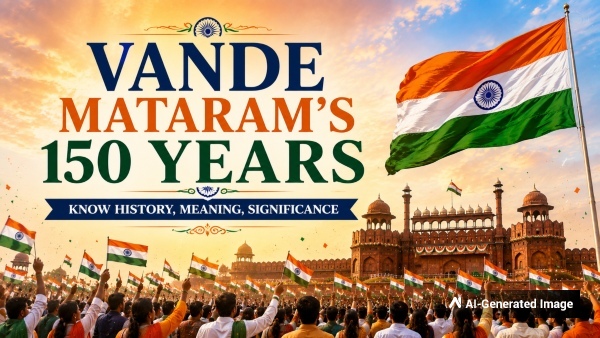
As India prepares to celebrate Independence Day on August 15, one patriotic song will once again echo across the country - Vande Mataram. But who wrote Vande Mataram, when was it written, and why did a poem written nearly 150 years ago become such a powerful symbol of India's freedom struggle?
The answer takes us back to Bankim Chandra Chattopadhyay, one of the most influential writers of 19th-century Bengal.
Who Wrote Vande Mataram?
Bankim Chandra Chattopadhyay wrote Vande Mataram. The Government of India's 150-year commemoration records November 7, 1875 as the date of its first publication in his literary journal Bangadarshan. The song was later included in his famous Bengali novel Anandamath, published in 1882.
Bankim was not alive when India became independent. He died on April 8, 1894, more than five decades before August 15, 1947.
Yet his words survived him and became part of the emotional vocabulary of India's freedom movement.
Bankim was a writer as well as a British-era civil servant. His novels explored Indian society, history and identity at a time when ideas of nationalism were beginning to take shape. Among his best-known works are Anandamath, Devi Chaudhurani, Kapalkundala and Durgeshnandini.
Vande Mataram Meaning: What Do the Words Mean?
The phrase "Vande Mataram" broadly means "I bow to the Mother" or "I salute the Mother".
Here, the mother is the motherland.
The opening lines describe India through images of nature and prosperity - "Sujalam, Suphalam, Malayaja Shitalam, Shasya Shyamalam."
The words evoke a land rich in water, abundant in produce, cooled by fragrant breezes and covered with green crops.
That is what made the song so different from an ordinary patriotic composition. Bankim was not simply describing a country on a map. He was presenting India as a mother - nurturing, beautiful and worthy of devotion.
This idea gave the song a deep emotional force.
Vande Mataram and India's Freedom Struggle
The song's journey from literature to the freedom movement gathered momentum in the late 19th and early 20th centuries.
In 1896, Rabindranath Tagore sang Vande Mataram at the Indian National Congress session in Calcutta, now Kolkata, giving the song a prominent public platform.
Its political importance grew dramatically after the Partition of Bengal in 1905. During the Swadeshi and anti-Partition movement, Vande Mataram became a rallying cry. Protesters shouted the words while demanding the boycott of British goods and promoting Indian-made products.
The British authorities understood its influence. At Barisal in 1906, public chanting of Vande Mataram was prohibited.
A song had become a form of political resistance.
The story also connects Vande Mataram to several generations of Bengal's nationalist movement. Sri Aurobindo wrote extensively about it, while later revolutionary groups adopted it as a slogan. Subhas Chandra Bose's Indian National Army also used a marching version associated with its mobilisation efforts.
Vande Mataram and Jana Gana Mana: National Song or National Anthem?
One of the most frequently asked questions about India's national symbols is: Is Vande Mataram the National Anthem?
No. Jana Gana Mana is India's National Anthem, while Vande Mataram is the National Song.
On January 24, 1950, the Constituent Assembly gave Vande Mataram the status of India's National Song, while Jana Gana Mana was adopted as the National Anthem.
The distinction is important because the two compositions have different histories and meanings.
The first two stanzas of Vande Mataram focus largely on the beauty and abundance of the motherland. The later portions contain religious imagery, including references to Hindu goddess forms. This became an important part of the debate surrounding the song's place in a religiously diverse India.
The decision to recognise Vande Mataram as the National Song while adopting Jana Gana Mana as the National Anthem allowed both compositions to occupy an important place in independent India's national identity.
From Independence to Lata Mangeshkar and A.R. Rahman
Vande Mataram has never had just one musical identity.
Different singers and composers have interpreted it across generations. Rabindranath Tagore sang an early version, while Lata Mangeshkar's rendition in the 1952 film Anand Math gave the song a hugely popular cinematic identity, with music by Hemant Kumar.
Decades later, A.R. Rahman's "Vande Mataram" and "Maa Tujhe Salaam" introduced the patriotic theme to a younger generation through a modern musical style.
The music changed, but the central emotion remained the same.
And perhaps that explains why Vande Mataram has survived for 150 years.
Bankim Chandra never saw India become independent. He never saw the Tricolour rise over the Red Fort. But his words were present when India entered freedom in 1947.
On August 14, 1947, the Constituent Assembly proceedings began with Vande Mataram, sung by Sucheta Kriplani. On August 15, Pandit Omkarnath Thakur rendered it on All India Radio.
From a poem first published in 1875 to a song heard during India's Independence Day celebrations in 2026, the journey of Vande Mataram is remarkable.
It is not merely a song about India.
For generations of Indians, those two words have carried a much larger message:
Vande Mataram - I bow to the Mother.


 Click it and Unblock the Notifications

 Sign in with Google
