

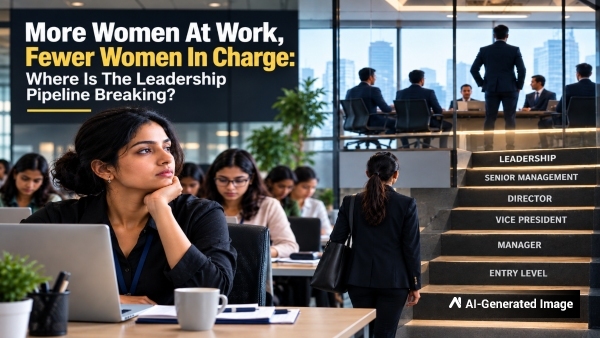
Women are entering India's corporate workforce in significant numbers. But getting through the door is only the beginning of the challenge.
The bigger question is what happens when women reach the first major turning point in their careers: moving from individual contributor to manager.
A new study by Great Place To Work India: The Missing Middle: Redesigning How Women Build and Sustain Career Momentum, reported by Business Today highlights a sharp drop in women's representation at precisely this stage. Women account for 32% of individual-contributor roles, but their share falls to 20% at the first managerial level. Representation drops further to 18% in middle management and 16% at the executive level.
The numbers point to a familiar problem in corporate India. Women are being hired, but many are not progressing through the leadership pipeline at the same pace.
The promotion point where careers begin to diverge
The first promotion often comes at a stage when professional ambitions collide with responsibilities outside the workplace.
For many women, this can be the period when parenting, eldercare and household responsibilities become more demanding. At the same time, the transition into management brings greater expectations, longer-term career decisions and increased visibility within an organisation.
Great Place To Work India describes this intersection of career and life stages as a "collision zone".
The report argues that the issue cannot simply be placed on women to solve. Workplace structures, promotion systems, flexibility, career development and access to senior leaders can all influence whether an employee continues to build career momentum.
This makes the first promotion more than a routine career milestone. It can become a critical point in determining who remains on the leadership track.
Hiring women is only the first step
Corporate diversity discussions have traditionally focused heavily on hiring more women. But recruitment alone does not create a strong female leadership pipeline.
The bigger challenge is retaining women, developing their careers and ensuring that they continue to receive meaningful opportunities as their responsibilities change.
That means companies need to look beyond maternity benefits. Career sustainability can involve flexible work arrangements, returnship programmes, parental leave, continued access to learning and development, and opportunities to take on high-impact assignments.
The report also highlights the importance of sponsorship. A woman returning from an extended career break should not have to rebuild her professional visibility from scratch. Senior leaders can play a role in keeping returning employees connected to important projects, succession discussions and career opportunities.
What companies can change
One area that deserves attention is the way organisations assess employees for promotion.
A career break or extended leave should not automatically push an employee out of consideration when she has the skills and experience required for the next role. Companies can also create ways for employees on leave to remain connected to the organisation by choice, without creating an expectation that they should continue working.
Shared caregiving is another part of the equation. Meaningful parental leave for both parents can help reduce the extent to which caregiving responsibilities become disproportionately associated with women's careers.
The Great Place To Work India study also found differences between organisations recognised as Best Workplaces for Women and the broader workplace sample. Women at these organisations reported better experiences across areas including benefits, career growth, pay fairness and work-life balance. The report said women at these companies were also taking four out of every 10 new roles.
The leadership pipeline starts much earlier
The debate around women in corporate leadership often focuses on boardrooms and C-suite representation. But the numbers suggest that the problem begins much earlier.
If women make up 32% of individual contributors but only 20% of first-level managers, the leadership pipeline is already narrowing before employees reach senior management.
That raises a fundamental question for India Inc: Is the workplace designed only for uninterrupted career progression, or can it accommodate the realities of people's lives?
Building a larger female workforce is important. But ensuring women can progress, return, grow and remain visible throughout their careers may ultimately determine how much of that talent reaches the top.
The first promotion, therefore, is not just another step on the career ladder. It may be one of the most important points at which companies can prevent women from disappearing from their future leadership pipeline.


 Click it and Unblock the Notifications

 Sign in with Google
