

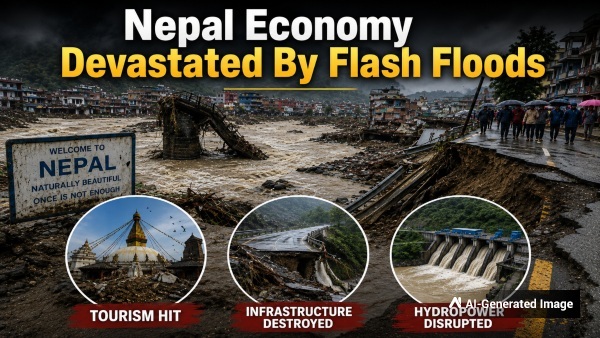
Nepal faces a devastating economic setback after a flash flood ripped through the Bhote Koshi River corridor, destroying homes, roads, bridges, and critical infrastructure across parts of the country.
The disaster struck on August 26 after a massive collapse of ice and rock in the Himalayan region triggered a torrent of water, mud and debris. The flood swept through Rasuwa and downstream areas, affecting places including Nuwakot and Dhading.
As of August 27, Nepal's government said 359 bodies had been recovered, while hundreds remained missing. Authorities also reported extensive damage to roads, bridges, hydropower facilities, and other critical infrastructure.
But beyond the immediate humanitarian tragedy lies another concern: what will the Nepal floods mean for an economy that was already struggling to regain momentum?
Nepal Was Already Heading Into A Weak Growth Phase
The timing of the disaster could make the economic impact particularly painful.
According to the World Bank's April 2026 outlook, Nepal's GDP growth was projected to slow to 2.3% in FY2026, down from 4.6% in FY2025. The slowdown was already being attributed to the lingering impact of the September 2025 unrest, weaker tourism, higher energy costs and external economic uncertainty.
The World Bank had expected Nepal's economy to recover gradually, with growth averaging around 4.4% in FY2027 and FY2028, helped by reconstruction, hydropower development and stronger domestic consumption.
The floods could now make that recovery considerably more complicated.
Infrastructure Damage Could Run Into Billions
One of the biggest immediate economic problems is infrastructure.
Nepal's Physical Infrastructure Minister has put the preliminary damage to roads and bridges at around Rs 200 billion. This is an early estimate and does not represent the full economic cost of the disaster.
Several hydropower projects have also been affected.
Preliminary reports indicate that 14 hydropower projects with a combined capacity of about 748 MW were damaged, including operating and under-construction projects.
This matters because hydropower is one of Nepal's most important potential engines of economic growth.
Damage to power plants, transmission infrastructure, roads and bridges could therefore have a double impact - the country will have to spend money rebuilding infrastructure while some projects may be unable to generate expected revenues.
Tourism And Trade Could Also Take A Hit
Nepal's economy depends heavily on tourism, remittances, agriculture and services.
The flood has hit an important Himalayan tourism and trade corridor. The destruction around the Rasuwagadhi border area has also disrupted a key connection between Nepal and Tibet, potentially affecting cross-border trade and tourism.
For local businesses, the consequences can extend well beyond the flood zone.
Hotels, restaurants, transport operators, shops, guides and small businesses depend on tourists moving through these regions. When roads and border facilities are destroyed, the economic damage spreads through the wider supply chain.
Agriculture Could Face A Second-Round Shock
Nepal is also particularly vulnerable because agriculture remains an important source of livelihoods.
Floods do not only destroy crops that are ready for harvest. They can damage farmland, livestock, irrigation systems, storage facilities and rural roads.
That can reduce household incomes today while also affecting agricultural production in the next season.
Earlier analysis of Nepal's disasters found that floods and landslides create significant hidden economic losses for rural families because workers lose income and farmers lose future production.
So, How Long Will Nepal Take To Recover?
There is no reliable official estimate yet for the total economic damage or the time required for reconstruction.
However, the recovery is likely to happen in stages.
The first few weeks and months will focus on rescue, temporary shelter, restoring roads and bridges, clearing debris and reconnecting isolated communities.
The next six to 18 months could involve large-scale reconstruction of roads, power infrastructure, bridges and damaged public facilities.
But rebuilding major hydropower projects and strategically important infrastructure could take several years, particularly where entire structures have been destroyed or where access remains difficult.
That means Nepal's economy could begin recovering relatively quickly at the headline GDP level if reconstruction spending increases. But full economic recovery for affected communities may take much longer.
Could Reconstruction Actually Boost Nepal's Economy?
There is an important paradox here.
Disasters destroy economic wealth, but the reconstruction effort can temporarily increase economic activity.
Government spending on roads, bridges, power plants, housing and public facilities creates demand for construction, labour, materials and transport.
This is one reason the World Bank had already expected reconstruction to support Nepal's growth outlook.
But reconstruction-driven GDP growth should not be confused with genuine economic prosperity.
If Nepal spends billions simply replacing infrastructure that already existed, the country is recovering lost ground rather than creating new wealth.
The Bigger Problem: Nepal's Climate Risk
The latest disaster also raises a longer-term question for Nepal's economy.
The Himalayas are becoming increasingly vulnerable to glacial collapse, landslides, flash floods and other climate-related hazards. Scientists say rising temperatures are contributing to greater instability in high-altitude environments, although the precise contribution of climate change to any individual event requires careful assessment.
For Nepal, this means disaster management can no longer be treated simply as an emergency response issue.
The country may need to spend significantly more on early-warning systems, climate-resilient roads, safer hydropower infrastructure, flood monitoring and disaster preparedness.
Nepal's Recovery May Take Years, Not Months
The immediate priority is saving lives and getting relief to affected communities. But once the rescue phase ends, Nepal will face a huge rebuilding challenge.
The country's economy was already expected to grow slowly in FY2026. The flood has now added another major shock to infrastructure, energy, tourism and local livelihoods.
Nepal may be able to restore basic connectivity within months, but rebuilding damaged infrastructure and restoring lost economic capacity could take several years.
The bigger test will be whether Nepal uses the reconstruction period simply to replace what the floods destroyed - or to build a more resilient economy capable of withstanding the next Himalayan disaster.


 Click it and Unblock the Notifications

 Sign in with Google