

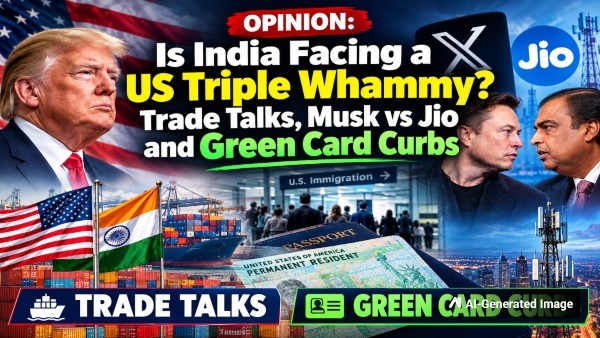
India's economic relationship with the United States is facing pressure on three fronts. Trade negotiations have stalled, Elon Musk has escalated his public confrontation over Starlink's entry into India, and Washington has suspended major technology companies from a programme that lets them sponsor foreign employees for Green Cards.
These incidents are unfolding one by one, raising questions about market access, regulatory barriers and the future of Indian businesses and professionals in the US. There is no evidence that the three disputes are part of a coordinated campaign against India. But together, they highlight growing uncertainty over one of India's most important economic partnerships.
India-US trade deal stuck as tariff risks rise
The clearest sign of trouble is the stalled trade agreement. On October 5, Finance Minister Nirmala Sitharaman said negotiations had reached a plateau, with limited room for further concessions. US Trade Representative Jamieson Greer has also hinted that a deal is not imminent. The two countries had agreed on a framework in February 2026, which helped reduce punitive US tariffs on most Indian goods from 50% to 18%. However, a final agreement remains elusive.
The disagreement extends beyond tariffs. Washington wants India to reduce its purchases of Russian oil and address trade imbalances. New Delhi, meanwhile, is seeking better tariff terms and protection for sensitive sectors such as agriculture and dairy.
A new US law has added another layer of uncertainty by providing for tariffs of up to 100% on goods from countries buying significant volumes of Russian oil. A separate investigation into excess industrial capacity could also expose Indian exporters to additional trade measures.
The stakes are considerable. India exported $42.79 billion worth of goods to the US between April and August 2026, up from $40.39 billion a year earlier. India also recorded a trade surplus of nearly $34 billion with the US in the 2025-26 financial year.
Without a final agreement, exporters face uncertainty over future tariffs, pricing and competitiveness. Higher duties could make Indian products more expensive for American buyers and complicate investment decisions.
Why has Elon Musk taken on India's powerful industrialists?
As trade negotiations struggle, another dispute has brought the question of market access into the spotlight.
Elon Musk has accused unnamed powerful business interests of obstructing Starlink's entry into India to protect existing market positions. On October 8, he escalated the confrontation by asking on X, formerly known as Twitter, whether Reliance Industries chairman Mukesh Ambani was the "real boss of India."
Starlink, operated by Musk's SpaceX, wants to provide satellite broadband services in India. The company has received an initial licence but is still awaiting final clearances, including security-related approvals and spectrum arrangements.
India's telecommunications ministry has rejected allegations of discrimination, saying Starlink and the satellite ventures associated with Reliance Jio and Bharti Airtel are at broadly the same regulatory stage. All must satisfy the government's security requirements.
The dispute is not proof that Indian industrialists have blocked Starlink. However, it puts the country's regulatory process under international scrutiny.
Satellite broadband could expand internet access in remote and underserved areas, while opening a new market for global technology companies. At the same time, India must consider national security, spectrum allocation and competition among providers.
The timing adds significance. When a prominent American entrepreneur publicly questions the fairness of India's business environment while a trade agreement remains unresolved, the dispute can feed into wider concerns about market access, even though the two matters are not formally linked.
Green Card restrictions add pressure on Indian IT companies
The third development affects Indian technology companies and thousands of skilled professionals working in America.
On October 8, the US government announced suspensions affecting major technology firms, including Tata Consultancy Services, Infosys, Wipro, HCL, Cognizant and Capgemini. Microsoft and Adobe were also affected by separate suspensions from the Permanent Labor Certification Programme, or PERM. The administration cited investigations and allegations involving the employment of foreign workers at the expense of American employees.
| Company | H-1B-related LCA filings in FY2026 |
|---|---|
| Cognizant | 5,771 |
| Infosys | 4,574 |
| TCS | 2,922 |
| Wipro | 1,875 |
| Capgemini America | 1,694 |
| HCL America | 1,372 |
Note: These figures represent Labour Condition Application (LCA) filings, not actual H-1B visa petitions or approvals. Source: H-1B Grader, FY2026 employer filing data.
PERM is an important step in the employer-sponsored Green Card process. The programme generally requires employers to demonstrate that qualified American workers are not adversely affected before proceeding with certain permanent-residency applications.
The suspensions prevent affected employers from making new filings while the restrictions remain in force. The allegations against the companies should not be treated as proof of wrongdoing by every firm or employee.
For Indian professionals, however, the immediate concern is the prospect of further delays in obtaining permanent residency. Indian applicants already face lengthy queues because demand for employment-based Green Cards exceeds the available annual allocation.
The consequences could extend to some H-1B visa holders approaching the normal six-year limit, depending on their circumstances and eligibility for extensions. The PERM suspensions do not automatically cancel existing H-1B visas, but they can complicate the path towards permanent residency.
For Indian IT companies, the move adds uncertainty to staffing, recruitment and long-term workforce planning in their largest overseas market.
What connects these developments?
The three disputes involve different policy areas, and there is no established evidence that Washington is using them together as leverage against India. Yet each touches a central pillar of the economic relationship.
Trade talks concern the price and conditions under which Indian goods enter the American market. The Starlink dispute concerns the terms under which a US technology company can operate in India. The Green Card suspensions affect how Indian technology companies employ and retain skilled workers in the US.
The common thread is uncertainty.
Indian exporters need predictable tariffs. Foreign companies want clear regulatory processes. Technology firms need stable immigration rules to manage international operations, while employees need clarity about their future.
The wider relationship also includes defence, technology investment and strategic cooperation. Progress in these areas does not automatically resolve disagreements over trade or immigration.
For New Delhi, the challenge is to defend domestic interests while keeping commercial channels open. For Washington, the challenge is to pursue its priorities on American jobs, energy and trade without creating wider uncertainty for businesses operating across borders.
Could the pressure affect India's economic outlook?
The consequences will depend on how these disputes develop. Further tariffs could hurt export competitiveness and weigh on business sentiment. Immigration restrictions could delay permanent residency for Indian professionals and force technology companies to reassess staffing plans. The Starlink dispute could influence competition and investment in India's satellite broadband market.
None of these outcomes is inevitable. Trade negotiations could resume, regulatory approvals could progress and immigration restrictions could be revised following further reviews.
But the simultaneous pressure on trade, technology access and skilled-worker mobility deserves attention.
The critical question is whether India and the US can resolve these separate disputes before the uncertainty begins to undermine the wider economic partnership that both countries have spent years building.


 Click it and Unblock the Notifications

 Sign in with Google