

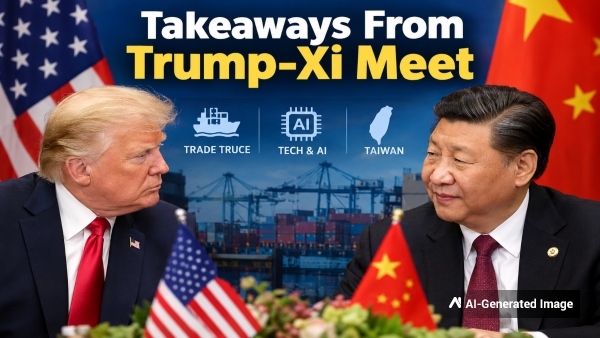
US President Donald Trump and Chinese President Xi Jinping met at the White House on September 24 as the world's two biggest economies tried to put a lid on their escalating strategic and economic rivalry. The meeting produced signs of cooperation, but few indications that the deeper disagreements between Washington and Beijing have been resolved.
Here are 10 key takeaways from the Trump-Xi summit.
1. US-China trade truce gets another extension
The immediate economic takeaway was an extension of the existing US-China trade truce by two months. The extension gives both sides additional time to negotiate, rather than allowing tariffs to return to the much higher levels seen during the earlier US-China trade war.
2. No major breakthrough on a wider trade deal
The extension should not be mistaken for a comprehensive US-China trade agreement. Major issues including tariffs, Chinese purchases of US goods, rare-earth supplies and technology restrictions remain part of the negotiations.
3. China's rare-earth advantage remains critical
Rare earths continue to give Beijing significant leverage over Washington. China accounts for about 60% of known rare-earth deposits and around 90% of processing capacity, making the supply chain important for semiconductors, electronics, advanced technology and defence manufacturing.
4. Agriculture remains an important bargaining chip
US agricultural exports remain central to the trade negotiations. China has committed to purchasing US soybeans and other farm products, but progress on some of the earlier commitments has been uneven. Agriculture therefore remains one of the areas where both countries can demonstrate tangible economic gains.
5. Artificial intelligence moves higher on the agenda
AI was another major theme of the Trump-Xi meeting. The two countries are competing for leadership in artificial intelligence, advanced computing and technology, even as they explore ways to manage some of the risks associated with increasingly powerful AI systems.
6. Technology rivalry is far from over
The meeting did not eliminate the broader US-China technology conflict. Washington continues to focus on maintaining its technological advantage, while Beijing is investing heavily in domestic technology capabilities. The competition extends beyond AI to semiconductors, advanced manufacturing and strategic technologies.
7. Taiwan remains a major fault line
Taiwan continues to be one of the most sensitive issues in US-China relations. Xi urged Trump to oppose Taiwanese independence and handle the issue cautiously, according to Chinese state media. The White House did not immediately provide a comparable detailed account of the Taiwan discussion.
8. Iran adds another layer of tension
The Iran conflict also featured in the broader discussions. Washington wants Beijing to support efforts to isolate Tehran economically, while China has maintained close economic ties with Iran. No major breakthrough on the issue was reported from the summit.
9. Both sides have an economic reason to avoid escalation
Despite their strategic rivalry, the US and China remain deeply connected through trade and global supply chains. A renewed tariff war could hurt exporters, businesses and consumers while creating fresh uncertainty for global markets. The temporary truce therefore provides breathing room for negotiations.
10. Stability, rather than a grand bargain, is the immediate message
The summit's biggest outcome may be that Washington and Beijing are keeping communication open. Trump described the meeting positively, while Xi emphasised the need for the two countries to compete without allowing rivalry to spiral into confrontation. For now, the relationship remains a mix of economic interdependence and strategic competition.
What happens next?
The next phase of the US-China relationship will depend on whether the two governments can turn the temporary trade truce into a more durable framework. Tariffs, rare earths, agriculture, technology, AI and Taiwan will remain closely watched by businesses and investors.
For the global economy, the immediate relief is that another sharp escalation in the US-China trade war has been avoided. But the summit also makes clear that the underlying US-China rivalry has not disappeared. The coming months will show whether the latest pause becomes a stepping stone towards a broader trade deal or simply another temporary break in a much longer economic and geopolitical contest.


 Click it and Unblock the Notifications

 Sign in with Google
