

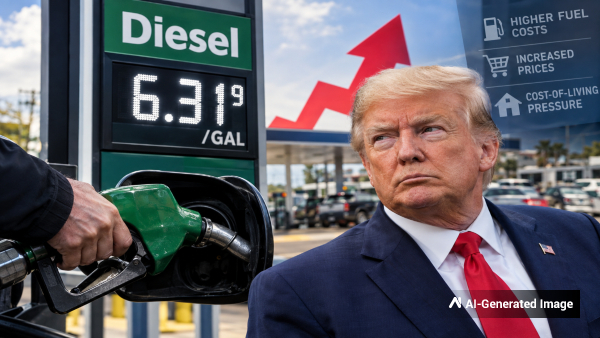
The US economy faces a fresh energy headache, and this time, diesel is at the centre of it.
US diesel prices have climbed to a record $6.31 a gallon, sharply raising the cost of moving goods nationwide. Gasoline prices have also moved higher, with the national average nearing $4.43 a gallon on September 17, according to AAA data cited in recent reports.
The immediate impact is being felt by trucking and freight companies. But the bigger concern for economists is what happens if elevated fuel prices stay around for long enough to work their way through the entire supply chain.
Also, record US diesel prices are adding to the cost-of-living pressure facing the Trump administration just weeks before the November midterm elections.
Why are US diesel prices rising?
The latest surge is closely linked to the disruption in global oil supplies and refining capacity.
Crude oil prices have remained above $100 a barrel, as geopolitical tensions in the Middle East continue to threaten production, shipping routes, and energy infrastructure. Brent crude settled at around $104.82 a barrel on September 17, while US WTI stood near $101.91.
Diesel has been particularly vulnerable because it depends not only on crude oil but also on refining capacity and the availability of middle-distillate products.
"Diesel and gasoline are both refined from crude oil, but they don't always move in lockstep. Gasoline prices tend to be driven by consumer driving patterns. Diesel is more tightly linked to commercial demand such as freight, construction, agriculture and industrial activity. So, when diesel supply tightens, the price impact can be broader and faster to reach businesses," according to Sergei Klebnikov at J.P. Morgan Wealth Management.
"A big part of the run-up in prices is geopolitical disruption. Two pressure points have been front and center recently: the ongoing conflict involving Iran - which has raised risks around energy flows through key Middle East routes - and Russia - where refinery disruptions and policy responses have reduced the availability of products for export.3 What's more, Iran-related risks have pushed crude oil above $100 per barrel several times this year, adding broad pressure to energy markets"
Recent US inventory data shows why the market remains tight. Distillate stocks, which include diesel and heating oil, were around 107.9 million barrels, roughly 13% below the five-year average for this time of year.
That leaves less room for the market to absorb another supply disruption.
Why diesel matters more than the pump price suggests
Unlike gasoline, diesel is deeply embedded in the US economy.
Trucks use it to transport everything from food and medicines to building materials and consumer goods. Railways and heavy equipment also depend heavily on diesel.
That means a sustained increase in diesel prices can quickly become a business-cost problem.
A trucking company paying significantly more for fuel has several choices: absorb the additional cost, increase freight rates, reduce journeys or pass the expense to customers through fuel surcharges.
Large logistics companies may have some protection through fuel hedging and scale. Smaller trucking operators, however, can have less room to absorb sudden increases.
That creates a potential second-round effect for consumers.
From diesel prices to grocery bills
The journey from an oil refinery to a supermarket shelf involves multiple stages of transportation.
Higher diesel costs can raise the expense of moving agricultural produce, packaged food, beverages and other goods. Perishable products can be particularly sensitive because they often require refrigerated transportation.
The American economy has already seen how fuel-price shocks can feed into transportation and consumer costs. The latest increase therefore raises concerns about another round of cost pressures if oil and diesel remain elevated.
Recent analysis has warned that the increase is already affecting transportation costs, while heating oil could also become more expensive ahead of winter.
Could expensive diesel fuel push inflation higher?
This is where the issue becomes important for the wider US economy.
Fuel is not included in every measure of underlying inflation, but businesses use energy throughout the production and distribution process. If higher diesel prices persist, companies may eventually raise prices to protect margins.
That could make the Federal Reserve's inflation challenge more complicated.
At the same time, high fuel prices can weaken consumer spending. Households paying more to fill their cars, while also facing higher transportation-related costs for goods and services, have less money available for discretionary purchases.
In other words, expensive oil can create a difficult combination: higher costs for businesses and less spending power for consumers.{document2}
The bigger risk is duration
For now, the key question is not simply whether diesel has crossed $6 a gallon.
It is how long it stays there.
Oil prices have remained above $100 despite some easing in crude prices on September 17. Reuters reported that concerns over Middle East supply disruptions remain, while diesel markets are facing additional pressure from global supply-chain disruptions.
If energy markets stabilise, some of the pressure could eventually ease. But if supply disruptions continue, expensive diesel could move from being a transportation problem to becoming a broader US inflation and economic growth problem.
For American consumers, the warning may therefore be less about what they pay at the pump today and more about what a prolonged fuel shock could mean for the price of getting almost everything else delivered tomorrow.


 Click it and Unblock the Notifications

 Sign in with Google
