



 Click it and Unblock the Notifications

AI-Led Market Rout Deepens as US Equities Fall in November 2026, Led by Nvidia and Chipmakers

US equities opened a key week with a sharp slide, led by AI stocks. An estimated $2.2 trillion in value vanished across major indices overnight. The drop pushed monthly returns deeper into the red and shook recent momentum. Investors now watched whether the move signalled a wider risk-off phase, or a reset after a fast tech-led run.
The Dow Jones fell 739.38 points, or 1.41%, to 51,608.17 on November 16, 2026. The S&P 500 sank 145.08 points, or 1.92%, to 7,416.59. The Nasdaq Composite dropped 626.52 points, or 2.5%, to 24,509.76. Selling pressure concentrated in large technology and chip names.
The main index moves were as follows.
| Index | Close | Points change | % change |
|---|---|---|---|
| Dow Jones | 51,608.17 | -739.38 | -1.41% |
| S&P 500 | 7,416.59 | -145.08 | -1.92% |
| Nasdaq Composite | 24,509.76 | -626.52 | -2.5% |
Chip and AI-linked names took the hardest hit, with Nvidia central to the move. Nvidia lost $1.22 trillion in market value from October 29 to November 13. The fall followed CEO Jensen Huang’s resignation amid controversies, including alleged extramarital affairs. The iShares Semiconductor ETF (SOXX) dropped 12.8% over the same period.
Nvidia slid another 4.1% in the latest session. Other chipmakers also fell hard. Micron Technology and Intel sank more than 7% each. Advanced Micro Devices lost 5%, while Sandisk dropped about 8%. Dell Technologies fell 7%, and Oracle declined 5% during the rout.
Pressure also spread to several mega-cap technology counters. Among Magnificent 7 stocks, Alphabet fell 4%. Microsoft dropped over 15%. Amazon declined more than 3.3%. The broad damage was reflected in index-level value erosion, led by the S&P 500 and Nasdaq.
| Index | Estimated market value wiped out |
|---|---|
| S&P 500 | $1.06 trillion |
| Nasdaq | $870 billion |
| Dow Jones | $270 billion |
| Total (estimated) | $2.2 trillion |
Nvidia’s first earnings announcement without Huang as CEO was due on November 17. Investors tracked it closely for clues on demand and margins. The week also included the upcoming Anthropic IPO and US retail sales data. The October 2026 FOMC minutes were expected to shape rate expectations.
Analysts still saw solid multi-year earnings growth for Nvidia, but risks remained. Concerns included competition and execution without Huang. Demand for "compute" to run AI stayed firm, and Nvidia held an 80% share of top-end AI chips. A Charles Schwab report noted Broadcom and Advanced Micro Devices gained last week.
Nvidia also faced questions beyond earnings forecasts and market share. Investors looked for signs of stability after the leadership change. One key issue was how Nvidia could keep staff during a sensitive period. The company’s ability to retain talent could influence confidence in product roadmaps and customer delivery schedules.
Interest-rate risks also stayed in focus as equities fell. Collin Martin, Schwab’s head of fixed income research and strategy, expected more tightening. Martin’s base case was for two more hikes. Martin added, "The CPI print supports that view. Inflation's just too hot right now."
AI stocks bubble risk: Jason Furman’s market decline scenarios
Jason Furman, former chair of the US Council of Economic Advisers, flagged a broader concern. Furman questioned whether AI stocks were priced like a bubble. Furman also explored how far Wall Street could slide if sentiment broke. The analysis focused on the largest AI-linked companies and market-wide valuation levels.
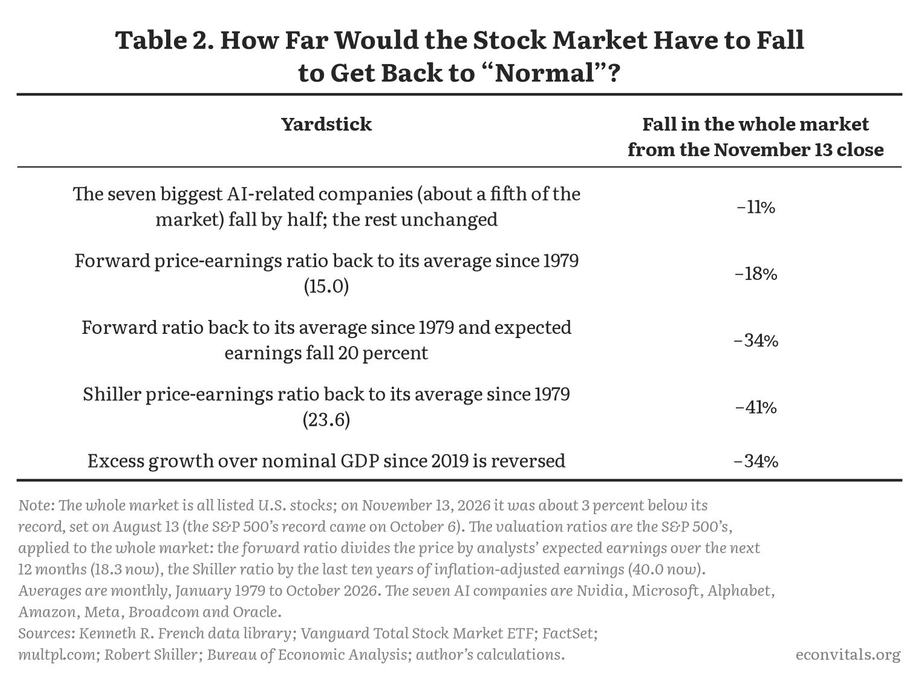
"If forced to answer the question of how much the stock market would fall if it is in a bubble, I would use a number of methodologies," Furman wrote in his blog. Furman estimated a 50% drop in the biggest AI stocks could cut the broader market by 11%. The estimate excluded knock-on declines in other sectors.

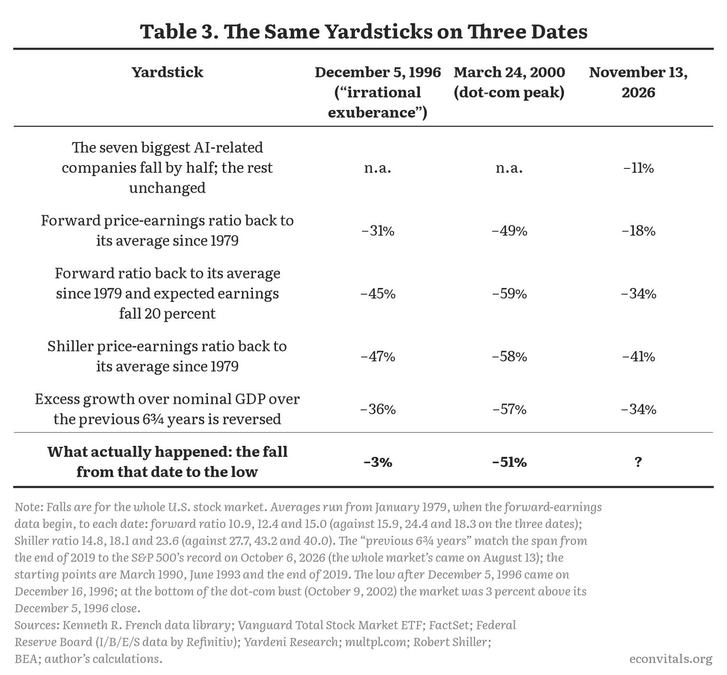
Furman also discussed valuation-based approaches that used profit assumptions. Furman said, "These give answers in the range of 18 to 41%." Furman added, "All of these declines are much larger than what options markets treat as likely; in fact, options pricing suggests an unusually low chance of a large market decline-but, of course, if the market is misvalued, these options may be too," the Harvard Kennedy School professor suggested.
Furman viewed a repeat of the dot-com crash scale as a tail risk. Furman described a 50% market fall, like 2000, as very low probability. If forced to choose a baseline outcome, Furman preferred a 25% decline if an AI bubble burst. Furman also argued market structure in 2026 differed from 2000.
Since end-2019, the S&P 500 rose 135%, while index earnings grew 125%. Furman attributed much of the move to mature, high-revenue firms. Nvidia’s revenue increased ninefold over three years. Alphabet’s and Microsoft’s revenue rose 60% each. Furman noted AI adoption appeared faster than the internet or computers.
Furman contrasted past themes with current spending priorities. In the late 1990s, fibre networks drew capital on "build it and they will come". Those shares later suffered in the 2000s. Furman wrote that today’s focus was data centres, AI infrastructure, semiconductors, and chips. Renting an Nvidia H100 rose over 50% in December last year.
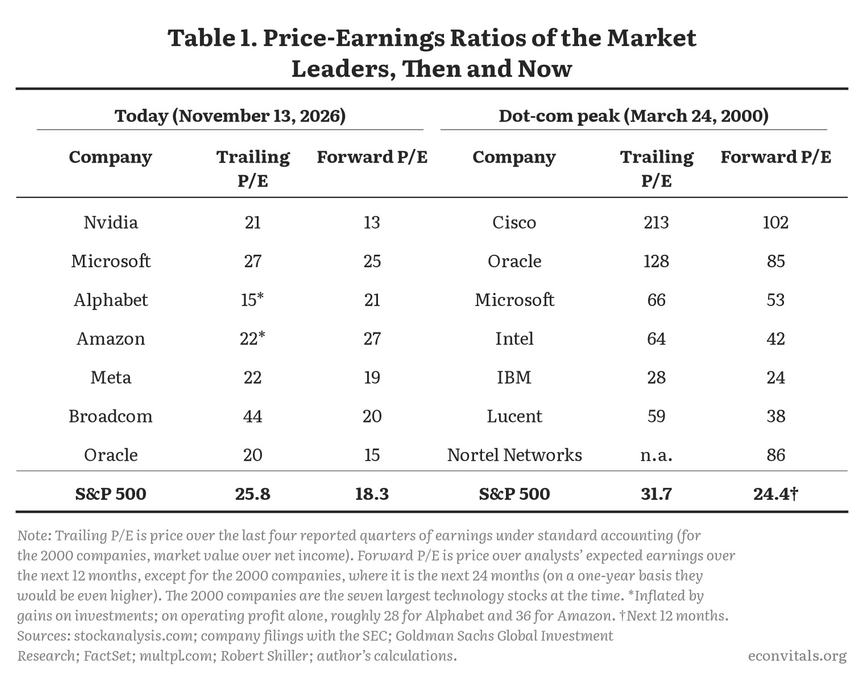
Valuation comparisons also framed Furman’s view on risk. In 2000, Cisco’s price-to-earnings ratio reached 213 times in late March. Nvidia’s was 21 times as of November 13, 2026. Furman said, "The aggregate market tells a similar story. The ratio of stock prices to expected earnings over the next twelve months is 18.3, the 77th percentile of its history since 1979 (Figure 1). This is well below the 24 to 25 of 1999 and 2000," Furman said.
Furman argued the larger threat could come from realised earnings, not forecasts. Furman said AI valuations relied on two linked beliefs. One was a productivity lift that drew businesses and consumers. The other was monetisation through durable competitive moats. Furman viewed the second assumption as more uncertain.
Furman also outlined how falls could transmit across sectors. If Nvidia, Microsoft, Alphabet, Amazon, Meta, Broadcom, and Oracle dropped 50%, Furman estimated an 11% market decline. Furman said such a move would matter despite these firms’ large non-AI profit pools. Furman also noted software stocks fell 14% from September 2025 peaks.
For the wider index, Furman used a forward P/E reset exercise. If the ratio dropped from 18.3 to the 15.0 long-run average since 1979, the market could fall 18%. If that coincided with a 20% drop in expected earnings, the total decline could reach 34%. Furman placed a peak-to-trough range at 18%-41%.
Disclaimer: The views and recommendations expressed are solely those of the individual analysts or entities and do not reflect the views of Goodreturns.in or Greynium Information Technologies Private Limited (together referred to as "we"). We do not guarantee, endorse or take responsibility for the accuracy, completeness or reliability of any content, nor do we provide investment advice or solicit the purchase or sale of securities. All information is provided for informational and educational purposes only and should be independently verified with licensed financial advisers before making any investment decisions.
The $2.2 trillion slide left investors weighing earnings clarity against valuation risk. Nvidia’s November 17 results, the Anthropic IPO, retail sales, and the October 2026 FOMC minutes remained key near-term signals. Furman’s work suggested sizeable downside was possible under bubble scenarios, even if a dot-com repeat looked unlikely.

 Sign in with Google