
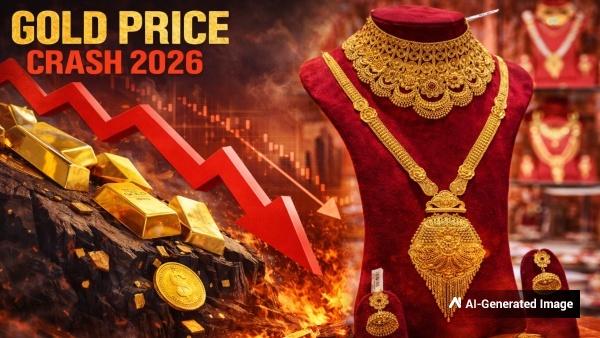
Gold prices corrected sharply this year, with the yellow metal nosediving almost 30% from an all-time high in January, and investors have bet against the precious metal since the never-ending war between the US and Iran fueled oil prices, while markets still await a clear, concise decision on the conflict front.
Gold's historic rally peaked on January 28, 2026, when US Spot prices climbed to an all-time high of nearly $5,590 per ounce. Since then, bullion has corrected by about 26% and is currently trading around $4,100 to $4,130 per ounce. In the domestic market, India's MCX Gold rates today are trading near Rs 1,44,940 per 10 grams, down approximately 21% from the record high it touched earlier this year.
While the drop was somewhat led by profit booking after the rally last year and a stronger US dollar, geopolitical tensions pushed gold prices down after Iran blocked the Strait of Hormuz, triggering a sharp jump in global oil prices. Higher energy costs pushed US inflation to 4.2% in June, its highest level in three years, forcing investors to rethink expectations of Federal Reserve rate cuts.
Instead, markets are now calibrating on the possibility of another interest rate hike. Since gold doesn't pay interest, higher borrowing costs make interest-bearing assets more attractive, reducing demand for the precious metal and putting pressure on prices.
A peace deal is yet to be reached between the US and Iran, and with uncertainty hovering over that decision, markets remain skeptical.
Ironically, world leaders, especially from the so-called developed nations, love talking about peace and harmony in every speech they give, but that hasn't stopped them from bombing the infrastructure and humanity of other volatile countries. The situation remains dire, and it is having a cascading effect worldwide.
GoodReturns Gold Price Analysis
The retail side of the story is slightly different. Gold rates in India have jumped over 7% this year so far after skyrocketing over 70% in 2025. The 22k precious metal price stood at Rs 1,32,450 as of Jul 8, 2026 compared with Rs 1,23, 800 in January 2026, according to GoodReturns.in, which gives the most accurate retail prices for gold, silver, and other utilities.
/img/2026/07/shot-121406-3f6583fd787b-desktop.jpg)
India is the world's second-largest gold consumer after China and one of the largest jewellery retail markets, worth around Rs 7.31 lakh crore ($85 billion) in 2026, making it one of the country's largest consumer retail sectors. It is predicted to grow to Rs 11.18 lakh crore ($130 billion) by 2030.
/img/2026/07/shot-121430-a7add5ead546-desktop.jpg)
This market is primarily driven by domestic weddings, festivals, gifting, and investment demand, and with India accounting for about 22% of global jewellery demand, retail prices are unlikely to fall in the near future.
Despite the expensive shift in gold prices in India, leading jewellery brands like Tata's Tanishq, Malabar Gold & Diamonds, Joyalukkas, and Kalyan Jewellers have reported strong revenue growth, supported by higher ticket sizes and store expansions.
Gold Price Outlook: Beyond Wars and Unprecedented Times
The outlook for gold prices over the next 6-12 months remains constructive, but investors should expect higher volatility than in the past few years.
"Can gold resume its upward trend? The short answer is yes, but it requires a clear catalyst," said Juan Carlos Artigas, global head of research at World Gold Council.
"This could come from three primary sources: worsening economic or geopolitical conditions, a reversal in interest-rate expectations, or long-term investor participation.
In this context, our macro-based scenario analysis suggests that gold could resume its upward trend around US$4,500/oz, but only a strong, clear signal may push it sustainably towards US$5,000/oz."
JPMorgan has also turned cautious on the precious metal in the short term. The bank trimmed its Q4 2026 forecast by about 25% to $4,500 per ounce, down from around $6,000. In line with that, Goldman lowered its year-end gold target by $500 to $4,900 an ounce, citing decreasing Fed rate-cut bets and weaker ETF inflows.
For now, gold's glitter is being driven less by jewellery demand and more by global uncertainty and as long as the world remains unsettled, investors may continue to find comfort in the oldest safe haven.


 Click it and Unblock the Notifications

 Sign in with Google
