

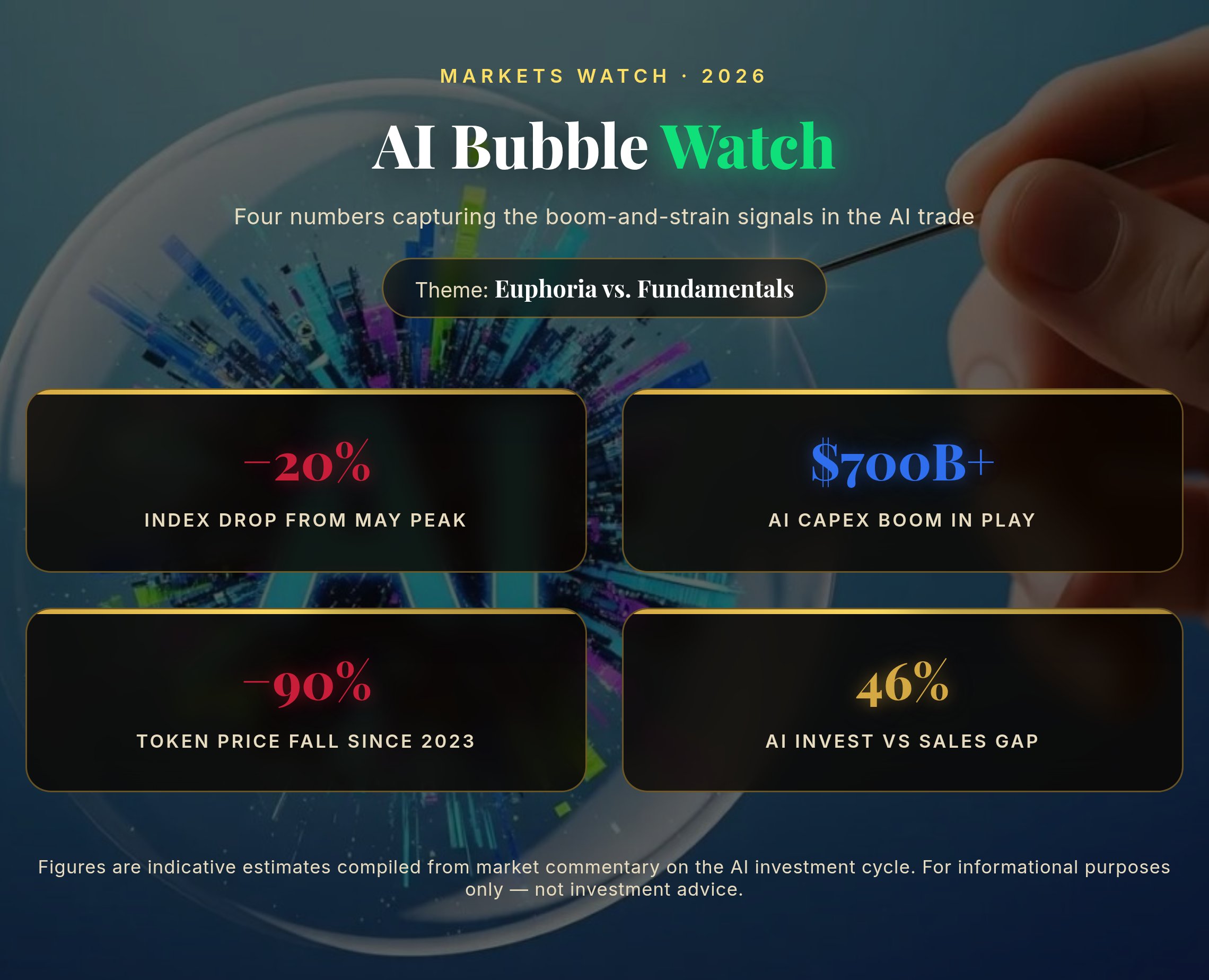
It is one of the most consequential charts in global markets right now - and very few retail investors know it exists. The Silicon Data LLM Token Expenditure Index tracks what businesses and developers actually pay when they use AI services, measured in tokens - the fundamental unit of AI computation. And after nearly doubling from its launch in December 2025, it has spent the past several weeks quietly sliding. The drop from its May high is now approaching 20%.
For context, this index matters because it sits at the intersection of two things every AI investor cares about: real demand, and pricing power. It is not a sentiment measure. It is not a survey. It is the aggregated footprint of what people are actually willing to spend on AI tools right now. When it rises, it suggests that AI usage is expanding and that companies have enough leverage with customers to sustain premium pricing. When it falls, the story gets more complicated - and that complication is exactly what is making serious investors nervous.
/img/2026/07/ai62-16681783398965.jpg "AI")
What the Index Is - and What It Isn't
Before diving into the implications, it is worth being precise about what this index actually measures. Silicon Data, the firm that built it, has been at pains to warn people against treating it as a simple price tag. The index blends usage volume with pricing data - meaning a decline could reflect at least three very different things happening simultaneously in the market.
/img/2026/07/shot-190629-556308a88de9-desktop.jpg)
Silicon Data calls the index a proxy for "marginal willingness to pay" - the question not of whether AI is useful, but of how much the last unit of AI output is actually worth to the buyer. That framing is the crux of the entire debate.
The Bull Case: Cheaper Tokens Are Growing the Market
The optimists have a compelling rebuttal. Token prices have crashed more than 90% since early 2023 - yet total AI spending has roughly doubled over the past year. This is classic technology economics: as costs fall, adoption broadens, and the overall market expands even if the revenue-per-unit contracts. Under this reading, the recent dip in the index is simply the market pausing to digest extraordinary growth, not reversing it.
During the training phase, the cost of AI infrastructure and token generation is extraordinarily high - but in the current inference stage, the economics are significantly better. The net use of AI delivers a positive return on investment for companies, at least over the long term.
- David Miller, Senior Portfolio Manager, Catalyst Funds
This is the foundation on which the bull case for NVIDIA, memory chip manufacturers, and data centre operators rests. If cheaper access is simply expanding the total addressable market, then the capex cycle - already running at levels that make the 2001 telecom boom look modest - remains entirely justified.
The Bear Case: The Gap Between Investment and Revenue Is Widening
Bears are watching a different number entirely. Research from Allianz points to a 46% divergence between AI investment spending and the revenues being generated from that investment - a gap that is already worse than the 32% mismatch recorded during the 2001 telecom bubble before it burst. The concern is not that AI is worthless. It is that the timeline between spending and returns has been consistently and materially underestimated by the market.
/img/2026/07/shot-190652-792b3605a560-desktop.jpg)
Why Regulation Is Now Part of the Pricing Story
One of the more underappreciated dimensions of this debate is the regulatory layer being added to the AI stack. Washington recently removed access restrictions on a frontier AI model from Anthropic, after reportedly asking OpenAI to delay a product rollout. In Europe, the AI Act is moving into enforcement, requiring the most capable models to undergo mandatory evaluations and meet transparency standards that smaller, cheaper alternatives are not yet subject to.
None of this changes token prices directly. But it does create a compliance overhead that sits disproportionately on the premium end of the market - giving corporate finance teams a perfectly rational argument to route lower-priority AI workloads to cheaper, lighter-regulated alternatives. That is a demand-mix shift, and it feeds directly into what the index is signalling.


 Click it and Unblock the Notifications

 Sign in with Google