

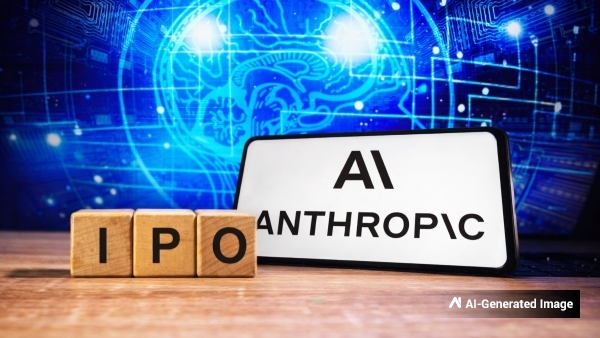
In the rapidly growing world of artificial intelligence, generative AI stocks, and large language model companies, one name has climbed faster than almost any other - Anthropic. The AI safety company behind the Claude family of AI models confidentially filed its S-1 registration statement with the US Securities and Exchange Commission on June 1, 2026, setting the stage for what could be the largest technology IPO since Facebook's 2012 listing. With a post-money valuation of $965 billion after its Series H funding round, Anthropic's Nasdaq debut - targeted for October 2026 - is expected to cross the $1 trillion mark, making it one of the most watched IPOs in history for global investors, including those tracking AI stocks in India and emerging markets.
For investors asking "what is Anthropic," "who founded Claude AI," or "when is the Anthropic IPO date," the answer is both a financial story and a philosophical one. Anthropic's annualised revenue has exploded from $1 billion in December 2024 to $47 billion by May 2026 - growth that no software company in history has matched over a comparable period. Yet its founder Dario Amodei simultaneously warns that AI could displace half of all entry-level white-collar jobs within five years. This is the story of how that paradox came to define one of the most consequential companies of the 21st century.
2021 - The Breakaway: Seven People and a Big Disagreement
Anthropic was founded in May 2021 by Dario Amodei and his sister Daniela Amodei, along with five other senior researchers from OpenAI - including Tom Brown, Sam McCandlish, Jack Clark, Jared Kaplan, and Chris Olah. Dario, who had served as VP of Research at OpenAI, left over what he described as a fundamental disagreement about how seriously the company was treating AI safety relative to its race to commercialise.
The founding team raised $124 million in a Series A at a $623 million valuation - modest by the standards of what was to come. The company's stated mission from day one: the responsible development and maintenance of advanced AI for the long-term benefit of humanity. Unlike most Silicon Valley companies, Anthropic was structured as a Public Benefit Corporation, with a built-in governance mechanism designed to prevent the safety mission from being overridden by commercial incentives.
2022-2023 - Building Claude and Winning Google's Confidence
Anthropic spent its first two years deep in research, publishing its foundational work on Constitutional AI - a novel training approach that teaches AI models to self-evaluate against a set of principles rather than relying entirely on expensive human feedback. The first Claude model shipped publicly in March 2023 with a 9,000-token context window, drawing immediate comparisons to OpenAI's GPT-4.
The year 2023 was also when the serious money arrived. Google invested $300 million in early 2023, later committing a total of $2 billion. Amazon followed with a landmark $4 billion investment commitment in September 2023 - the largest single corporate investment in an AI company at that time. By the end of 2023, Anthropic's valuation had reached $4.1 billion. The company had gone from seven people in a San Francisco office to the third-largest frontier AI lab in the world in under three years.
/img/2026/06/anthropic-1782110650.jpg "Anthropic IPO")
2024-2025 - Claude Becomes a Business, Not Just a Chatbot
The launch of Claude 3 in March 2024, with its Opus, Sonnet, and Haiku model tiers, marked the moment Anthropic stopped being just a research lab and became an enterprise technology company. Annualised revenue crossed $1 billion in December 2024 - a milestone that took OpenAI years to reach. The Claude API, distributed through Amazon Web Services Bedrock and Google Cloud, powered the engine. Eight of the Fortune 10 became Claude customers.
Then came Claude Code. Launched in mid-2025, Anthropic's agentic coding product reached $2.5 billion in annualised revenue within nine months of launch - a growth rate that stunned even the company's own investors. By early 2026, an estimated 4% of all public GitHub commits globally were being authored by Claude Code. The product turned Anthropic from a model company into an infrastructure company - one that enterprises were building entire workflows on top of.
2026 - The IPO Year
On June 1, 2026, Anthropic filed its S-1 confidentially with the SEC - days after closing a $65 billion Series H round at a $965 billion valuation led by Altimeter, Dragoneer, Sequoia Capital, and a roster of institutional investors including Baillie Gifford, Blackstone, and Fidelity. The offering is expected to raise more than $60 billion. Goldman Sachs, JPMorgan, and Morgan Stanley are the lead underwriters. A $1 trillion first-day market cap is now the base case among investment bankers, which would place Anthropic alongside the top ten most valuable companies on earth from day one of trading.
For Indian Investors: Anthropic is not yet publicly listed. There is no tradable stock. Pre-IPO access is available only to accredited/institutional investors via secondary platforms like Forge Global. The KraneShares AI ETF (AGIX), which holds 4.21% Anthropic exposure, is currently the only indirect listed vehicle. Retail investors will be able to buy shares post-IPO on Nasdaq, expected in October 2026.
The Man Behind the Mission: Dario Amodei
Dario Amodei is not a typical tech CEO. A former computational neuroscience researcher with a PhD from Princeton, he has consistently been one of the most candid voices in the AI industry - about both the technology's extraordinary promise and its genuine dangers. His October 2024 essay "Machines of Loving Grace" - a 14,000-word argument that AI could compress decades of medical research into five to ten years - is one of the most read documents in modern technology history.
"It will help us cure cancer. It may help us eradicate tropical diseases. It will help us understand the universe. But there are these immense and grave risks."
- Dario Amodei, World Economic Forum, Davos 2026
Yet Amodei is equally unsparing about the downsides. Speaking on CBS 60 Minutes in November 2025, he said he was "deeply uncomfortable" with a handful of companies making decisions that would reshape civilisation. He has publicly warned that AI could displace half of all entry-level white-collar jobs within five years, and personally authored a New York Times op-ed opposing a 10-year moratorium on state AI regulation, calling it "far too blunt an instrument." In January 2026 at Davos, he said AI was now advancing faster than public awareness - and that he felt "more negative about the actions of wider society" on AI risk than he had a year earlier.
His position has evolved. Anthropic formally dropped a conditional pause commitment in early 2026 - under which it had pledged to halt development if its own models became too dangerous - and has opened conversations around defence contracts. Some critics argue the company's commercial ambitions now sit in tension with its safety mission. Amodei's response, characteristically, is to lean into the contradiction: the only way to ensure safe AI wins is to ensure safe AI also wins commercially.
The Risks Investors Should Not Ignore
The IPO numbers are dazzling, but the risks are equally real. Anthropic is not profitable - it posted a $5.6 billion loss in 2024 - and plans to spend approximately $19 billion on compute infrastructure in 2026 alone. The company is deeply reliant on Amazon and Google as both investors and cloud infrastructure providers, a concentration risk that its own S-1 will likely flag at length. Revenue accounting - Anthropic counts gross cloud reseller revenue, which inflates its top line relative to net revenue peers - has already drawn scrutiny from analysts. And at a 22x price-to-sales ratio on annualised run-rate revenue, the market is pricing in near-perfect execution through 2030, when the company aims to hit $70 billion in revenue and $17 billion in free cash flow.
Whether the Anthropic IPO represents the defining investment opportunity of the AI era or the high-water mark of one of the great valuation bubbles of the 21st century will be one of the most debated financial questions of the coming decade. What is beyond debate is the scale of what Dario Amodei and his co-founders built - and the speed at which they built it.


 Click it and Unblock the Notifications

 Sign in with Google
