

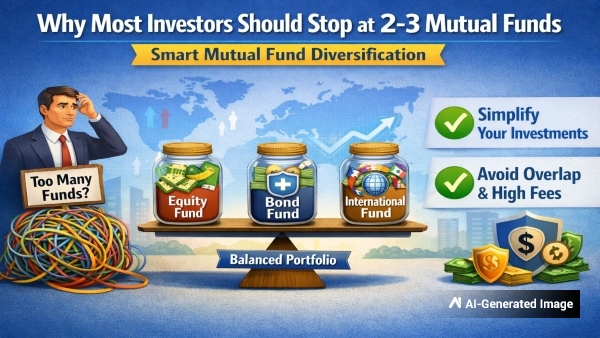
In the world of investing, especially when it comes to mutual funds (MFs), the mantra "don't put all your eggs in one basket" is perhaps the most famous piece of advice.
For many beginners, this translates into a frantic search for variety, leading them to invest in a dozen or more mutual funds in an attempt to reach the pinnacle of diversification. However, there is a point where diversification not just falters but also breaks down.
For the vast majority of retail investors, holding more than two or three well-selected mutual funds provides no additional safety and can actually undermine financial goals.
Portfolio overlap
The biggest pitfall of owning a large number of funds is the illusion of variety. Investors often believe that by buying different funds, they are spreading their risk. In reality, they are often just buying the same stocks multiple times. This is known as portfolio overlap.
Most top-performing equity funds in a specific category tend to gravitate toward the same market leaders. Thus, Instead of being diversified, you are simply heavily concentrated in a few stocks while paying multiple sets of management fees.
By sticking to two to three funds with distinct mandates, such as one Nifty 50 index fund and one mid-cap fund, you ensure that every rupee is actually working in a different corner of the market.
Dealing with complexity
Managing an investment portfolio should not feel like a full-time job. Yet, it might come across like just that, as every additional fund added to a folder increases the administrative weight.
This, even as tracking the performance of each fund, and at times each component of a fund, becomes a dizzying exercise of checking multiple Net Asset Values (NAVs), reading dozens of factsheets, and monitoring various fund-manager changes.
For some, the real headache starts during tax season. Rebalancing a 10-fund portfolio requires complex calculations to ensure that asset allocation hasn't drifted. Furthermore, when the time comes to file taxes, consolidated capital gains statements become significantly more complicated.
A simple portfolio of two to three funds allows the investor to see their financial health at a glance, making it easier to stay disciplined and consistent with SIPs.
Diluted returns
When you spread your capital across too many funds, you inadvertently create your own expensive version of an index fund.
If one fund has a great year because of a specific stock pick, but that stock only represents 0.5% of the total wealth because you have 15 other funds, the positive impact on your life is negligible. This is known as diluting your returns.
Furthermore, many active funds become "closet indexers" when they grow too large or when an investor holds too many of them.
By concentrating your capital in just two to three high-conviction funds, you allow the fund managers' best ideas to move the needle on your total net worth.
Difficulty in tracking
Investing is as much psychological as it is mathematical. To stay invested during market downturns, you need to have deep conviction in what you own.
It is nearly impossible to maintain a deep understanding of the investment philosophy and underlying holdings of ten different funds.
When the market inevitably crashes, investors with bloated portfolios often feel overwhelmed. Because they don't truly understand the "why" behind each of their
twelve holdings, they are more likely to engage in reactive decision-making such as selling at the bottom or jumping to the latest "hot" fund.
A curated portfolio of two to three funds is easier to "know". When you understand exactly what you own, you are far more likely to stay the course during volatility, which is the single most important factor in long-term wealth creation.
The case for simplicity
As we have seen, over-diversification leads to hidden duplication, unnecessary complexity, mediocre returns, and a dangerous loss of focus.
Thus, for most investors, a simple approach is all that is needed to capture market growth while managing risk.
By stopping at two to three mutual funds, you reduce costs, save time, and increase your chances of superior long-term performance.
About the Author
Handa Uncle is an AI-powered Personal CFO focused on simplifying finance, investing, taxation, and wealth-building concepts through practical and easy-to-understand insights.


 Click it and Unblock the Notifications

 Sign in with Google
