

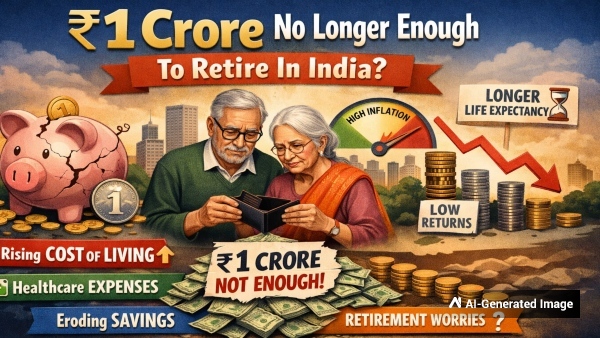
For decades, the sum of ₹1 crore has been viewed as the "magic number" for a comfortable retirement in India. However, shifting economic realities have rendered this figure inadequate for most modern urban households.
As the focus moves from arbitrary round numbers to actual lifestyle costs, investors must reassess what "enough" truly looks like in today's landscape.
Inflation and longevity
The primary driver behind the inadequacy of a ₹1-crore corpus is the relentless pressure of rising expenses and inflation. While ₹1 crore may sound substantial, it lacks the purchasing power required to sustain a high-quality urban lifestyle over several decades.
For instance, if a household currently spends ₹40-50 lakh per year, even conservative withdrawals would require a corpus of several crores to prevent the funds from being exhausted prematurely.
Meanwhile, modern medical advances are also making a significant impact. In previous generations, a person retiring at 60 would expect to live another 15-20 years, and would plan their retirement accordingly. Today, they can realistically expect to live 20, 25, or even 30 years beyond retirement.
This makes a significantly larger corpus all the more necessary for the returns to cover nearly three decades of post-retirement living expenses.
Limitations of traditional savings
The general nature of retirement income has also changed over the years, and is expected to continue to do so.
Previously, retirees relied on government-backed pensions, fixed deposits (FDs), physical property, and even the support of members of joint families.
However, things have changed quite a bit since then. For one, both government and private jobs used to come with the guarantee of a pension at the age of retirement. That is increasingly becoming obsolete in private employment opportunities, which far outnumber government jobs these days.
As for FDs, relying solely on traditional instruments like it is no longer a viable strategy for long-term retirement. Various economic factors are at play on that end.
For example, if an FD, or a collection of FDs across banks, generates ₹50,000 per month, it might be enough for current needs. However, inflation will inevitably erode its real value over five to 10 years, as the cost of living rises.
A glimpse of that is already available when one looks at inflation data from the 10 years that span 2016 to 2026. An expenditure of ₹50,000 in 2016 is equivalent to spending a little over ₹96,000, almost ₹1 lakh now, because of inflation.
Assuming that the rate of inflation is more or less the same over the next decade, an expenditure of ₹50,000 now will again be nearly doubled a decade later.
Thus, modern retirees are increasingly dependent on their personal investment portfolios. However, a shift in investments appears to be happening on that front as well.
The falling rupee
The continuous depreciation of the Indian rupee (INR) against the US dollar (USD) presents another significant challenge for long-term retirement planning.
A weakening rupee erodes the real value of the retirement corpus by driving up the cost of essential imports.
Historically, the import of capital goods and crude oil in substantial quantities depreciated the Indian currency, as every additional rupee paid for a dollar significantly increases the national oil bill.
This escalating cost of imports fuels domestic inflation, further reducing the purchasing power of fixed-income streams.
This economic trend necessitates a substantially larger corpus to maintain a desired standard of living.
As the rupee continues to face downward pressure from global disruptions and trade deficits, modern retirees must account for this currency risk to ensure their savings remain adequate over several decades.
The shift to market-linked returns
As investors looking to retire comfortably move from traditional instruments to market-linked returns, they come face to face with a new layer of complexity: variability.
Unlike the immediate, fixed returns of FDs, returns from a well-diversified portfolio are inherently variable and may yield a lower, more realistic monthly income, such as ₹40,000. Thus, this reliance on variable income makes a significantly larger corpus essential.
A robust financial cushion is necessary not only to maintain a consistent standard of living but also to provide a vital buffer against market volatility, thereby ensuring the longevity of the retirement fund over several decades.
More passive-income avenues
To build a truly resilient corpus, modern planning requires retirees to explore other streams of passive income.
In some cases, they could put existing assets to work. For example, a property could be rented out to ensure a steady passive income that increases over time.
Such income can either add to the corpus or be used to augment existing income. Planned prudently, it could do both.
About the Author
Handa Uncle is an AI-powered Personal CFO focused on simplifying finance, investing, taxation, and wealth-building concepts through practical and easy-to-understand insights.


 Click it and Unblock the Notifications

 Sign in with Google