

Picture this: You are at a cafe, meeting a friend, having a private conversation. The person across from you is wearing a stylish pair of glasses. What you probably do not know is that those glasses have been silently capturing audio and images of everything around them - including you - since they left home that morning. You never consented. They may not have even actively chosen to record. The glasses just... did.
This is not a science fiction scenario. It is what Meta is reportedly building right now.
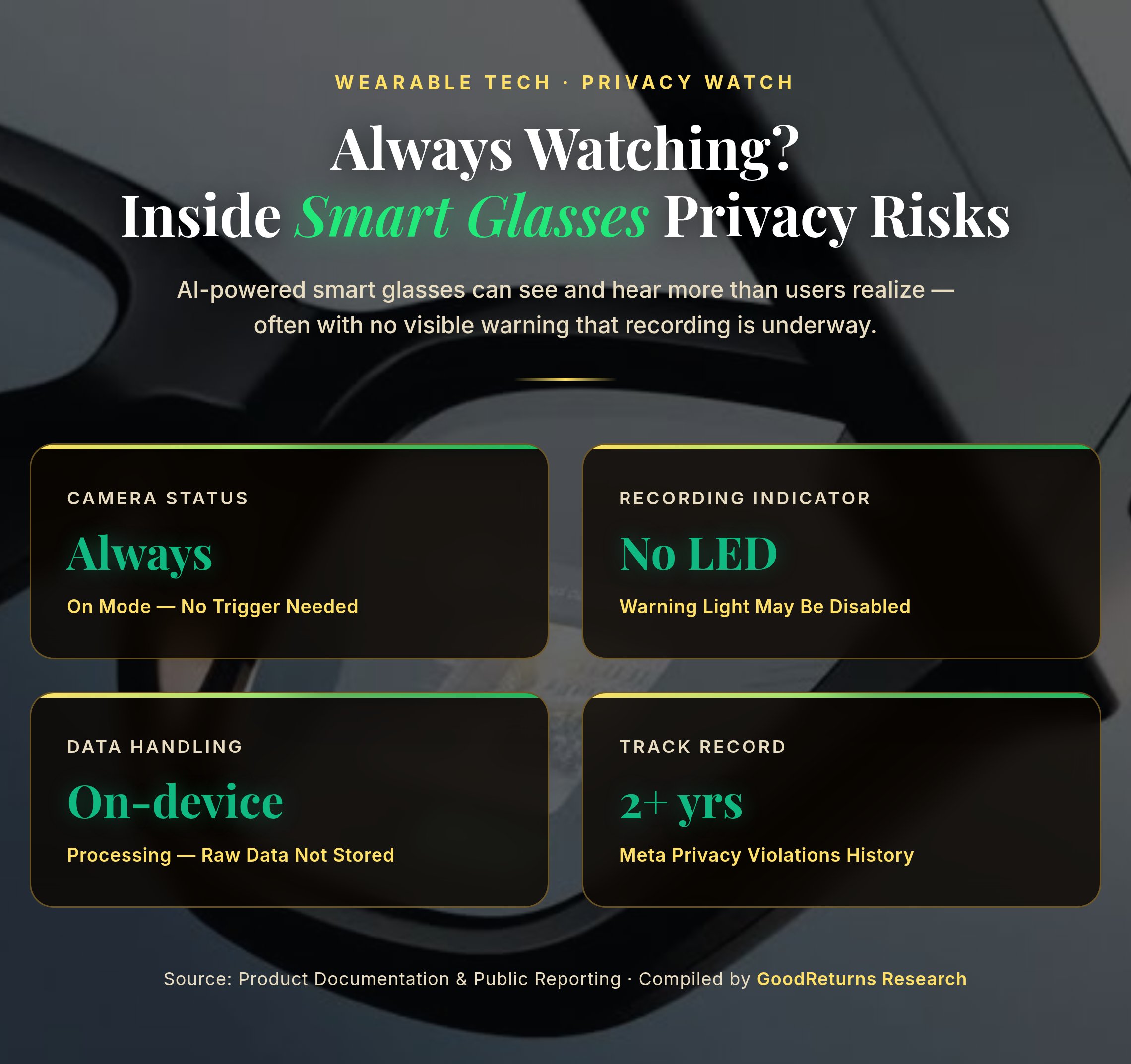
Leaked details published by the Financial Times on July 8, 2026 reveal that Meta - the company behind Facebook, Instagram, and the Ray-Ban Meta smart glasses - is internally testing next-generation AI glasses with a feature called "super sensing." The prototype glasses are designed to passively capture audio and periodic images throughout the wearer's day, without requiring them to press a button or say a command. The AI then processes this continuous stream of data so that the wearer can ask it questions later: Where did I leave my keys? What did my colleague say in that meeting? What was the name of that restaurant I walked past?
/img/2026/07/metaai-21391783583862.jpg "meta ai")
The LED Light Problem - And Why It Matters
Here is where the privacy alarm bells really start ringing. Meta's current Ray-Ban smart glasses already have a small LED indicator light at the front of the frame that lights up whenever the camera is actively recording. It is not perfect - it is small, and many people do not know to look for it - but it is at least a signal that recording is happening.
With the new super sensing feature, Meta is reportedly considering disabling that LED entirely during passive background capture. The rationale, according to internal discussions cited by the Financial Times, is that if the light were blinking continuously all day, people would eventually tune it out - reducing its effectiveness as a privacy signal anyway. Meta has also separately stated that it will now disable cameras on existing glasses if the LED is physically blocked or tampered with, which speaks to the company's own awareness that the light matters.
While we don't comment on internal prototypes, we're committed to getting our glasses right because they need to be loved by both the people wearing them and those around them.
- Meta spokesperson, statement to the Financial Times, July 8, 2026
But critics are not buying the reassurance. Academics, privacy campaigners, and consumer advocates are pointing out that a device that records continuously in public - without any visible signal - is, by any reasonable definition, a covert surveillance tool. The fact that it sits on your face and looks like a normal pair of glasses makes it significantly more concerning than, say, a security camera mounted on a wall.
/img/2026/07/shot-132611-f735c030b0c0-desktop.jpg)
/img/2026/07/shot-132635-b63968f8a7ec-desktop.jpg)
Meta's Privacy Track Record - Why Trust Is the Real Issue
Meta's response to the leaked plans has followed a familiar script: the company says privacy is built in from the ground up, that it does not comment on internal prototypes, and that it wants its glasses to be loved by everyone - wearers and bystanders alike. This messaging might land better if the company did not have one of the most consequential records of privacy violations in the history of the technology industry.
The Cambridge Analytica scandal, multiple child safety lawsuits, keystroke logging of employees to train AI - and more recently, a report that outsourced Kenyan workers were shown graphic content from users' glasses footage while labelling data for AI training. The company that is asking you to trust it with a device that watches and listens to you all day is the same company that has repeatedly found itself in court, or before regulators, over what it does with the data it already collects.
Some US states have two-party consent recording laws - meaning it is illegal to record a conversation without the knowledge of all participants. Smart glasses that record passively in public, without any visible signal, would walk directly into that legal minefield. Courts in New York state have already begun banning smart glasses in proceedings. Several cruise lines have prohibited them on board. The category of "always-on wearable AI" is already running into legal walls before the most powerful version of it has even launched.


 Click it and Unblock the Notifications

 Sign in with Google
