

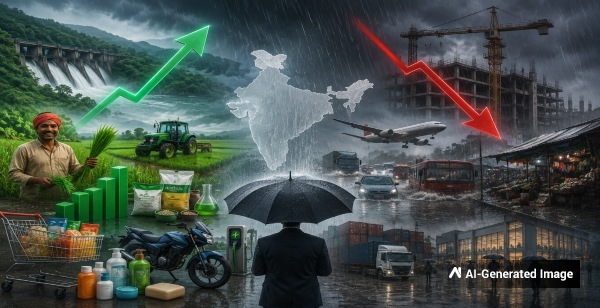
India's economy has always danced to the rhythm of its rains, and 2026 is no exception. Cumulative rainfall stood 43% below the Long Period Average as of June 28, and Kharif sowing was running 23% behind last year's pace, as per the Finance Ministry's Monthly Economic Review. Yet even in a weak-rain year, the monsoon doesn't hurt everyone equally — it creates clear winners and losers across big corporates, small traders, and everything in between.
Stocks and Sectors That Could Gain This Monsoon
Agri-inputs (seeds, fertiliser, agrochemicals): According to a StockEdge sector report, fertiliser, seed and agrochemical companies see a direct spike in demand as farmers gear up for kharif sowing, making this the earliest-moving winner of the season.
Rural FMCG: As per the same StockEdge analysis, soaps, packaged foods and personal care brands benefit once improved agricultural output raises rural household income, translating farm earnings directly into consumer spending.
Two-wheelers and tractors: StockEdge noted that automobile demand — especially two-wheelers, tractors and entry-level passenger vehicles — tracks rural cash flow closely, so improved farm income lifts sales in this segment specifically.
Hydropower and power generation: As per Jarvis Invest's sector analysis, about 12% of India's power comes from hydro sources, and a good monsoon boosts hydro output, cutting reliance on costlier thermal power and steadying grid supply.
Insurance, healthcare, tea/coffee and rainwear brands: Vritti iMedia co-founder Rajesh Radhakrishnan noted in a Social Samosa report that these categories deliberately raise their marketing spend through the monsoon, since the season itself creates natural, immediate demand for them.
Quick commerce and home delivery: LoveLocal founder Akanksha Hazari told Business Standard that despite operational strain during Mumbai's recent flooding, consumer demand did not fall — repeat purchases instead grew by around 25%, as shoppers leaned on home delivery when stepping out became difficult.
Hill-station and monsoon tourism: As per a Jarvis Invest report on monsoon-linked stocks, destinations known for rain-driven scenery — misty hill stations and Western Ghats waterfalls — see rising hotel occupancy and travel bookings through the season.
/img/2026/07/shot-145342-fa3d5a6449c3-desktop.jpg)
Which Sectors Are Hit by Heavy Monsoon Rains?
Construction and real estate: During Mumbai's recent heavy spell, Paradigm Realty CMD Parthh Mehta said construction speed had dropped nearly 25%, with site productivity running at about 75% of normal, as reported by Business Standard.
Retail footfall, transport and daily-wage work: Vijay Kalantri of the All India Association of Industries estimated that Mumbai's disruption alone could cost over Rs 1,000 crore, hitting perishable-goods sellers, transport operators and daily-wage workers hardest — the small-business segment with the least cushion against lost working days.
Aviation and logistics: As per a Claims Journal report citing University of Reading climate scientist Akshay Deoras, Mumbai recently received nearly 80% of its typical July rainfall within days, disrupting flights, trains and highway links to Pune and Goa.
Small-town real estate and rural construction: As per a Vajiram & Ravi current affairs analysis, these segments are hit early in weak-rain years too, since they depend on quick rural cash cycles that slow when farm income is delayed.
Outdoor advertising (OOH): Interspace Communications' OOH head Sumit Taneja told Social Samosa that street footfall dips during the monsoon, though the impact is softening as dwell time in malls and metro stations rises to partly offset it.
/img/2026/07/shot-145406-87db7bc73c20-desktop.jpg)
A more resilient economy?
There is a balancing note in the data. As per the Finance Ministry's June 2026 review, India's economic sensitivity to rainfall swings has steadily declined over five decades, thanks to wider irrigation, better farming practices and stronger buffer stocks — reservoir levels were still 5.7% above normal as of June 25.
IMD Director General Mrutyunjay Mohapatra has emphasised that the distribution of rain matters more than its quantity, meaning a single well-spread week in July could still reshape outcomes for businesses on both sides of this seasonal divide.


 Click it and Unblock the Notifications

 Sign in with Google