
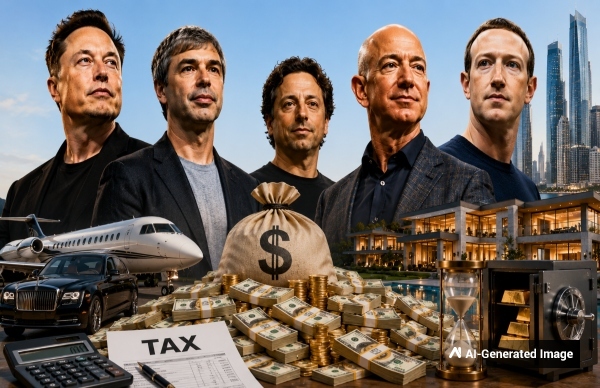
The top five billionaires of the world together hold a wealth of nearly 2 trillion dollars. The companies they founded are worth trillions. One of them is even a trillionaire! But have you ever wondered how much tax they pay? Surely, one would like to believe they contribute a humongous amount of tax revenue to the government. But the reality is far more jarring, and once you finish this article, you will be left speechless.
Who are the top five billionaires of the world?
Elon Musk is the richest man in the world with a net worth of $856 billion as of July 16, 2026. His wealth has fallen from its peak of $1.45 trillion in mid-June due to a sharp decline in his rocket stock, SpaceX, which has nosedived by over 40% since its listing.
Despite this, Musk is still the richest and continues to be the biggest winner with $236 billion gains in wealth year-to-date. Remember, Musk's major gains come from Tesla and SpaceX stocks.
After him are Larry Page and Sergey Brin, who together co-founded Alphabet Inc, the parent company of Google. At the fourth and fifth ranks are Amazon's Jeff Bezos and Meta's Mark Zuckerberg.
All five are US-based billionaires and all five own tech giants.
True Tax Rate Of Billionaires
An analysis by Oxfam in January 2026 shows the 10 richest US billionaires recorded a $698 billion jump in net worth in 2025.
Meanwhile, an investigation by ProPublica of leaked tax returns reveals the 25 richest Americans paid up to $13.6 billion in taxes between 2014 to 2016. This is a true tax rate of 3.4% against $401 billion in wealth they created.
Earlier, a 2021 White House study observed that the 400 wealthiest billionaire families only paid an average federal tax rate of 8.2%. To give more clarity, the average American taxpayer, who spans from middle-to-upper salaried individuals, paid 13% in that year. That's a difference of 4.8% tax rate between the billionaires and the common man.
"The tax code should be designed to work for ordinary people, not rigged to produce the world's first trillionaire," said Rebecca Riddell, Senior Policy Lead for Economic and Racial Justice at Oxfam America on January 18, 2026.
One must note, though, that the billionaires aren't missing out on their tax payments. They're simply paying less taxes legally, and there is a reason to it.
How Billionaires Actually Pay Taxes?
Since all the top 5 richest men in the world are based in America. We will understand the American tax rates and regulations.
1. Near-zero salaries:
At the top of the list is the fact that the majority of billionaires hold near-zero salaries. For instance, Amazon's Bezos has set around $80,000 annual income since long ago. Billionaires like Zuckerberg and Larry Page have all taken a symbolic $1 salary per annum.
The bottom line is that incomes are taxed at an ordinary tax rate, which is currently up to 37% federal tax. But there are no taxes on stock appreciation.
2. Unrealized Gains Are Not Taxed:
Bezon and Musk's net worth majorly relies on the growth of their stocks since tech giant Amazon and EV behemoth Tesla do not pay dividends. In the USA, gains from stocks are not taxed until they are sold.
Stock appreciation is a form of unrealized gains and is not considered "income" until and unless they are realized. Which means these unrealized gains become income under the US law when they are sold or when the profit is booked. Till the time these unrealized gains stay in your portfolio, there is no need to file with the IRS as well. Hence, there are zero tax rates on stock appreciation.
3. Borrowing Against Securities Assets:
"Billionaires generally derive most of their income from asset appreciation, rather than salaries or bonuses. Unlike ordinary income, asset appreciation is not taxed until a gain is realized through the sale of the asset," said a BNY Wealth report.
Further, the broker explains, to avoid or delay the hefty tax obligation resulting from the capital gains incurred, they borrow against their wealth and use the proceeds to not just to pay for their expenses but also to reinvest in new ventures. In this way, they keep their tax bills low, continue to benefit from the appreciation of their invested assets, plus increase their overall net worth with the additional investments made with the loan proceeds.
4. Tax Haven Countries:
Many of these billionaires shift their profits to tax haven countries.
A total of 23 of the largest and most profitable American companies practically paid zero federal corporate income taxes between 2018 and 2022. Approximately 109 entities did not pay any federal tax for at least one of those years, a recent study by the Institute on Taxation and Economic Policy showed.
Oxfam observed that US companies transferred about $1 trillion in global profits to tax havens in 2022-depriving countries all over the world of desperately needed tax revenue.
What Can Be Done For Fair Tax Rate?
According to Oxfam, two things can be done. Firstly, the IRS code should raise individual tax rates for billionaires and equalize taxes on capital gains and labor income, so work isn't taxed more than wealth.
Secondly, billionaires should pay a wealth tax, and we should close tax loopholes that permit the rich to stash profits in tax havens.
For many years, billionaires' strategy of escaping taxes was termed "Buy, Borrow, Die". However, in May 2026, Bezos had denied the 'Buy, Borrow, Die" strategy to a media house and called it "no truth".
Whether this strategy is true or not is for you to decide!
Billionaires' Stock Returns in 5 Years:
In 5 years, Larry Page and Sergey Brin's Alphabet has outperformed other billionaires' stocks. The Google parent's gains are a whopping 181%, followed by Zuckerberg's Meta, which surged nearly 100% as of June 15, 2026. These two giants have outperformed US indices like the Dow Jones, the Nasdaq, and the S&P 500. While Bezos' Amazon and Musk's Tesla gained by 84% and 43%, respectively.


 Click it and Unblock the Notifications

 Sign in with Google
