

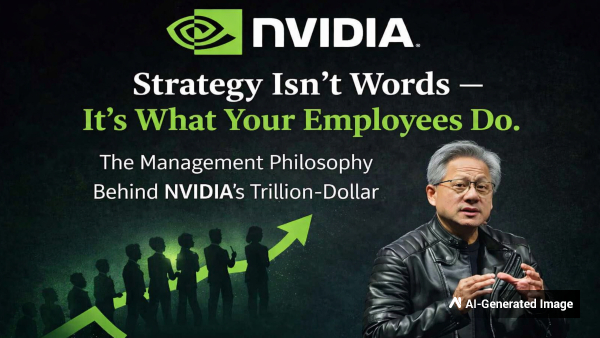
In a world where corporate strategy typically means thick documents, quarterly planning cycles, and polished PowerPoint decks delivered to the board, Jensen Huang has built one of history's most valuable companies by doing almost none of that. The NVIDIA founder and CEO has a radically different definition of what strategy actually is - and it begins with watching what people do, not listening to what leaders say.
Huang's now-widely-cited view is deceptively simple: a company's true strategy is not its stated priorities or its vision documents - it is the sum total of the daily actions taken by the people inside it. If the two are misaligned, you do not have a strategy problem. You have an execution problem. And in Huang's view, most companies confuse the two constantly.
No Plans. No One-on-Ones. No Status Reports.
What makes Huang's philosophy genuinely unusual is that he has built the institutional architecture of NVIDIA around it - not just repeated it as a management mantra. He has spoken publicly about having over 60 direct reports, a number that would make most organisational consultants wince. His reasoning: the flatter the structure, the faster information flows, and the less it gets distorted in translation between layers of management.
He does not conduct one-on-one meetings. Instead, he holds group discussions where everyone - from VPs to engineers - operates from the same information at the same time. Feedback is given in public, not in private, on the basis that a critique delivered to one person teaches the room, while the same critique delivered behind a closed door teaches only one.
We don't do a periodic planning system. The reason for that is because the world is a living, breathing thing. So we just plan continuously - there is no five-year plan, there is no one-year plan. There is just what we are doing.
- Jensen Huang, Founder & CEO, NVIDIA
And there are no formal status reports. Huang has described the problem with traditional reporting systems precisely: by the time information is packaged and presented to a CEO, it has lost what he calls its "ground truth" - the raw, unfiltered reality of what is actually happening. To solve this, he asks anyone in the organisation to email him a list of their "top five things" - whatever is most on their mind at that moment. He reads approximately a hundred of these every morning, using them as a real-time pulse on where the company's attention and energy are actually focused.
Why This Is Harder Than It Sounds
Huang's model places enormous demands on everyone inside the organisation, not just the CEO. When there are no planning cycles to hide behind, no layers of management to absorb accountability, and no periodic reviews to surface problems, individuals must take genuine ownership of their decisions every day. The "top five things" system is not a communication tool - it is a discipline. It forces every employee to articulate their priorities clearly enough to write them down and share them with the CEO.
The Results Speak for the Method
Whatever one thinks of Huang's unconventional management style, its outcomes are difficult to argue with. NVIDIA reported revenue of $81.6 billion in the first quarter of its FY2027 - up 85% year-on-year - as demand for its AI chips from data centres, cloud providers and research institutions continues to surge. The company has become the defining infrastructure play of the global AI boom, and Huang has been at its helm for over three decades, through multiple cycles of near-extinction and explosive reinvention.
Huang's philosophy cuts against decades of MBA-era management theory, which elevated strategy as a separate, senior function - something that leaders designed and then delegated downward for execution. His view collapses that distinction entirely. Execution is strategy. What people prioritise tomorrow morning is more revealing of a company's true direction than any slide deck produced last quarter.


 Click it and Unblock the Notifications

 Sign in with Google
