

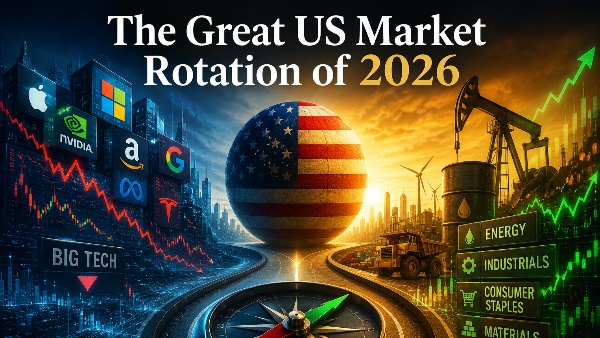
For three years, the Magnificent Seven - Apple, Microsoft, Nvidia, Amazon, Alphabet, Meta, and Tesla - were Wall Street's engine. They delivered an 86% total return on the S&P 500, versus just 43% on its equal-weight counterpart. Investors barely looked elsewhere. In 2026, that dynamic has cracked open. What we are watching now is the most significant sector rotation since the early 2000s tech bubble unwind - and its ripples are landing squarely on Indian markets.
The Numbers That Tell The Story
The data is unambiguous. Energy stocks have surged over 22% year-to-date, industrials are up more than 16%, consumer defensives have gained roughly 13%, and materials have climbed 17%. Technology, by contrast, started 2026 as the worst-performing sector, slipping into negative territory. The equal-weighted S&P 500 ETF (RSP) has materially outperformed the cap-weighted index - the clearest signal that market breadth is no longer concentrated in a handful of names.
/img/2026/06/shot-232634-bdc697e9bc87-desktop.jpg)
The companies leading this charge tell the broader story clearly. Caterpillar has returned 32%, benefiting from AI data-centre construction and infrastructure spending. Walmart is up 13.7% as cost-conscious consumers flock to value. Exxon Mobil and Chevron have powered the energy rally, with Chevron returning 21.8% amid a supply crunch triggered by war in the Middle East.
Iran, Oil, and the Fed's Impossible Position
No single factor has shaped 2026 markets more decisively than the US-Israel war on Iran, which began in late February. The Strait of Hormuz - the chokepoint through which roughly 20% of the world's seaborne crude and LNG flows - was blockaded, triggering what the International Energy Agency called the greatest global energy security challenge in history. Brent crude surged from around $57 per barrel at the start of the year to a peak of $113 in April before falling sharply to around $77-$80 after a peace framework was signed in mid-June 2026. Even so, experts caution that price normalisation will take months, not days, as inventories rebuild and supply chains recalibrate.
/img/2026/06/shot-232657-9362ad812dc8-desktop.jpg)
That oil spike has put the Federal Reserve in a bind. At its June 17 meeting - the first chaired by new Fed Chair Kevin Warsh - the FOMC voted unanimously 12-0 to hold rates steady at 3.50%-3.75%, where they have sat since December 2025. But the real story was in the projections. The dot plot now shows a median rate of 3.8% by year-end, with 9 of 18 officials pencilling in a rate hike before December. The Fed raised its 2026 PCE inflation forecast sharply to 3.6% - up from 2.7% in March - while trimming its GDP growth outlook to 2.2%. Warsh, who mentioned "price stability" twelve times in his first press conference, has effectively buried expectations of any 2026 rate cut. Markets now price in a 25-basis-point hike by October.
What It Means for Indian Investors
The rotation and its macro backdrop have a direct read-through to Dalal Street. On the FII front, the picture is one of sustained but not catastrophic withdrawal. Over Rs 2,74,000 crore exited Indian equity markets in early 2026 as global risk appetite contracted. FIIs have sold Rs 43,000 crore in June alone through mid-month, even as a single session on June 19 saw net buying of Rs 4,859 crore - the largest since February. On that same day, FIIs bought Rs 384 crore in cash as recently as June 27, while DIIs added Rs 5,748 crore, underscoring the critical role of domestic institutions in absorbing foreign exits.
Three linkages matter most for Indian investors. First, the Nifty IT index remains directly exposed to a cooling of US technology spending - Accenture's recent guidance cut was a warning shot, sending Indian IT stocks lower in tandem. Second, every dollar-per-barrel that Brent stays elevated adds to India's import bill, pressures the current account deficit, and weakens the rupee - a currency that has already faced headwinds from a strong dollar. Third, if the Fed hikes rates in the second half of 2026, it will further enhance the relative attractiveness of US assets, creating another gravitational pull away from emerging-market equities.
The silver lining is structural. India's GDP growth of 6.5% dwarfs the US's 2.2% and China's 4%, meaning global allocators cannot ignore the subcontinent indefinitely. Amundi, Europe's largest asset manager, has India as one of its preferred emerging market selections. Goldman Sachs and HSBC turned overweight on Indian equities even as broader global emerging market sentiment stayed cautious. The rotation away from US Big Tech is also, paradoxically, a reminder that diversification eventually finds its way back to high-growth markets.


 Click it and Unblock the Notifications

 Sign in with Google